
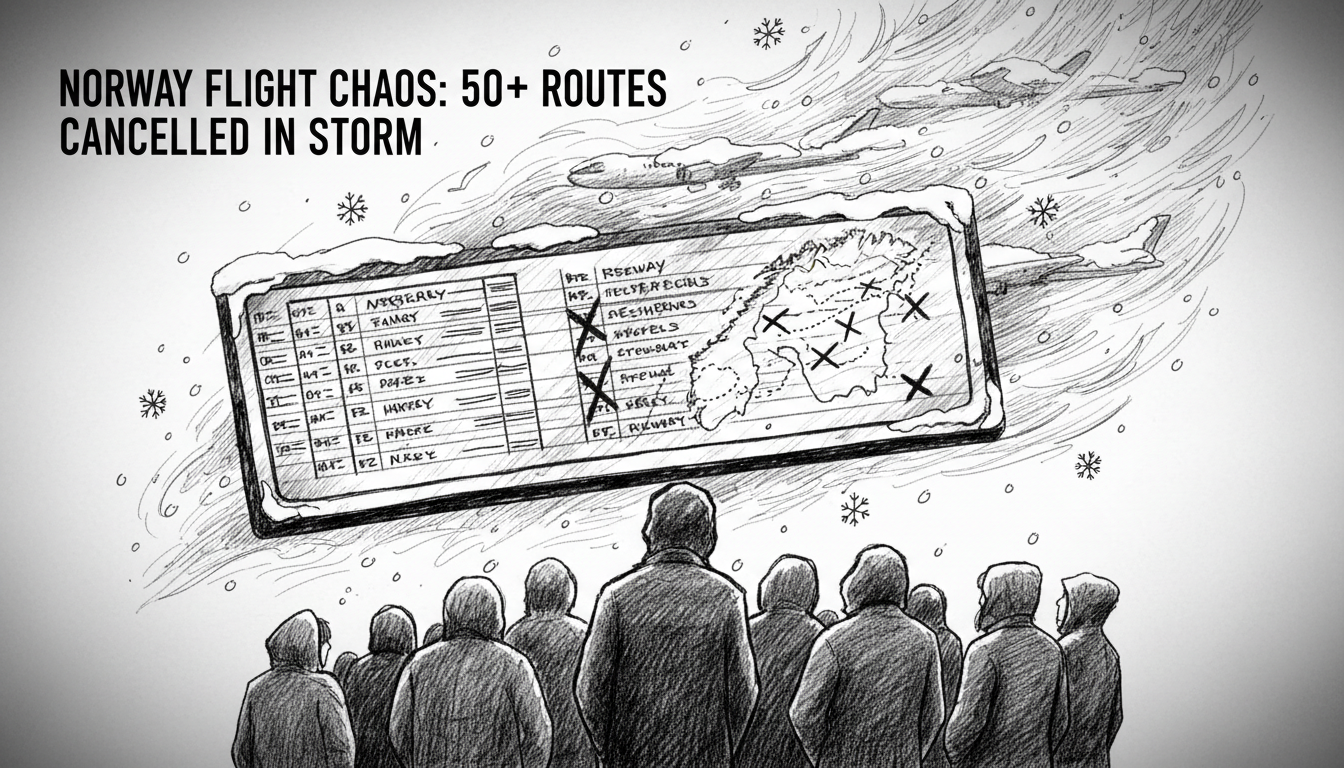
Norway flight cancellations have grounded dozens of aircraft across the country's central and northern regions this weekend. A severe storm system is battering the coastlines of Nordland and Troms counties, bringing winds powerful enough to halt all air traffic at several key airports. The disruption highlights the persistent vulnerability of Norway's essential air bridge to its Arctic communities when the North Atlantic weather turns violent.
Airports from Trondheim to Tromsø are reporting significant operational challenges. Widerøe, the dominant regional carrier for Northern Norway, has cancelled the majority of its services north of Trondheim. Scandinavian Airlines (SAS) and Norwegian Air Shuttle have also suspended flights to Bodø, Evenes, and Tromsø. The cancellations are not due to precipitation or visibility, but specifically to forecasted wind gusts exceeding 70-80 knots in exposed areas. These speeds surpass the safe operational limits for the regional turboprops and larger jets that serve these routes.
The Fragile Lifeline of the North
For residents of Norway's northern counties, this is more than a travel inconvenience. It is a temporary severing of a critical lifeline. With a landscape carved by deep fjords and rugged mountains, road travel is often a long, circuitous, and sometimes impossible alternative. The coastal ferry service, Hurtigruten, is also facing significant delays and rough seas, compounding the isolation. Essential services, from specialist medical appointments to business logistics and family visits, are built around the reliability of the air network.
“When the planes stop, everything stops,” said Kari Nilsen, a county councilor from Sortland in Vesterålen. “The hospital in Bodø serves our entire region. A cancelled flight can mean a cancelled cancer treatment consultation. There is no train to take instead.” This sentiment echoes across the region, where communities are heavily dependent on air links for everything from education to commerce. The economic ripple effect is immediate, affecting tourism, freight, and daily workforce mobility.
Meteorological Challenges in Complex Terrain
The storm causing this disruption is a classic North Atlantic low-pressure system, but its impact is magnified by Norway's dramatic topography. Aviation meteorologists note that predicting exact wind speeds in these regions is exceptionally difficult. Wind accelerates over mountain passes and funnels through narrow fjords, creating localized gusts that can be far stronger than forecasts for the general area.
“Our models are excellent, but the terrain in Northern Norway creates micro-weather phenomena that are hard to capture with perfect precision,” explained a meteorologist with the Norwegian Meteorological Institute, speaking on background. “An airport might report manageable winds, but the approach path over a nearby ridge could be experiencing severe wind shear. In these conditions, the only safe decision is to ground flights.” This inherent uncertainty is a fundamental operational challenge for airlines serving Norway’s periphery.
Infrastructure and Economic Implications
The recurring nature of these weather-induced shutdowns raises questions about infrastructure resilience. While airports like Oslo Gardermoen are equipped to handle harsh winter conditions, the regional airports in the north are more exposed to the raw power of coastal storms. Investment in improved instrument landing systems and ground infrastructure can mitigate some issues, but it cannot negate the fundamental physics of flying small aircraft in hurricane-force winds.
The economic cost is substantial. A 2022 study by Transportøkonomisk Institutt estimated that a single day of major disruptions to Norwegian aviation can have a direct and indirect economic impact running into hundreds of millions of kroner. For the tourism industry, particularly in the popular Lofoten Islands which are accessed via airports like Leknes and Svolvær, such cancellations during a weekend can mean lost revenue that is never recovered.
Policy Responses and Future Preparedness
The Norwegian government and aviation authorities acknowledge the critical role of air travel. The state subsidizes many regional routes through public service obligation (PSO) contracts, ensuring that remote communities retain a basic level of connectivity. Widerøe operates most of these PSO routes. However, subsidies do not control the weather. There is an ongoing discussion about whether to invest more heavily in alternative transport infrastructure, such as improved roads and tunnels or faster coastal vessels, to create a more robust multi-modal network.
“We must have a holistic transport policy for the north,” argued Svein Rennemo, a former CEO and transport analyst. “Aviation will always be the primary mode for long distances, but we need better fallbacks. That means evaluating where fixed links like bridges or subsea tunnels could replace ferry crossings and make road travel a more viable alternative when the skies close.” The ambitious Krifast project, which connected the island of Krifast to the mainland via a series of bridges and tunnels, is often cited as a model that reduced weather dependency.
For now, stranded passengers have few options but to wait. Airlines are advising travelers to monitor their websites and apps for updates, warning that rebooking volumes will be high once operations resume. Hotels near airports like Trondheim Værnes and Bodø are seeing a surge in occupancy from passengers caught mid-journey.
The storm is expected to peak throughout Saturday before gradually weakening on Sunday. Aviation authorities hope for a phased return to normal operations by Sunday afternoon, but caution that the clean-up from the backlog will take days. This weekend’s events serve as a stark reminder of the enduring power of nature over even the most advanced societies. In Norway, a nation that has mastered offshore oil extraction in the same treacherous seas, the simple act of flying between its communities remains a negotiation with the elements. As climate models suggest the potential for more frequent and intense North Atlantic storms, this negotiation may only become more difficult, pressing policymakers to find new answers for keeping the Arctic connected.