
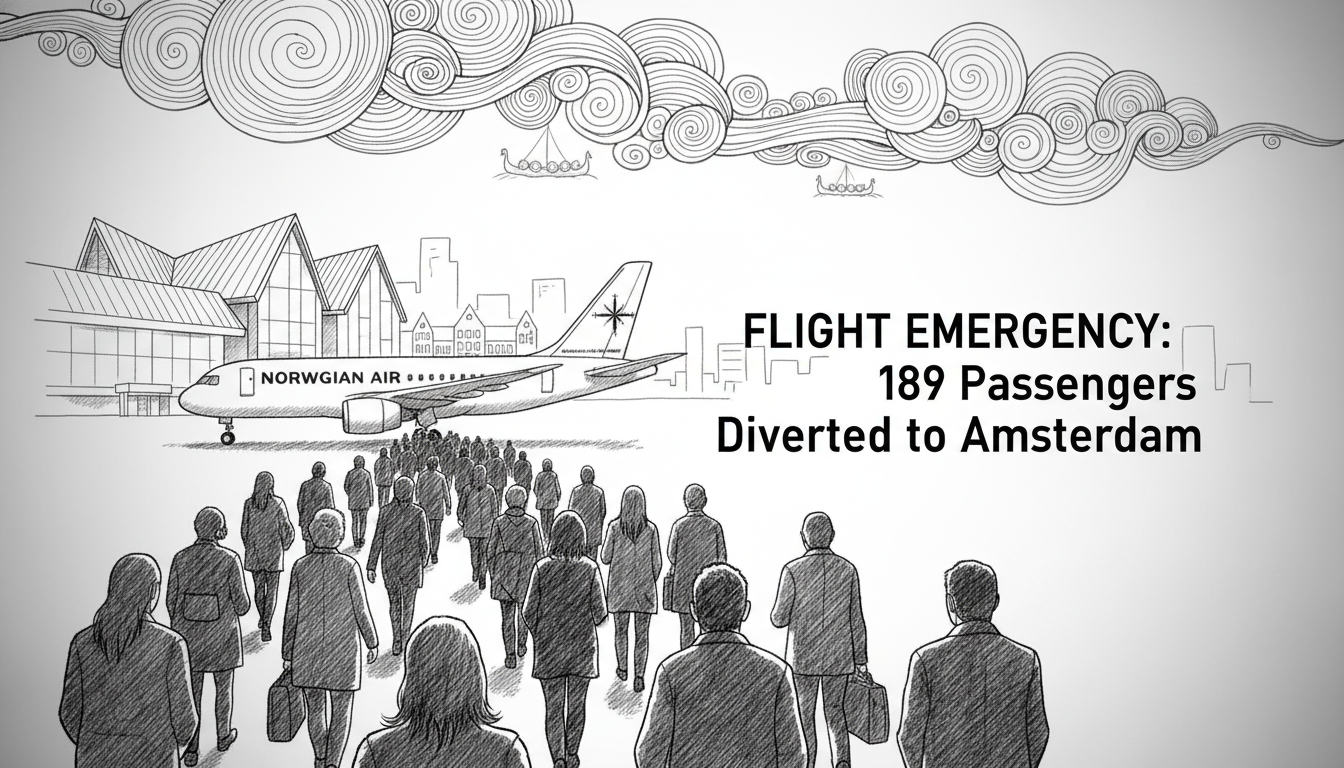
Norwegian Air flight DY1805 from Oslo to Alicante executed an emergency landing at Amsterdam's Schiphol Airport on Tuesday evening. The Airbus A320neo, carrying 189 passengers, diverted after pilots and cabin crew detected an unusual odor in the cockpit and cabin. The airline confirmed the precautionary safety landing was completed without injury. All passengers were disembarked safely in Amsterdam while engineers began an immediate technical inspection of the aircraft.
Norwegian spokesperson Silje Glorvigen said passenger safety is the absolute priority. "We performed a safety landing in Amsterdam because the pilots and cabin crew discovered an unknown odor on board," Glorvigen said. "Safety comes first and such cases must always be investigated." The airline mobilized its operations center at Oslo Airport Gardermoen to arrange a replacement aircraft. A fresh Airbus A320neo was dispatched from Oslo to collect the stranded passengers and continue their journey to Spain.
A Textbook Response to an Unknown Risk
Aviation safety experts describe the crew's decision as a standard, textbook response to a potential cabin air quality issue. Unidentified smells can indicate a range of problems, from minor electrical overheating to more serious issues like oil leakage into the aircraft's air conditioning systems. International protocols demand that crews treat any unexplained odor as a potential hazard until proven otherwise. "The threshold for initiating a diversion in these cases is intentionally low," said Lars Jensen, a former Scandinavian airline safety officer. "It is always better to be on the ground with a minor technical fault than in the air with a major one. The crew followed their training precisely."
The incident caused a significant delay for the holidaymakers bound for Spain's Costa Blanca. The original flight departed Oslo at approximately 3:30 PM local time. The diversion to Schiphol and the subsequent wait for the replacement aircraft meant the group did not arrive in Alicante until close to midnight. Norwegian stated it provided refreshments and assistance to passengers during the wait in Amsterdam. The airline is also processing claims for compensation under EU passenger rights regulations, which mandate support for delays over three hours.
The Complexities of Modern Cabin Air Systems
Modern jetliners like the Airbus A320neo have highly complex environmental control systems. These systems compress air from the engines, known as bleed air, to pressurize the cabin and provide fresh oxygen. While extremely reliable, potential faults can sometimes lead to the introduction of fumes. Investigations into such events typically involve checking air conditioning packs, engine seals, and auxiliary power units. Engineers in Amsterdam would have taken air samples and downloaded data from the aircraft's flight data recorder to pinpoint any anomalies.
Norwegian operates one of the youngest and most fuel-efficient fleets in Europe, with an average aircraft age of just over seven years. The specific aircraft involved, registered as LN-DYG, was delivered to the airline in 2018. This relatively new age makes a serious mechanical fault less likely, but does not eliminate the possibility of a minor leak or sensor issue. The airline has not released any preliminary findings from the technical inspection. A full report will be filed with Norway's Accident Investigation Board, which may choose to open its own inquiry depending on the severity of the underlying cause.
Operational Ripples Across a Low-Cost Network
For a low-cost carrier like Norwegian, such disruptions have a tangible financial and operational impact. Diverting an aircraft incurs immediate costs for landing fees, ground handling, and passenger care. It also takes an aircraft out of service, potentially disrupting subsequent flights in its schedule. The airline's ability to quickly deploy a replacement aircraft from its Oslo base highlights the importance of strategic fleet positioning and operational resilience. Norwegian's main hub at Gardermoen serves as its primary maintenance and crew base, allowing for a rapid response.
This incident occurs as Norwegian has successfully navigated a complex financial restructuring and is now reporting strong profits. The airline has sharply focused on its core Nordic and European network after exiting long-haul operations. Maintaining an impeccable safety record while executing a tight low-cost model is a central challenge. Industry analysts note that the public's perception of safety is paramount, and transparent handling of incidents like this one reinforces passenger trust. "The communication was clear and focused on safety," said aviation analyst Trine Berg-Nielsen. "For passengers, seeing an airline err on the side of caution is ultimately reassuring, even if it causes personal inconvenience."
Passenger Rights and the Journey's End
For the 189 passengers, the episode transformed a routine three-hour flight into a lengthy travel day. EU Regulation 261/2004 entitles them to care, including meals and refreshments, during the delay, and financial compensation if the delay at arrival exceeds three hours. The cause of the delay will determine if Norwegian is liable for the standard compensation of 250 euros per passenger. If the airline can prove the diversion was caused by a technical defect identified during scheduled maintenance, it may seek an exemption. However, the burden of proof rests with the carrier.
Many of those on board were likely Norwegian families traveling for the autumn school break, a popular time for Mediterranean holidays. The Alicante route is a perennial favorite, connecting Oslo with the sunny Spanish coast. The disruption underscores the inherent unpredictability of air travel, even on short-haul European routes. Passengers were ultimately transported to their destination on the replacement flight, DY1805R, which landed in Alicante just before 11:30 PM local time.
A Reminder of Unseen Safety Protocols
While dramatic, Tuesday's event was a controlled demonstration of global aviation safety systems working as designed. From the crew's initial assessment to the decision to divert, the coordination with air traffic control over the Netherlands, and the logistical response from the airline's operations center, the process is heavily drilled. Such events are rare but form a critical part of airline safety management. They provide real-world data that feeds back into training manuals and technical maintenance schedules.
The final report on the odor's source will be crucial. Whether it was a trace of burnt insulation, a galley oven malfunction, or a transient smell from an external source, the investigation will seek to prevent a recurrence. For Norwegian, the incident concludes without harm, but with added paperwork and cost. For the aviation system, it serves as a quiet testament to a simple principle: any unknown smell in the sky is a problem best solved on the ground. The passengers who finally reached their Spanish hotels late Tuesday night might just agree.