
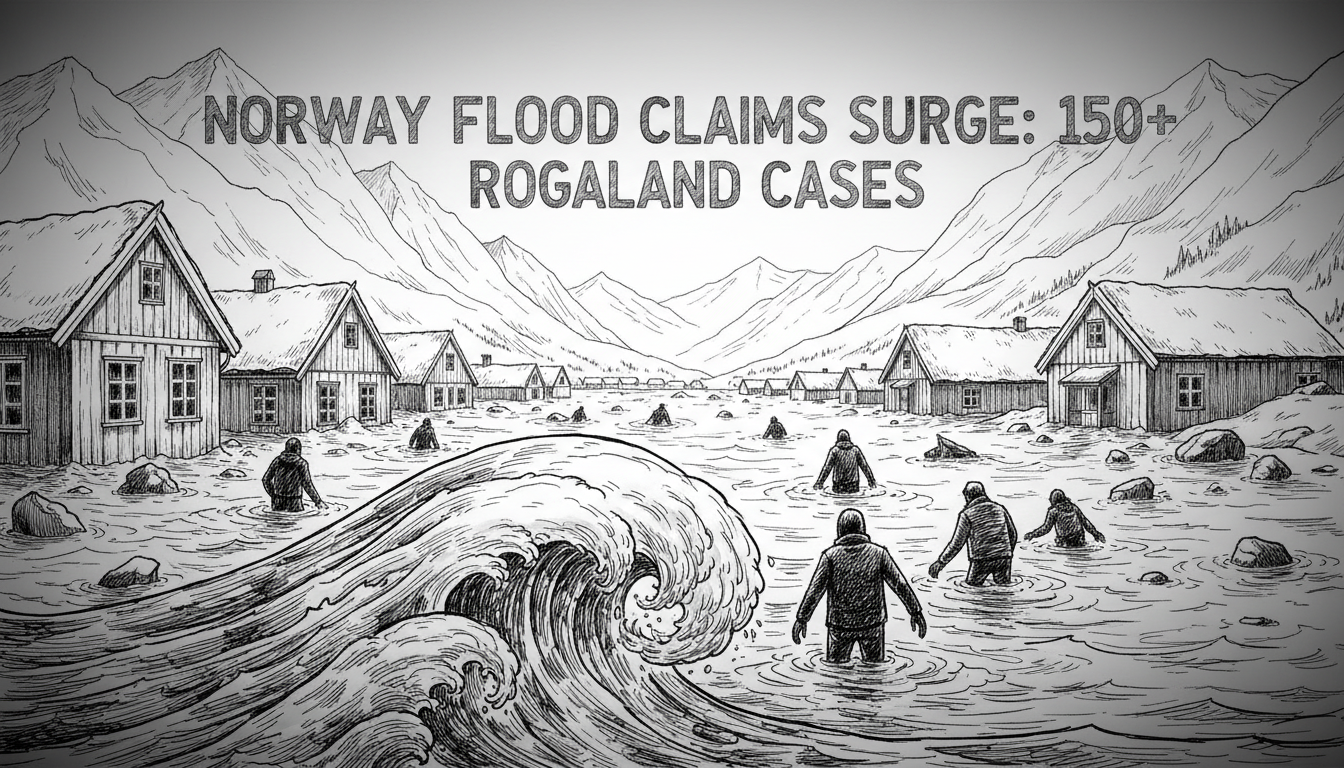
Norway's major insurers are processing over 150 damage claims following severe flooding in Rogaland county. If Forsikring reports approximately 100 claims, while competitor Gjensidige has registered 50. Both companies warn the final number will be significantly higher as residents and businesses continue to assess water damage to properties, vehicles, and infrastructure. The event underscores a growing pattern of costly extreme weather battering Norwegian communities.
A Familiar Yet Intensifying Threat
Rogaland, famed for the dramatic Lysefjord and Preikestolen cliff, is no stranger to powerful autumn storms. Its complex topography of mountains and narrow valleys can funnel intense rainfall, leading to rapid flooding. This latest event fits a documented trend of increasing precipitation intensity across Western Norway. Data from the Norwegian Meteorological Institute shows a marked rise in the frequency of extreme rainfall events over the past five decades. For insurers, each event translates from a weather forecast into a ledger of future payouts. "We are still in the early phase of reporting," a spokesperson for If Forsikring said in a statement. "Historical data from similar floods tells us to expect a substantial increase in claims over the coming weeks as the full extent of the damage becomes clear."
The insurance process itself is now a familiar, stressful routine for many. Homeowners must document damage, file reports, and navigate assessments. For businesses, the interruption can mean lost revenue on top of repair costs. The immediate financial burden falls on insurers, but the long-term implications ripple through the national economy and into policy debates in Oslo. The Storting has repeatedly grappled with funding for climate adaptation and reinforced infrastructure, particularly for vulnerable regions like Rogaland.
The Rising Cost of a Wetter Climate
Insurance analysts view these recurring floods as financial barometers of climate change. "The insurance industry acts as a societal mirror for climate risk," explains Lars Moe, a senior analyst at the Finance Institute in Oslo. "When we see a consistent pattern of claims increasing in frequency and severity, especially for water damage, it is a direct financial signal of a changing environment. The traditional statistical models used for pricing premiums and calculating risk are being challenged." Moe points out that while single events are not solely attributable to climate change, the aggregation of data paints a compelling picture. Reinsurance companies—the firms that insure the insurance companies—are particularly attentive to these trends, as they ultimately bear the largest catastrophic risks.
This pressure is already influencing the market. Some insurers are revising risk maps, potentially leading to higher premiums in areas deemed most vulnerable. There is also a stronger push for policyholders to implement preventative measures. These can include installing backflow valves in basements, ensuring proper drainage around properties, and using water-resistant materials in construction. The Norwegian Directorate for Civil Protection (DSB) actively campaigns for such measures, arguing that kroner spent on prevention save many more kroner in future damages.
Infrastructure Under Water
Beyond private property, the floods test public infrastructure. Roads in Rogaland, including national highways, have been closed due to washouts and landslides. Local municipalities face hefty bills for repairing public buildings, roads, and water management systems. This places strain on local budgets and often triggers requests for state disaster relief funds. The Norwegian Water Resources and Energy Directorate (NVE) consistently warns that existing drainage and flood-control systems in many towns were built for a different climate era. Upgrading this infrastructure is a massive, multi-billion kroner undertaking that requires long-term political commitment.
Engineers are exploring solutions from traditional reinforcement to more innovative, nature-based approaches. "We cannot simply build higher walls everywhere," says Kari Nilsen, a civil engineer specializing in water management at the University of Stavanger. "We are looking at creating controlled flood zones—areas designed to safely absorb overflow—and restoring natural wetlands that act as sponges. The goal is to work with the landscape, not just against the water." These projects, however, require space and planning, often conflicting with development interests in growing municipalities.
A Political Imperative in Oslo
The recurring damage in Rogaland and elsewhere ensures that climate adaptation remains high on the political agenda. MPs from coastal and western constituencies regularly bring local flooding experiences into debates in the Storting building. The government's most recent Long-Term Plan for the Norwegian Economy dedicates significant sections to climate resilience, acknowledging that failure to adapt will incur far greater costs. The debate often centers on the balance between national support and local responsibility, and on how to fund the enormous investments needed.
There is also a growing discussion about land-use planning. Should municipalities permit new construction in historically flood-prone areas? Stricter zoning laws are a powerful tool for limiting future exposure, but they can be unpopular locally. The state, through the Ministry of Local Government and Modernisation, provides guidelines, but ultimate planning authority rests with the municipalities, creating a complex governance challenge.
What Comes After the Water Recedes
For the residents of Rogaland, the immediate focus is on cleanup and recovery. The true total of insurance claims will likely not be known for months. For If Forsikring, Gjensidige, and other insurers, the event will be logged, analyzed, and fed into their risk models for the future. For scientists and engineers, it provides another data point in an accelerating trend. For politicians, it is a reminder of the tangible, costly, and disruptive reality of climate adaptation.
The floods in Rogaland are not an anomaly. They are part of a pattern that is becoming the new normal for Norway. The critical question moving forward is not just how to pay for the damage, but how to fundamentally reduce vulnerability. This requires a coordinated effort between homeowners, businesses, local governments, and the state—a collective resilience against the rising waters. As the clean-up continues, the broader conversation about Norway's preparedness for a stormier future is once again flowing into the national discourse.