
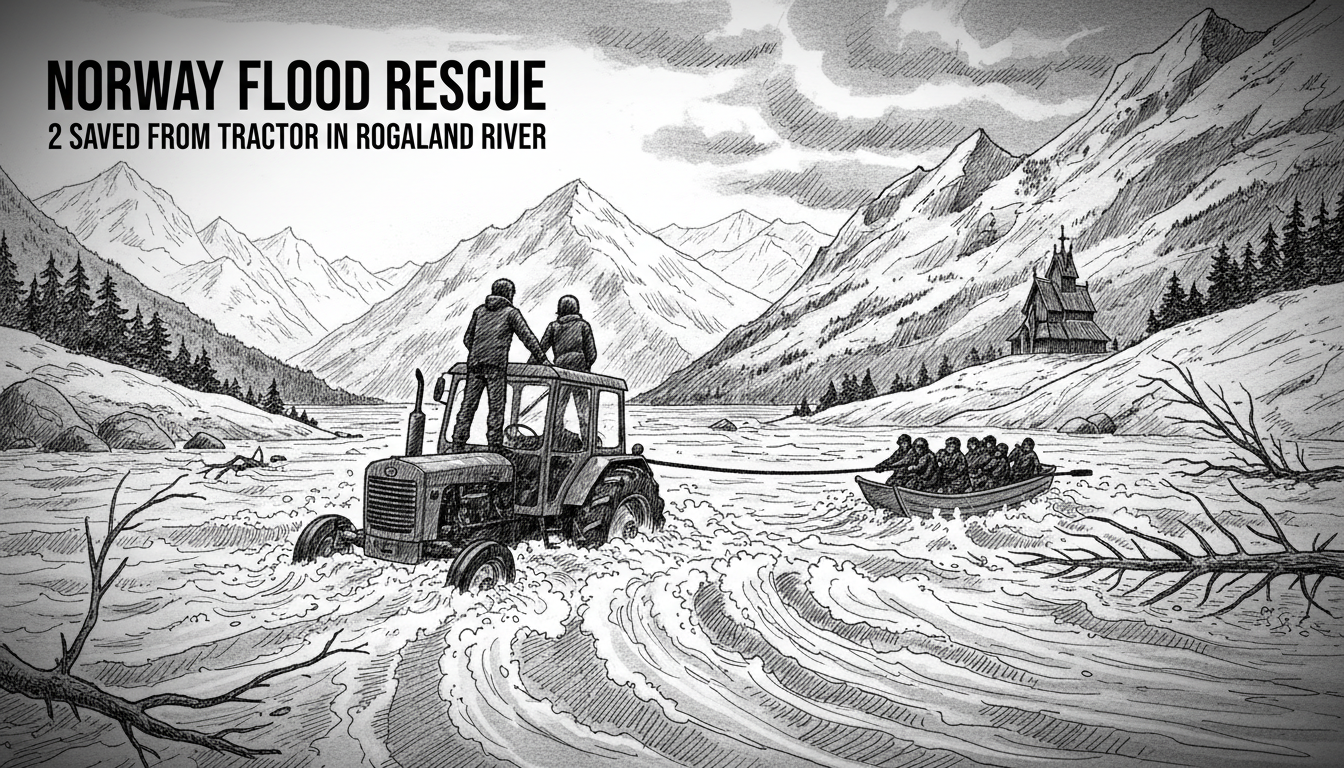
Norway flooding led to a dramatic rescue operation in Rogaland county after a tractor drove into a swollen river. Two people were stranded on the vehicle's roof in Hauge i Dalane before firefighters reached them by boat. The incident occurred under an orange flood warning, highlighting the severe weather battering southwestern Norway.
A Dramatic Rescue in Rising Waters
Emergency services received the call at 7:27 PM. A tractor had been driven into a powerful, flooded river in the village of Hauge i Dalane, part of the Sokndal municipality. Initial reports suggested three people were trapped, but police quickly corrected this to two individuals. They had climbed onto the tractor's roof to escape the rushing water. A rescue helicopter was dispatched to the scene, reflecting the seriousness of the situation.
"There is a strong current in the river. Emergency services and a rescue helicopter are on the way to the site," the South-West Police District's operations center stated. The region's rugged terrain and the specific danger of fast-moving floodwaters made both aerial and aquatic response necessary. By 7:52 PM, just 25 minutes after the initial alert, firefighters successfully extracted the two people using a boat. The rescue helicopter, having been launched, was likely stood down. Authorities have not released the names or conditions of those rescued, nor explained how the tractor entered the river.
The Weather Context: Orange Warnings and Soaked Soil
This rescue did not happen in isolation. The Norwegian Meteorological Institute had issued an orange danger warning for flooding in the area. This is the second-highest level on Norway's four-tier weather warning system, indicating "dangerous weather" that could pose a risk to life and property. Persistent, heavy rainfall had saturated the ground and caused multiple waterways to overflow their banks.
Large sections of Sokndal, particularly in the Hauge i Dalane area, were already underwater. This transformed familiar landscapes and roads into treacherous zones. The incident underscores a critical safety message repeated by Norwegian authorities: never attempt to drive or walk through flooded roadways. Water depth and current strength are often deceptive, and just 30 centimeters of flowing water can sweep a vehicle away.
Rogaland's Landscape: Beauty and Hazard
Rogaland county, home to iconic fjords like Lysefjord and Preikestolen, is defined by its dramatic interaction of water and steep terrain. This geography, while stunning, accelerates runoff during heavy rain. Water from the highlands funnels quickly into rivers and streams that can rise with astonishing speed. The area around Hauge i Dalane is characterized by such river valleys, or daler, which are particularly susceptible to flash flooding.
Agriculture is a key part of the local economy in these valleys. Tractors and other farm equipment are common, and farmers often need to move between fields, sometimes crossing or working near waterways. This necessary daily work can become unexpectedly hazardous during extreme weather events, potentially placing individuals in the path of rising floods.
Expert Perspective on a Changing Climate
Hydrologists and emergency management experts see this event as part of a broader pattern. "While Norway has always experienced seasonal flooding from rain and snowmelt, the intensity and frequency of these events are changing," explains a climate researcher familiar with Nordic hydrology. "A warmer atmosphere holds more moisture, leading to more extreme precipitation events when conditions are right."
This aligns with the findings of the Norwegian Centre for Climate Services (NCCS). Their climate projections for Norway indicate that western regions, including Rogaland, can expect an increase in the frequency and intensity of heavy rainfall. This translates to a higher future risk of flash floods and river flooding. The expert emphasizes that public awareness and adherence to official warnings are the first and most critical lines of defense. "The orange warning was there for a reason. This rescue, fortunately successful, is a stark reminder to respect the power of nature and the information provided by forecasters."
The Emergency Response Framework
Norway has a well-coordinated emergency response system that integrates police, fire, and medical services, often with support from the Norwegian Society for Sea Rescue (RS) and helicopter services. The rapid deployment of both a boat team and a rescue helicopter to this incident demonstrates this multi-pronged capability. The fire service, which led the successful boat rescue, routinely trains for water operations, a vital skill in a nation crisscrossed by rivers, lakes, and fjords.
The efficiency of the response likely prevented a tragedy. However, such operations pull significant resources and place emergency personnel at risk. Each preventable incident allows these resources to remain available for other crises. The National Flood Warning Service continuously monitors water levels across the country, and their data feeds directly into the public warnings issued by the Meteorological Institute.
Community Impact and the Road Ahead
For residents of Sokndal and surrounding municipalities, this event is a disruptive part of a larger weather pattern. Flooding damages infrastructure, isolates communities, and threatens property. Clean-up and damage assessment will follow once waters recede. The psychological impact of seeing one's community submerged and the direct scare of such a rescue operation also leave a mark.
Looking ahead, municipalities across Norway are increasingly factoring climate resilience into planning. This includes reviewing drainage systems, considering where new construction is permissible, and maintaining robust emergency plans. For individuals, the lesson is clear: preparedness is key. This means heeding official warnings, having an evacuation plan for homes in flood-prone areas, and never underestimating the danger of moving water. As the climate continues to shift, the relationship between Norwegians and their famous waterways may require renewed caution and respect. Will this near-miss lead to greater community vigilance during the next orange warning?