
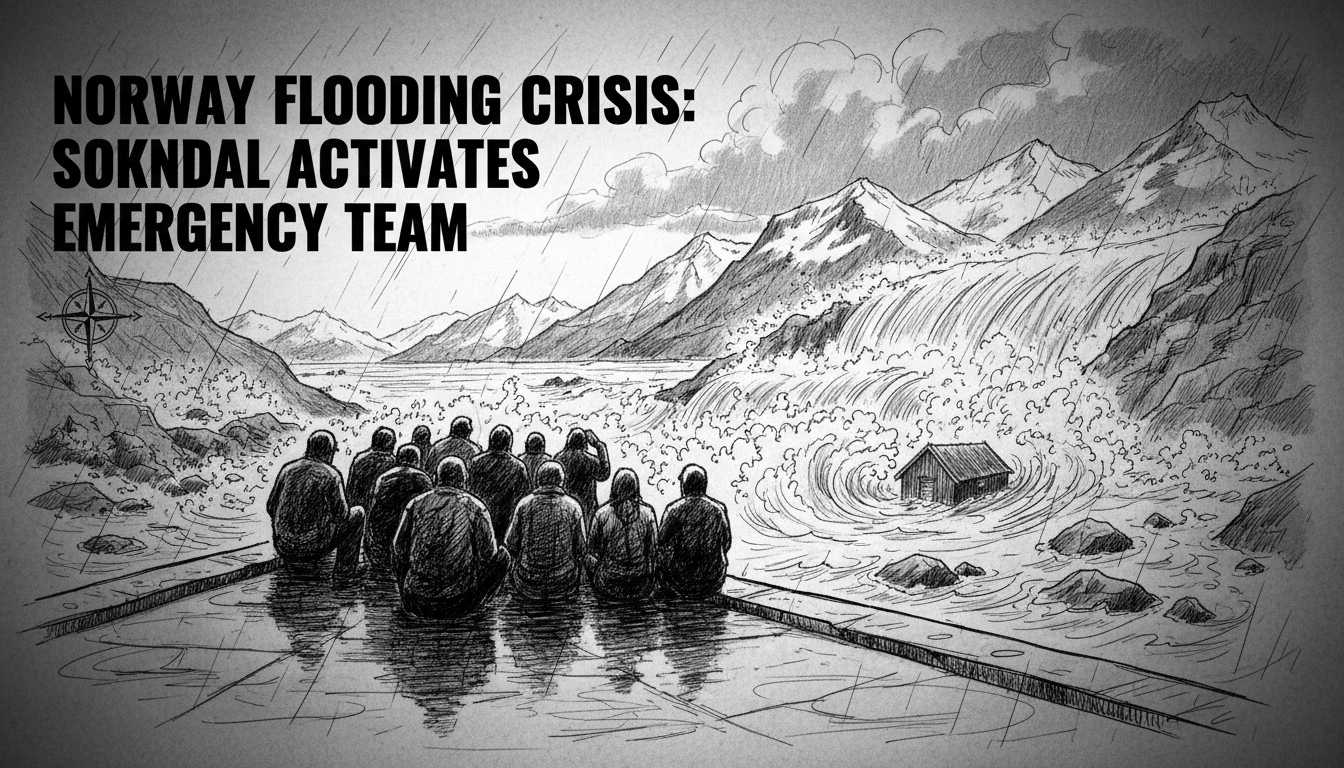
Norway's coastal municipality of Sokndal has activated its crisis management team due to dangerous flooding. Mayor Bjørn-Inge Mydland confirmed the emergency response was triggered Monday morning as rising waters inundated the population center of Haua. The situation highlights the growing vulnerability of Norway's coastal communities to extreme weather events linked to climate change.
A Community Under Water
Technical chief Dagfinn Mydland reported significant water accumulation in central Haua during the early morning hours. Residents awoke to flooded streets and properties, with emergency services scrambling to assess the damage and ensure public safety. The immediate priority for the newly established 'krisestab' is coordinating evacuation efforts where necessary and protecting critical infrastructure. This includes roads, power supplies, and communication networks essential for the response.
Local authorities are urging residents in low-lying areas to move to higher ground and avoid unnecessary travel. The crisis team, comprising municipal leaders, emergency services, and technical experts, is operating from a secure location to direct operations. Their mandate is to manage the acute situation and plan for the aftermath, which will involve damage assessment and potential financial aid applications to the state.
The Climate Change Context
While Norway is often associated with fjords and rugged coastlines, these very features make it susceptible to flooding. Sokndal, located in Rogaland county, faces a triple threat: intense rainfall, storm surges, and rising sea levels. Climate scientists have long warned that a warmer atmosphere holds more moisture, leading to heavier precipitation events. For coastal towns, this rainfall combines with higher sea levels to exacerbate flooding.
"What we are seeing in Sokndal is not an isolated incident," says Dr. Lena Strand, a climatologist at the University of Bergen. "The data shows a clear trend toward more frequent and intense precipitation along Norway's southwestern coast. Municipalities built around rivers and fjords are particularly exposed. This is a direct consequence of our changing climate." She notes that while individual weather events cannot be solely attributed to climate change, the pattern of increasing severity fits established models.
Norway's government has allocated substantial funds for climate adaptation, but implementation often falls to individual municipalities. Projects like upgraded drainage systems, sea walls, and zoning changes to prevent construction in floodplains require significant local planning and investment. For smaller communities like Sokndal, balancing these long-term needs with daily budgetary constraints remains a major challenge.
The Mechanics of a Norwegian Krisestab
The activation of a municipal crisis team is a formal step under Norway's Civil Protection Act. It centralizes decision-making authority during an emergency, cutting through normal bureaucratic channels. The team typically includes the mayor, the chief of police, the head of the municipal health service, and technical directors for infrastructure. Their decisions can override standard procedures to protect life and property.
This structure is designed for rapid response. The team can requisition private property for emergency use, order evacuations, and request immediate assistance from neighboring municipalities or the national government. In Sokndal's case, the technical chief's early report of high water levels provided the concrete data needed to trigger this response. The system emphasizes local knowledge and on-the-ground assessment.
Following the acute phase, the krisestab will oversee the transition to recovery. This involves coordinating with the Norwegian Water Resources and Energy Directorate (NVE) and the Norwegian Directorate for Civil Protection (DSB). These agencies provide expert analysis on water management and disaster response, and they administer state compensation schemes for flood damage to private homes and public infrastructure.
A Regional Pattern of Vulnerability
Sokndal's plight is part of a broader pattern affecting Rogaland and other coastal counties. In recent years, communities from Kristiansand in the south to Trondheim in the north have experienced severe flooding. Each event strains local resources and prompts questions about national preparedness. The Norwegian Coastal Administration has mapped flood risk zones, but converting these maps into actionable policy takes time and political will.
Experts argue that reactive measures, while necessary, are insufficient. "A crisis team manages the immediate disaster, but it doesn't stop the next one," notes Arne Johansen, a civil engineer specializing in water management. "We need to invest proactively in nature-based solutions—like restoring wetlands to absorb excess water—and in hardened infrastructure. The cost of prevention is almost always lower than the cost of repeated repair and recovery."
This flood will inevitably lead to a local debate about Sokndal's future development. Should rebuilding in the most affected areas of Haua be permitted, or should land use be changed? These are difficult questions for a small community where property rights and historical attachment to place are powerful forces.
The Road to Recovery
The immediate focus in Sokndal remains on safety and damage containment. As water levels eventually recede, the full extent of the impact on homes, businesses, and farmland will become clear. The municipal crisis team will then shift to coordinating clean-up operations and assisting residents with insurance and compensation claims. The psychological toll on affected families, often overlooked, is another long-term challenge.
This event serves as a stark reminder of the tangible costs of climate change for a wealthy, developed nation like Norway. Despite its global leadership in electric vehicle adoption and renewable energy, the country is not immune to the physical consequences of a warming planet. Local mayors like Bjørn-Inge Mydland are now on the front lines, forced to manage crises that were once considered rare.
The flooding in Sokndal raises a critical question for all of Norway: how quickly can the nation's famed planning and engineering prowess be applied to retrofitting vulnerable communities? The answer will determine whether scenes of flooded town centers become a regular winter headline or a catalyst for resilient transformation. For the residents of Haua, waiting for the waters to go down, that future feels very immediate indeed.