
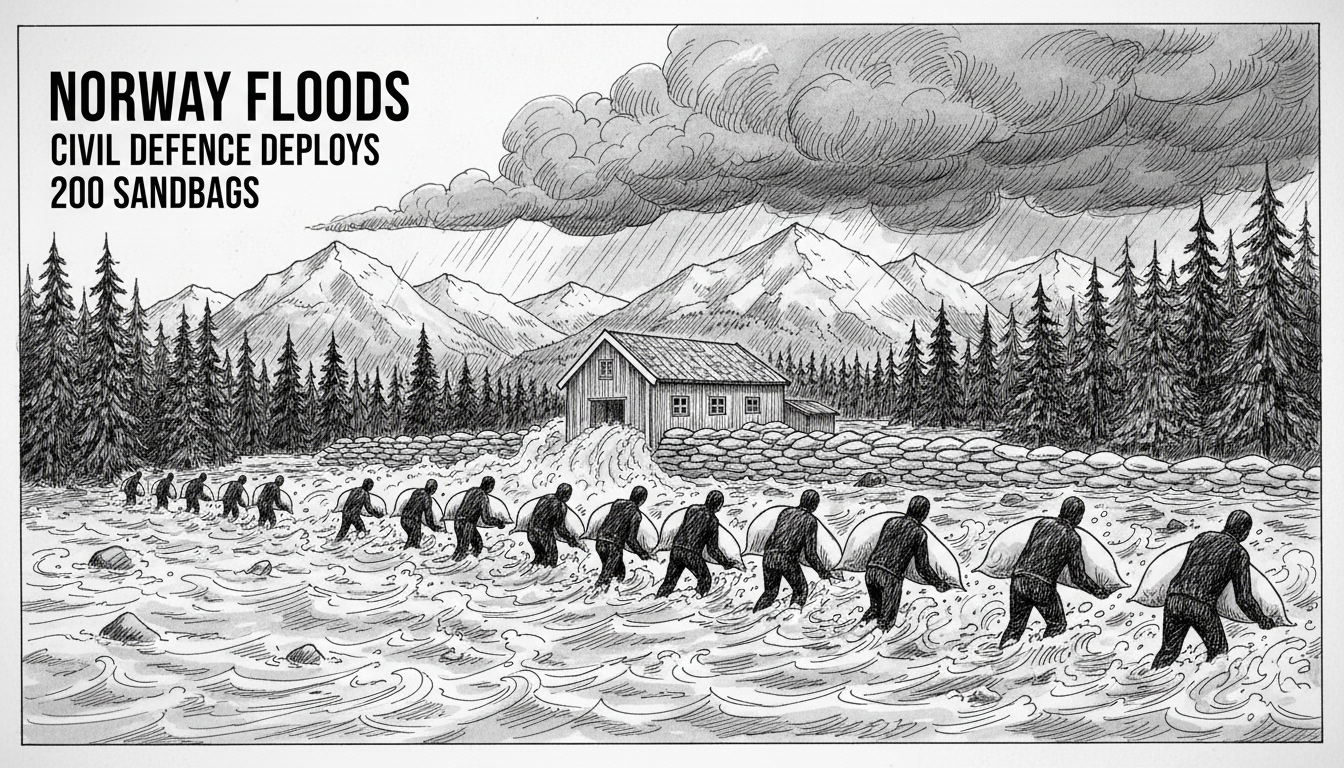
Norway's Civil Defence is deploying 200 sandbags to Sokndal as the worst flooding in years threatens Rogaland. The emergency supplies are being rushed to protect the town hall in the hardest-hit municipality. Officials warn the situation could deteriorate further in the coming hours.
A slow-moving storm system has dumped relentless rainfall across southwestern Norway for 48 hours. Rivers and streams in Sokndal have burst their banks, transforming streets into waterways. Local emergency services have been stretched thin, prompting the formal request for state assistance. This activation of the Civil Defence underscores the severity of the crisis now unfolding in this coastal community.
An Immediate Threat to Local Governance
“It is a couple of hundred sandbags we are assisting with,” said Arne Bratlien, the duty officer for the Rogaland Civil Defence district. His statement downplays the quantity but highlights a critical strategic priority. The sandbags have one clear objective: shielding the Sokndal municipal administration building from encroaching waters. Protecting this hub ensures local government can continue to coordinate the wider response, even as the floodwaters rise.
“This is a situational picture we have received from the county emergency preparedness council in Rogaland,” Bratlien explained. “We have the material to assist in disasters like this one.” The intervention follows established protocols where local authorities, overwhelmed by an event's scale, can request resources from the national Civil Defence's stockpiles. The move signals that local resources for flood containment have been exhausted.
Climate Change Intensifies Norway's Flood Risk
This event fits a troubling pattern documented by the Norwegian Water Resources and Energy Directorate (NVE). Scientists link the increasing frequency of intense, short-duration rainfall in Norway to broader climate change. Warmer atmospheres hold more moisture, leading to more powerful downpours. Traditional flood defenses, designed for historical weather patterns, are now regularly tested beyond their capacity.
“What we are seeing in Rogaland is a textbook example of the challenges we face,” said Dr. Ingrid Selmer, a hydrologist at the University of Bergen, commenting on the broader trend. “Our infrastructure and preparedness plans were built for a different climate. Events that were once considered extreme are becoming more common, requiring faster mobilization and greater resource flexibility.” Her analysis points to a future where inter-agency responses, like the one in Sokndal, will become a standard feature of Norwegian summers and autumns.
The Anatomy of a Localised Crisis
Sokndal’s geography makes it particularly vulnerable. The municipality is characterized by steep valleys and narrow river systems that funnel water rapidly from the highlands to the coast. When saturated ground can absorb no more rain, runoff accelerates. This leads to the swift and dangerous rise of water levels that catch communities off guard. The focus on the town hall is pragmatic; losing the administrative nerve center would cripple communication and decision-making during a critical phase.
While the national Civil Defence provides material, on-the-ground work falls to municipal crews and volunteers. Filling, transporting, and strategically placing hundreds of sandbags is a labour-intensive process. It is a race against time and the weather forecast, which promises more rain. The success of this operation will be measured by whether the building remains dry and functional, allowing officials to manage evacuation orders, public information, and support for affected residents.
A System Built for Preparedness
The Norwegian Civil Defence, known as Sivilforsvaret, maintains a decentralized network of equipment and personnel for exactly this scenario. Unlike a military unit, its role in peacetime is primarily civil emergency support. It stockpiles items like sandbags, pumps, and temporary shelters at districts across the country. This allows for a rapid, targeted response to local emergencies without requiring a massive centralized logistical operation.
This model is considered effective but is now facing new tests. The scale and simultaneity of climate-related disasters can strain even well-prepared systems. The request from Rogaland is a single data point in a national picture that includes landslides, forest fires, and avalanches, all increasing in volatility. Each event draws from the same pools of equipment and expert personnel.
Looking Beyond the Immediate Response
The flooding in Sokndal will inevitably recede, but the questions it raises will remain. Municipalities across Norway are now forced to re-evaluate their flood zone maps and infrastructure investments. Simple measures like sandbags are a last line of defense. Long-term solutions involve spatial planning—avoiding construction in high-risk areas—and significant investment in enlarged culverts, retention basins, and reinforced riverbanks.
For the residents of Sokndal, the coming days will be about damage assessment and cleanup. The economic cost to homes, businesses, and public infrastructure will be tallied. Insurance claims will be filed, many falling under Norway’s natural perils coverage scheme. The psychological impact of seeing one’s community under water leaves a longer-lasting mark.
The deployment of 200 sandbags is a small, tangible action in a vast and complex challenge. It represents the interface between local vulnerability and national support systems. As Arne Bratlien and his team execute their mission, a larger conversation continues about how Norway adapts its famous preparedness model for an era of climate disruption. The water lapping at the Sokndal town hall steps is a message, one that is being heard in increasingly frequent intervals across the Nordic region. Will future responses need to be measured in thousands of sandbags, rather than hundreds?