
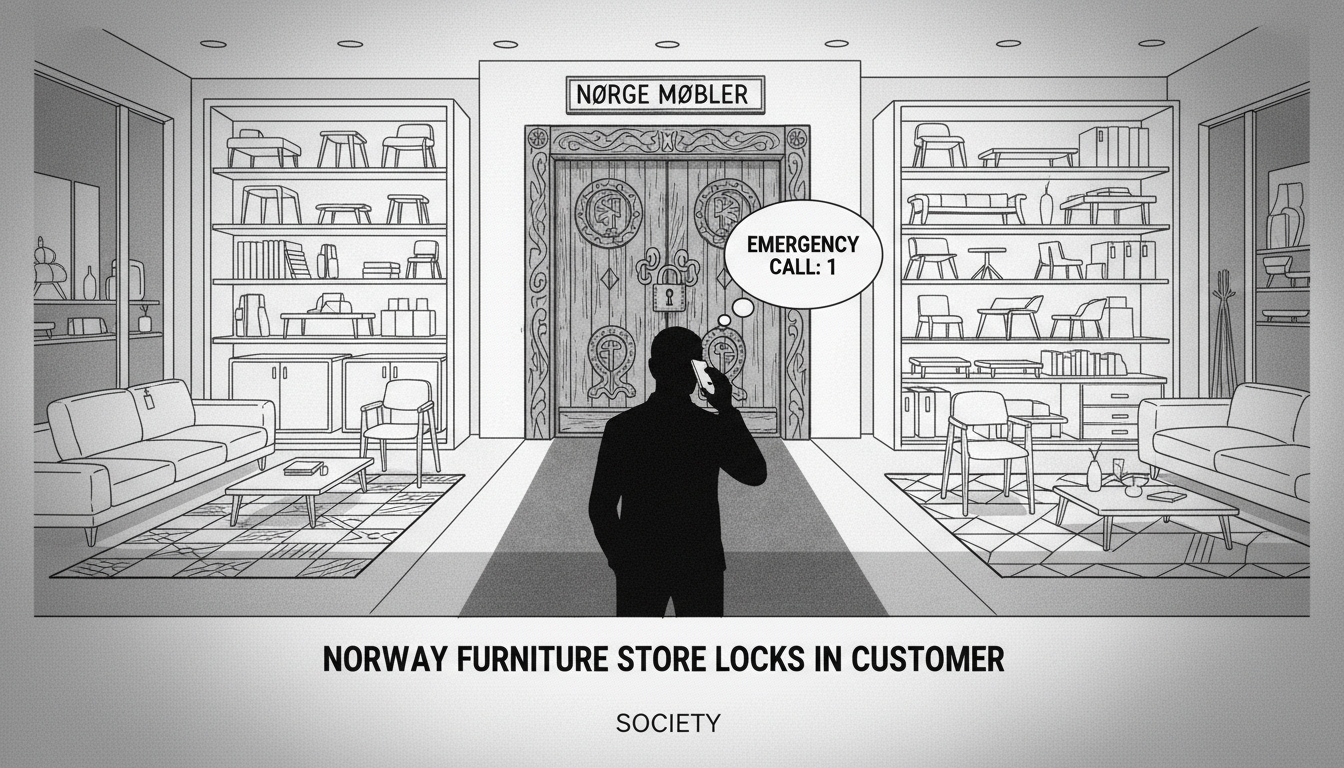
Norway furniture store security protocols are under scrutiny after a single, strange emergency call from the coastal town of Kristiansund. A man found himself imprisoned in a darkened showroom, rescued only after police intervention, because he tested a chair that proved too comfortable for the store's automated systems. This odd event underscores a quiet tension in modern Norwegian retail between efficiency, technology, and basic customer safety.
An Unexpected Night in the Showroom
The incident began mundanely. A man was shopping for furniture in Kristiansund, a town famed for its clipfish industry and island bridges. He located a promising armchair and did what any sensible shopper would do: he sat down. According to the police report, what happened next was disorienting. The lights abruptly cut out and the store's doors automatically locked. The customer, now trapped in utter darkness, had only his phone. He placed a call to the police, described as 'desperate' by Operations Manager Per Åge Ferstad. 'A desperate man called and said he was looking for an armchair in a furniture store,' Ferstad recounted. The caller insisted he had not fallen asleep. His explanation was simple: 'In the next moment, it got dark and the doors were locked.'
Police response was practical, not panicked. Officers made several calls to locate individuals with the right keys or codes to unlock the premises. 'After a number of calls, some knowledgeable people came to unlock him from the store,' Ferstad stated. The man was freed without injury, leaving the coveted armchair behind. With dry Norwegian wit, Ferstad later pondered the shopper's missed opportunity: 'So there was no armchair today? He was perhaps a little too late.' He added, 'The desperate man will probably buy the armchair another time.'
When Automation Overrides Awareness
This event, while minor, acts as a case study in unanticipated risk. Expert analysis suggests it highlights a significant blind spot in retail management. Many modern stores, especially larger chains, use automated systems for energy savings and security. Lights and doors are often on centralized timers or motion-sensitive systems. The assumption is that staff perform a final visual check. However, this protocol can fail if a customer is stationary in a secluded section, like a model living room set, or if staff members have a rushed closing routine. 'This incident highlights the potential risks associated with automated locking systems,' a retail security consultant notes, requesting anonymity to speak freely. 'It raises immediate questions about safety protocols. Is there an audible warning? Is there a defined process for a final walk-through that is actually followed? A store is not a prison; every customer must have a clear, guaranteed path to exit.'
In Norway, where trust in systems is high and crime rates are relatively low, the focus is often on efficiency. The potential for such a technological oversight to become a serious safety issue—particularly in winter, when temperatures plummet, or if the customer had a medical condition—is a wake-up call. The Norwegian Directorate for Civil Protection (DSB) provides guidelines for emergency preparedness in public buildings, but day-to-day retail security is largely self-regulated by businesses.
A Cultural Glimpse Through a Locked Door
The story resonated nationally not just for its oddity, but for its relatable core. The image of a man peacefully testing a chair one moment, and becoming an inadvertent prisoner the next, touches a nerve. It reflects a universal modern anxiety about being at the mercy of impersonal technology. Furthermore, it provides an unintentionally humorous glimpse into the Norwegian psyche: the calm, procedural police response, the understated official commentary, and the victim’s own reported insistence that he had not, in fact, succumbed to a nap. In a culture that values both practicality and personal responsibility, the incident sits in a funny middle ground—no one was at fault, yet the system failed.
Kristiansund itself, a community built across islands facing the Norwegian Sea, is a reminder that even in smaller towns, modern retail practices are fully integrated. This isn't a story from Oslo's sprawling suburbs; it can happen anywhere automated systems are installed without rigorous human backup checks. The town's geography, requiring bridges to connect its parts, adds a subtle layer of irony—a man trapped not by water, but by a locked door on dry land.
The Broader Implications for Norwegian Retail
For consumers, this is a minor oddity. For the retail industry and safety inspectors, it should serve as a prompt for review. Best practices would suggest a multi-layered approach: a clear audible announcement signaling imminent closure, a mandatory visual sweep of the entire sales floor by two employees, and an easily accessible, well-marked manual override or emergency exit mechanism that remains functional when main power is cut. Some larger stores already use these measures; this event suggests they should be standardized.
Data on such occurrences is scarce, as they rarely result in injury or formal reports. However, anecdotal evidence from online forums suggests similar incidents, often involving customers in changing rooms or restrooms, occur more frequently than official statistics show. They are usually resolved quickly by returning staff, preventing a police call. This Kristiansund case is unique because the resolution required external intervention, bringing it into the public record.
A Lesson in Unplugging the Automatic Pilot
Ultimately, the man from Kristiansund got a story, not a chair. His experience is a low-stakes parable for our automated age. It asks a simple question: in the quest for efficiency and security, have businesses programmed out basic human oversight? Norway's high-tech society runs smoothly because of a strong foundation of trust and common sense. This incident suggests that in certain, narrow contexts, that foundation needs a manual check. As stores consider ever more sophisticated systems—AI stock monitoring, automated checkout, energy management—the human element of simply looking around before locking up becomes more, not less, critical.
The chair, presumably, remains for sale. One hopes its next potential buyer will test its comfort with a new awareness, perhaps in the bright light of midday. And one hopes the store has reviewed its closing routine, ensuring that the path to the exit is always the clearest path of all. How many other everyday spaces have quietly traded human checks for automated convenience, and what does that mean for our shared safety?