
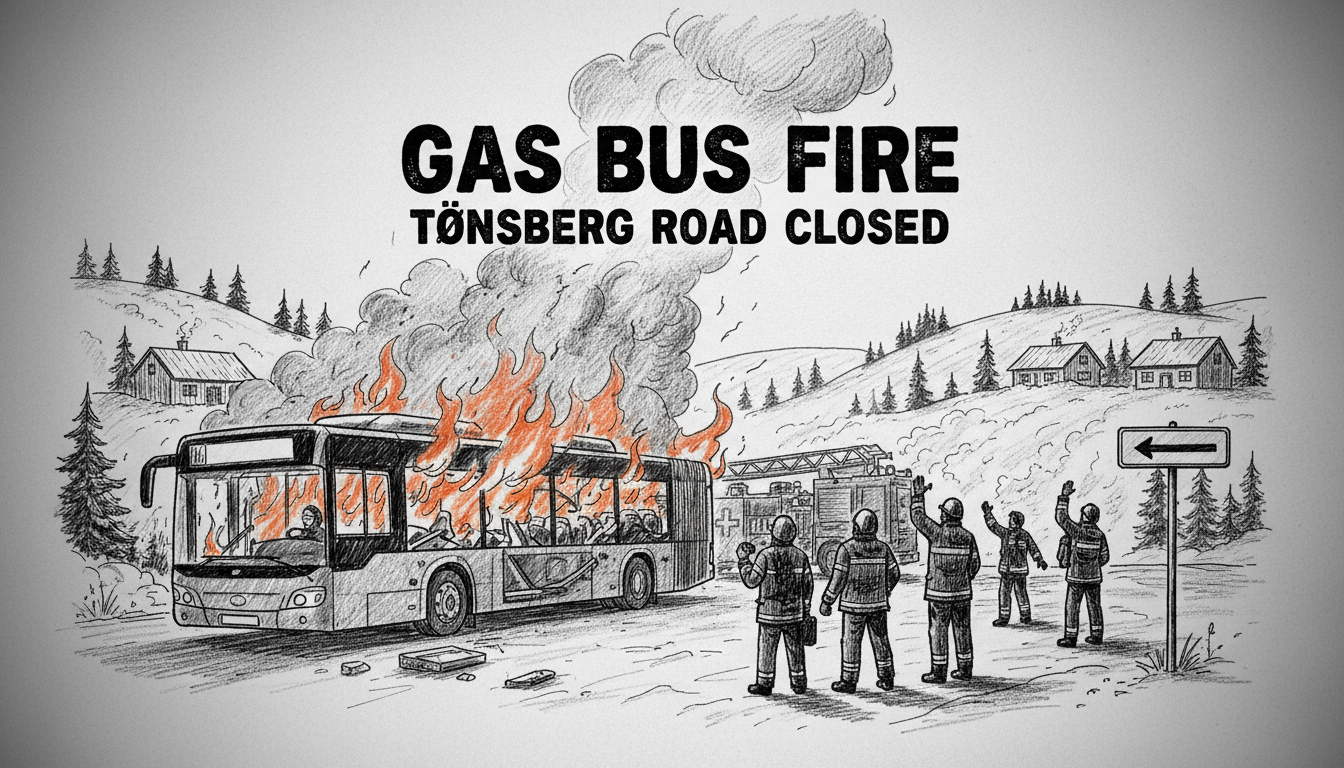
Norway's historic city of Tønsberg faced traffic disruption and a significant emergency response after a gas-powered minibus caught fire on Tuesday afternoon. The incident, which occurred at Tomsbakken, led to the closure of a major county road and required a large safety perimeter due to the vehicle's fuel type. No injuries were reported, with emergency services confirming they had the blaze under control by 3:55 PM.
Firefighters and police established a 300-meter safety cordon around the burning vehicle. This precaution is standard protocol for incidents involving compressed natural gas or other gaseous vehicle fuels, which pose unique explosion risks. The bus driver and a single passenger evacuated safely before the fire intensified. Ambulance personnel examined both individuals at the scene.
"We implemented a 300-meter safety distance because the bus runs on gas," operations manager Ottar Steinstø noted in the police log. The closure of Fylkesvei 35, a key county road, caused immediate traffic delays throughout the eastern part of the city. The Norwegian Public Roads Administration's traffic center issued alerts to motorists to seek alternative routes.
Emergency Response in Vestfold
The swift response from Tønsberg's fire brigade prevented the incident from escalating. Fire crews used specialized equipment and techniques designed for gas-fueled vehicle fires. These methods often involve controlled cooling and preventing gas tank rupture rather than immediate extinguishment. The successful containment highlights the training Norwegian emergency services undergo for such specific hazards.
Vestfold county's emergency coordination center managed the multi-agency response. Police secured the perimeter, ambulance services stood by for medical support, and the roads administration handled traffic flow. This integrated approach is standard across Norwegian municipalities. It aims to minimize risk to both the public and first responders during technical incidents.
The Risks of Alternative Fuel Vehicles
This fire places a spotlight on the safety considerations surrounding Norway's growing fleet of alternative fuel vehicles. The country is a global leader in electric vehicle adoption, but gas-powered buses and trucks remain part of the public and commercial transport mix. Experts note that while such fires are rare, they require distinct firefighting strategies compared to petrol or diesel blazes.
"Vehicle fires involving gas or hydrogen require very specific safety protocols," explained Lars Holm, a senior advisor at the Norwegian Directorate for Civil Protection. "The primary risk is not just the fire itself, but the potential for a sudden pressure release or explosion from the fuel tank. Establishing a large safety zone is the first and most critical step."
Holm emphasized that Norwegian fire services train extensively for these scenarios. The fuel tanks in gas vehicles are built to withstand high pressure, but intense heat can compromise their integrity. The goal is to keep the tank cool until the fuel supply can be safely isolated or burned off in a controlled manner.
Traffic and Infrastructure Impact
The closure of Fylkesvei 35 had a ripple effect on local traffic. This road serves as an important artery connecting residential areas with Tønsberg's city center and industrial zones. Disruptions lasted for several hours as crews worked to extinguish the fire, secure the scene, and eventually remove the damaged vehicle.
Local authorities used electronic road signs and traffic apps to redirect motorists. The incident occurred during the mid-afternoon, avoiding the peak morning and evening commutes, which likely limited the scale of the congestion. The quick dissemination of information by the Vegtrafikksentralen traffic center was crucial for managing the situation.
For residents, the event was a sudden reminder of how a single incident can impact daily mobility. Tønsberg, with a population of around 56,000, relies on a well-functioning road network. The efficient reopening of the road after the scene was cleared demonstrated the resilience of local infrastructure management.
Historical Context and Modern Safety
Tønsberg's rich history as one of Norway's oldest cities contrasts with the modern technical challenge it faced. Founded in the Viking Age, the city has evolved from a medieval trading hub to a modern municipality that must manage contemporary risks. Today's emergency services protect a historic urban landscape that includes wharves, wooden buildings, and the famous Slottsfjellet mountain.
The incident concluded without damage to nearby structures or the surrounding environment. This positive outcome underscores the effectiveness of current safety regulations and training. All gas-powered vehicles in Norway must undergo strict technical inspections, and their transport is governed by specific safety codes.
Norwegian regulations for vehicles using compressed natural gas (CNG) or liquefied petroleum gas (LPG) are among the most stringent in Europe. These rules cover tank manufacturing standards, vehicle conversion requirements, and regular inspection intervals. The systems are designed to prevent leaks and withstand impacts, but no system is entirely foolproof against all failure modes.
Analysis: A Routine Emergency with Broader Implications
While this fire was resolved successfully, it serves as a useful case study. For Norway, a nation deeply committed to transitioning away from fossil fuels, understanding the safety profile of all alternative energy sources is essential. Electric vehicles have their own fire risks, primarily related to lithium-ion battery thermal runaway, which also demands specialized firefighting techniques.
The event in Tønsberg was a routine emergency handled with professional precision. It did not rise to the level of a major disaster, but it perfectly illustrates the daily work of municipal emergency planners. Each such incident provides data and experience that informs future training and protocol updates.
From a policy perspective, these incidents are weighed against the broader benefits of cleaner transportation. Gas-powered buses typically produce lower emissions of nitrogen oxides and particulate matter than diesel equivalents. The safety record for such vehicles in Norway remains strong, thanks in part to rigorous response plans for when things go wrong.
Looking Ahead: Preparedness in a Changing Landscape
As Norway continues to innovate in transport technology, with experiments in hydrogen fuel cells and biofuels, its emergency services must continuously adapt. The lessons from this Tønsberg bus fire will be incorporated into training scenarios across Vestfold and neighboring counties. Sharing operational knowledge between municipalities is a key strength of Norway's civil protection system.
For the public, the main takeaways are reassurance. The system worked as designed: the occupants evacuated safely, a hazard zone was established, experts contained the threat, and traffic disruptions were managed. In an era of frequent alarming headlines, a controlled, non-fatal incident is a testament to effective public safety infrastructure.
The burned-out minibus on Fylkesbakken is now likely destined for technical examination. Investigators may look into the cause of the fire, whether it was a mechanical fault, an electrical issue, or something else. Their findings could contribute to future safety enhancements for similar vehicles across the country. In the quiet aftermath, Tønsberg returns to normal, its ancient streets once again clear, its modern safety systems having passed a small but significant test.