
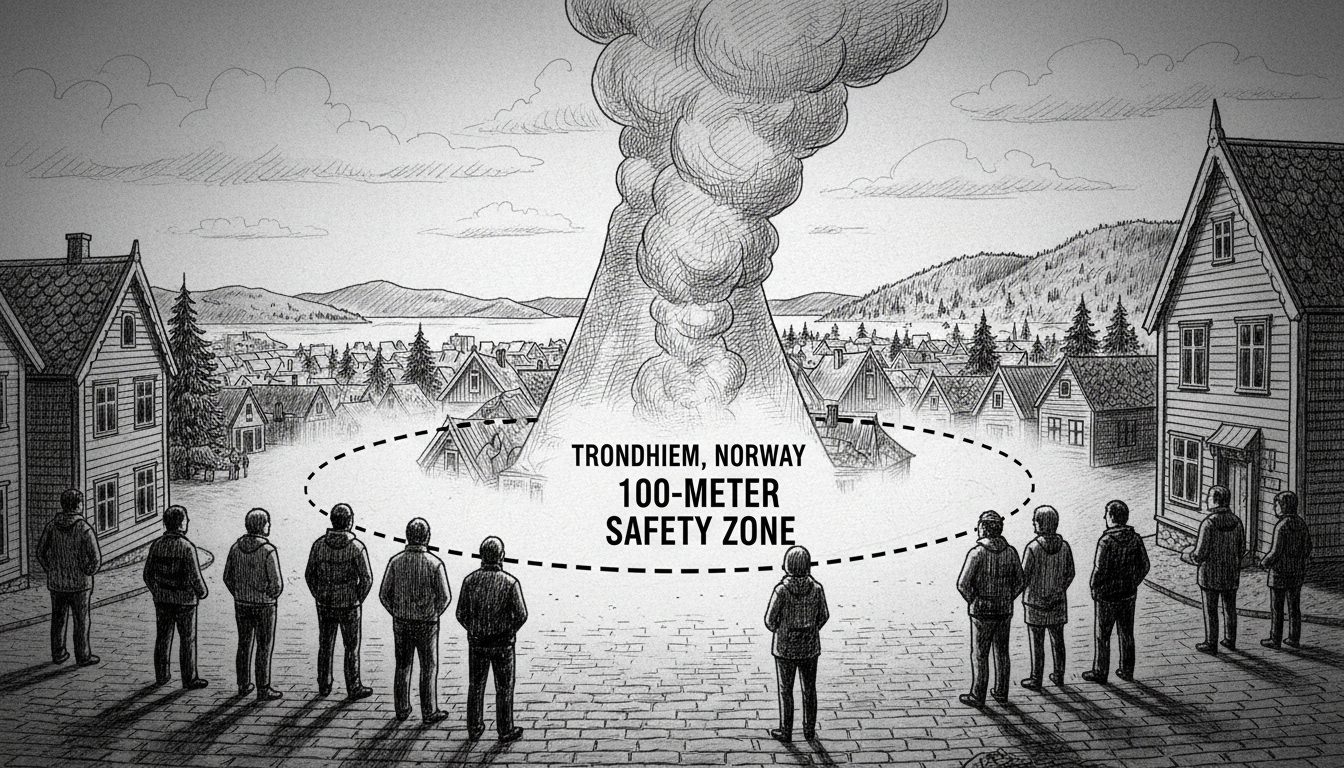
Norway emergency services rushed to contain a gas leak in Trondheim Wednesday morning, establishing a 100-meter safety zone around a refuse vehicle. Police and fire brigades responded to reports of a leak from a tank inside a garbage truck in the city. The incident caused brief disruption but was swiftly managed without evacuations. Authorities confirmed the gas involved was lighter than air, posing a reduced ground-level risk as it dissipated upwards.
The Morning Alert
Residents in a Trondheim neighborhood received early warnings via police logs around 8 a.m. The message advised neighbors to close windows and stay indoors. Trøndelag Police District coordinated with the fire department to isolate the scene. A single garbage truck was identified as the source. The vehicle was parked on a residential street when the leak was detected. No injuries were reported, and traffic was diverted for approximately two hours.
The gas type was not publicly specified beyond being 'lighter than air.' Common gases in such contexts include methane or propane mixtures from waste decomposition. Emergency teams used detectors to monitor air quality. Their assessment found no immediate threat to public health. The 100-meter cordon was a standard precautionary measure. It was lifted once the leak was secured and gas concentrations normalized.
Emergency Protocol in Action
Norwegian nødetater, or emergency agencies, follow strict protocols for hazardous material incidents. The response showcased inter-agency coordination between police and fire services. A safety zone is immediately established based on leak severity and gas properties. For lighter-than-air gases, the focus is on vertical dispersion rather than horizontal spread. This informed the decision against evacuating homes or businesses.
'Neighbors should close windows,' police stated in their official log. This instruction aimed to prevent any gas ingress into buildings. Firefighters conducted a technical inspection of the truck's tank. They likely employed sealing methods or controlled venting. The operation was declared stable by mid-morning. Such incidents are recorded in Norway's national incident database for safety reviews.
Analyzing the Gas Risk
Industrial safety experts emphasize rapid identification in gas leak scenarios. Dr. Lena Solberg, a chemical risk analyst at the Norwegian University of Science and Technology in Trondheim, provided context. 'Gases lighter than air, like methane, rise quickly and dilute,' she explained. 'The primary risk is ignition if concentrated, but in open areas, dispersion reduces this dramatically.' Her analysis aligns with the measured response.
The garbage truck's tank likely contained compressed gas from waste collection processes. Modern refuse vehicles often have systems to manage landfill gas or fuel residues. Leaks can occur from valve failures or pipe fractures. Regular maintenance is critical. Norway's robust industrial safety regulations require frequent inspections for such vehicles. This incident will trigger a mandatory investigation by the Norwegian Labour Inspection Authority.
Trondheim's Urban Safety Landscape
Trondheim, with over 200,000 residents, is a hub for technology and industry. It houses Norway's largest university and numerous research institutes. The city's infrastructure includes waste management facilities and transport networks. Industrial incidents, while rare, test urban emergency preparedness. This gas leak occurred in a mixed residential-commercial area. It highlights the interplay between daily services and public safety.
Local authorities have contingency plans for hazardous material events. Trondheim Fire Department conducts regular drills with police and health services. The city's geography, situated on a fjord, can influence air flow and gas dispersion. Wednesday's weather conditions—clear with light winds—aided the safe dissipation. Historical data shows few similar incidents in recent years, reflecting generally high safety standards.
Norway's Industrial Safety Framework
Norway maintains stringent regulations under the Working Environment Act and the Fire and Explosion Prevention Act. The Petroleum Safety Authority Norway often sets benchmarks, but land-based incidents fall under multiple agencies. For transport-related leaks, the Norwegian Public Roads Administration and the Climate and Environment Ministry oversee compliance. This multi-layered approach aims to prevent and mitigate risks.
The country's focus on industrial safety stems from its extensive oil and gas sector. Lessons from offshore operations are applied to onshore logistics. Regular audits and certification are mandatory for vehicles carrying hazardous materials. Garbage trucks with gas tanks require special permits. Enforcement is carried out through random checks and reporting systems. This incident may prompt a review of maintenance protocols for municipal fleets.
Resident Response and Community Impact
Nearby residents expressed relief that the situation was resolved quickly. Some reported seeing emergency vehicles but noted minimal disruption. 'We heard the sirens and checked the police website for updates,' said one local via social media. The advice to close windows was widely followed. Community alert systems, including digital police logs, provided real-time information. This transparency helps maintain public trust during emergencies.
The lack of evacuation avoided larger societal costs. Evacuations in Nordic cities can be logistically challenging, especially in dense urban areas. Trondheim's experience demonstrates effective risk communication. Authorities balanced caution with minimal intrusion. Future drills might incorporate similar scenarios to refine response times. Public education on gas leak precautions is also part of Norway's safety culture.
Lessons for Urban Management
This minor incident offers insights into broader urban resilience. Quick identification of gas properties allowed targeted measures. The 100-meter zone sufficed because the gas rose rapidly. In contrast, heavier gases would require wider cordons and likely evacuations. Norway's investment in emergency response technology, such as gas detectors and communication networks, proved effective. Continuous training ensures personnel readiness.
Comparatively, Nordic countries share similar response frameworks. Sweden and Denmark have analogous protocols for hazardous material leaks. Norway's integration of police and fire commands streamlines decision-making. The Trondheim case shows that even small-scale leaks are treated with high seriousness. It reinforces the principle that prevention through maintenance is paramount. Upcoming regulatory reviews may focus on aging vehicle fleets.
Looking Ahead: Safety in Focus
Norwegian authorities will compile a report on this incident within weeks. Recommendations could include enhanced inspection schedules for refuse trucks. Trondheim Municipality might review its waste management contracts. The broader conversation touches on transitioning to safer technologies, like electric waste collection vehicles. However, current infrastructure still relies on various gas systems.
As Norway advances its green energy goals, industrial safety remains a core concern. Balancing daily operations with risk management is an ongoing challenge. This gas leak, while swiftly contained, serves as a reminder of ever-present hazards. How can cities like Trondheim further integrate safety into urban planning? The answer lies in continuous improvement, learning from each event to protect communities better.