
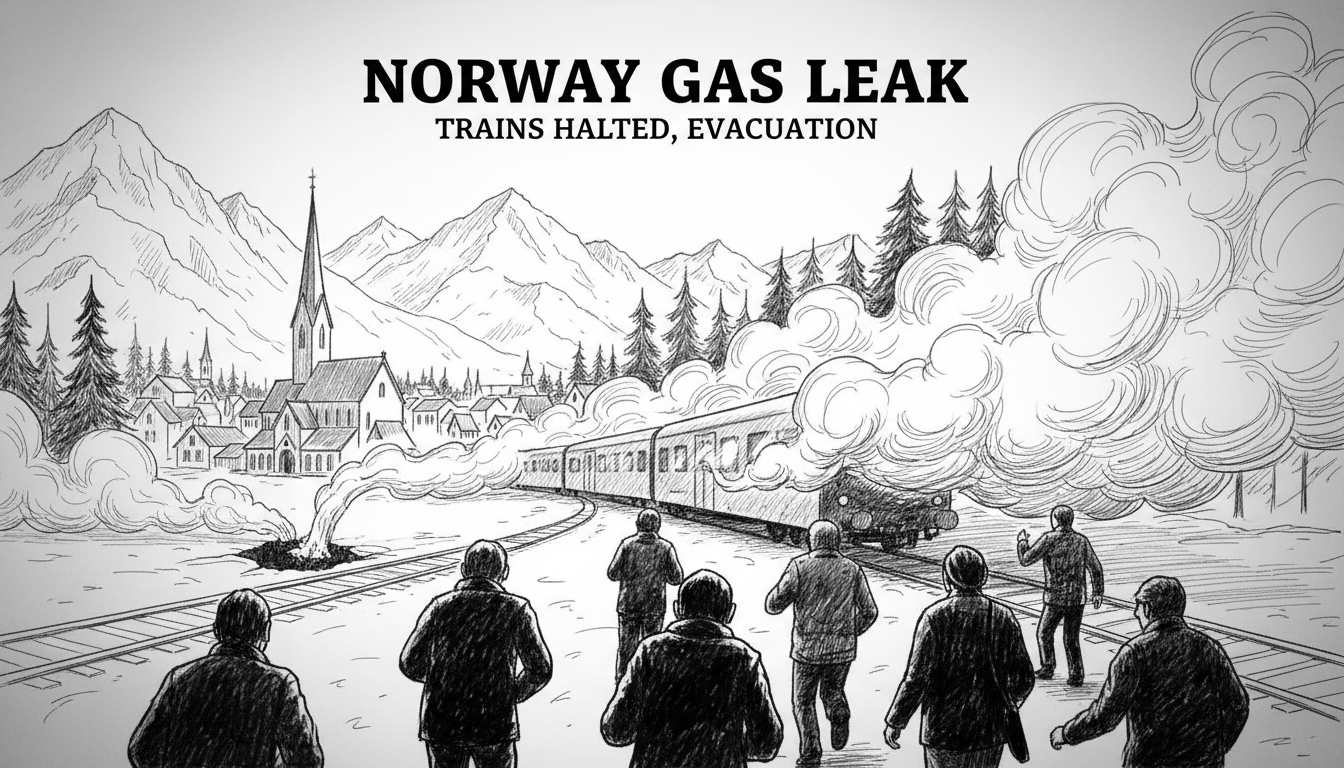
Norway emergency services responded to a significant gasoline leak at a Skien fuel station Thursday morning, halting regional train traffic and forcing evacuations. The incident, which occurred during a routine tanker truck delivery, led to a 100-meter safety cordon and disrupted the vital rail link between Skien and neighboring Porsgrunn.
Fire crews and police sealed off the area shortly after the leak was reported. Officials evacuated two nearby stores as a precaution. The exact volume of gasoline spilled has not been disclosed, but the response indicated a substantial incident. "All necessary resources were deployed immediately to secure the area and prevent any ignition risk," a police operations manager said in a statement.
Transport Artery Severed
The immediate operational impact was the suspension of all train services on the Skien-Porsgrunn line. Operator Vy confirmed the stoppage, stranding commuters and freight. This corridor is a critical piece of infrastructure for the Grenland industrial region, connecting major manufacturing and chemical plants. The disruption lasted for several hours during the morning rush, with residual delays continuing throughout the day as services resumed.
"When the train line stops, the region's economic pulse slows down," said Lars Andersen, a transport analyst based in Oslo. "This isn't just about passenger inconvenience. It's about just-in-time logistics for industry, shift workers arriving at factories, and the movement of goods. A few hours of disruption has a ripple effect." The incident highlights the vulnerability of key transport nodes to single-point failures, especially when located near residential and commercial areas.
Safety Protocols Under Scrutiny
While such leaks are rare, the event will likely trigger reviews of fuel handling procedures. Transferring petrol from a tanker to an underground station storage tank is a high-risk operation governed by strict safety protocols. Potential causes range from equipment failure, like a ruptured hose or faulty valve, to human error during the connection or monitoring process.
Industry experts stress the built-in safety measures designed to prevent such events. "Modern systems have multiple automatic shut-offs and alarms," explained Kari Nilsen, a veteran process safety engineer in the oil and gas sector. "The fact that a leak of this magnitude occurred suggests either a compound failure of these systems or an unforeseen scenario. The investigation will focus on whether procedures were followed and if the equipment met all safety standards."
Norwegian authorities, including the Norwegian Directorate for Civil Protection (DSB) and possibly the Petroleum Safety Authority Norway (PSA), are expected to examine the incident. Their findings could influence national regulations for fuel distribution logistics.
Local Impact and Response
For residents and businesses near the affected station, the morning was marked by urgency and disruption. The establishment of a 100-meter perimeter is a standard precaution for volatile petroleum vapors, which can travel and pose an explosion risk if ignited. The swift evacuation of nearby commercial premises prevented any potential injury.
The local fire department's response likely involved applying foam or other suppressing agents to limit vaporization and monitoring air quality with gas detectors. Containment of any spilled fuel to prevent environmental runoff into storm drains would also be a priority, given Norway's strict environmental protection laws.
"We heard the sirens and saw police quickly moving people back from the area," said a shopkeeper from a neighboring street, who asked not to be named. "It was handled efficiently, but it's a sharp reminder of what's stored and flowing through our urban centers every day."
Regional Resilience and Infrastructure
Skien, as an administrative and transport hub for Vestfold og Telemark county, relies on the smooth function of its road and rail networks. This incident underscores the interdependence of different infrastructure systems. A problem at a roadside service station can incapacitate a railway line, demonstrating how risks in one sector can spill over into another.
Questions may arise about the proximity of such hazardous material transfer points to critical transport infrastructure. While zoning laws regulate these distances, urban expansion and increased traffic volumes can change risk profiles over time. "This is a classic case for municipal risk planners," noted Andersen. "It forces a reassessment of whether existing buffers and mitigation plans between high-risk commercial activities and vital public infrastructure are still sufficient."
Looking Ahead: Normalcy Returns with Questions
By late morning, the immediate danger was contained. Train services gradually resumed, though passengers faced delays as the schedule stabilized. The evacuated businesses were allowed to return, and the safety perimeter was lifted once emergency services confirmed the site was secure.
Cleanup operations at the station will continue, and the business will remain closed until inspections are complete and any damaged equipment is repaired or replaced. The financial cost of the disruption, from lost trade to cleanup and potential regulatory fines, will be tallied in the coming weeks.
For Norway, a nation built on the safe handling of hydrocarbons, this incident serves as a small but significant operational test. It reinforces that routine procedures carry inherent risk and that public safety systems, from first responders to transport operators, must remain in a state of constant readiness. The investigation's conclusions will be closely watched by industry and municipal planners far beyond the borders of Skien, as communities worldwide balance logistical convenience with fundamental safety.