
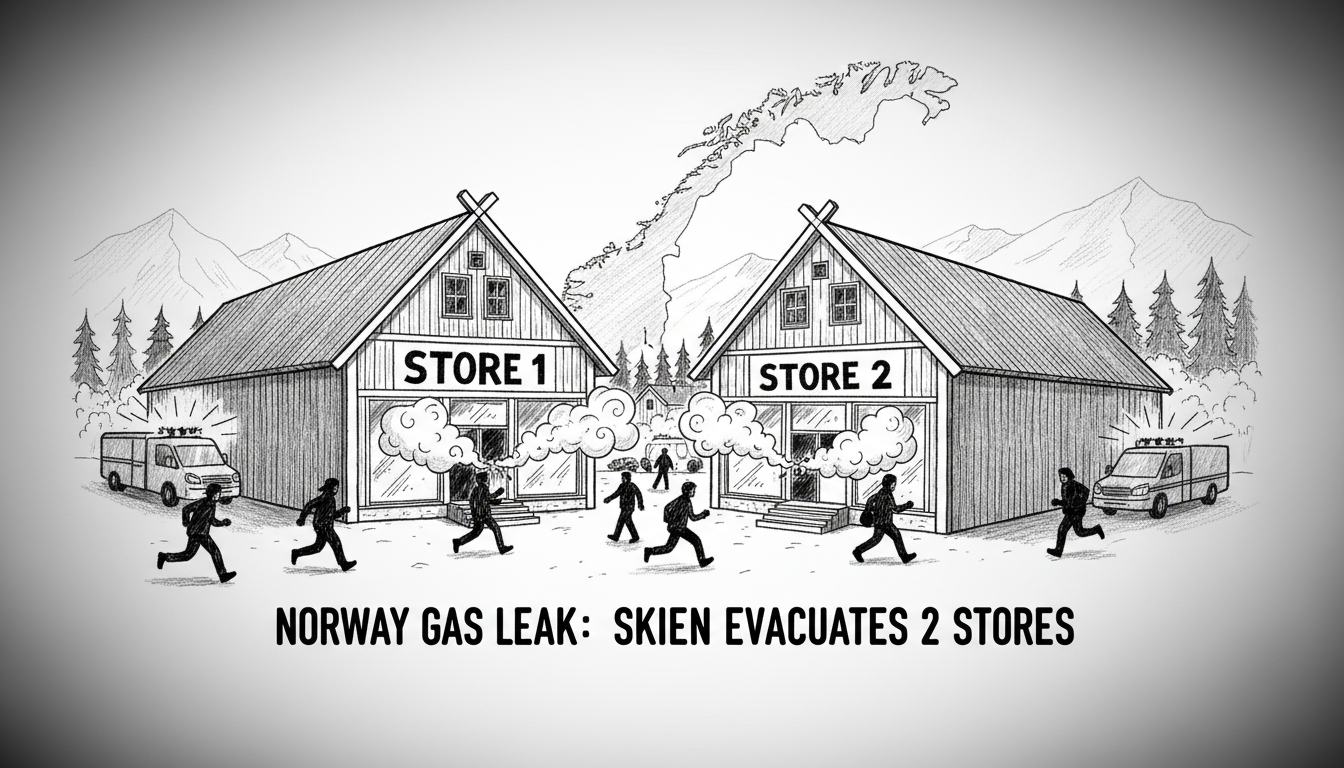
Norway emergency response teams mobilized in Skien Thursday after a significant gasoline leak during a routine fuel delivery forced the evacuation of two commercial stores. The incident, which occurred as a tanker truck was filling an underground station reservoir, prompted a swift police and fire service intervention to contain the environmental and safety hazard in the historic industrial city.
Police in the Sør-Øst region confirmed the sequence of events. "The leak happened in connection with the filling of gasoline from a tanker truck to a gas station," a police spokesperson said in a statement. The precise volume of fuel spilled has not been disclosed, but the decision to evacuate adjacent businesses indicates authorities perceived a substantial risk of fire or toxic vapor accumulation.
A Swift Containment Operation
Local fire brigades, likely from Skien Brannvesen, deployed to the scene immediately. Their primary objectives were standard for such incidents: secure the area to prevent ignition sources, contain the spread of the liquid gasoline, and begin the process of recovery and cleanup. Gasoline is highly flammable and its vapors can be explosive; even a small spark from electrical equipment or a vehicle could trigger a disaster. The rapid evacuation order for the two stores was a critical first step in risk mitigation.
Skien, the administrative heart of its municipality in Vestfold og Telemark county, is no stranger to industrial activity. As one of Norway's oldest cities, its development has long been tied to manufacturing and commerce. This industrial heritage means local emergency services are trained for a range of potential accidents. The response to this leak tests protocols designed to protect both urban populations and the local environment, particularly given Norway's stringent regulations on pollution.
The Environmental and Safety Calculus
While no injuries were reported and the incident appears contained, it opens a window into the persistent risks embedded in essential infrastructure. "Every transfer of hazardous materials like gasoline carries inherent risk," explains Lars Holm, a former safety inspector for the Norwegian Directorate for Civil Protection (DSB). "The protocols are extremely detailed—from grounding the tanker to prevent static discharge to having spill kits on hand. When a leak of this magnitude occurs, it typically points to a mechanical failure or a procedural breach during the coupling or monitoring process."
Holm's analysis underscores a key point. Norway maintains an excellent safety record across its energy sector, from offshore platforms to onshore distribution. However, this incident in Skien is a reminder that the chain of fuel delivery—from refinery to forecourt—relies on countless technical components and human actions functioning perfectly each time. A single faulty valve, seal, or gauge can lead to a rapid and dangerous release.
From an environmental perspective, gasoline is a toxic mix of hydrocarbons and additives. It can contaminate soil and, if it reaches storm drains or groundwater, pose a longer-term threat to waterways. Skien is situated near the mouth of the Skienselva river, which flows into the Frierfjord. While this leak seems to have been caught on-site, it highlights the constant vigilance required to protect Norway's intricate network of fjords and waterways from accidental pollution.
Broader Implications for Fuel Infrastructure
This is not a story about systemic failure, but rather a case study in routine risk management. For residents, it is a sudden interruption—a closed store, a cordoned-off street, the sight of emergency vehicles. For authorities, it is a checklist of contained escalation: evacuate, secure, contain, investigate, and remediate.
The investigation will now focus on causation. Was it an equipment malfunction on the tanker or the station's receiving tank? Was there an overfill situation due to a faulty sensor or human error? The answers will dictate any regulatory follow-up. The Norwegian Labour Inspection Authority (Arbeidstilsynet) may become involved, as they oversee workplace safety, including at service stations.
For the gas station operator and the fuel delivery company, the financial and reputational costs begin to mount. Beyond the immediate cleanup, which involves specialized hazardous materials contractors, there may be fines if violations are found. Business interruption for the evacuated stores could also lead to claims.
A Resilient Community Response
The response in Skien reflects a high level of societal resilience built on trust in public institutions. Citizens generally comply promptly with evacuation orders, and emergency services coordinate effectively. This social contract is crucial for managing acute incidents without panic. The communication from police was direct and factual, a style typical of Norwegian authorities that aims to inform without inciting unnecessary alarm.
Looking ahead, the aftermath will involve remediation. Contaminated soil may need to be removed. The station's fuel system will be inspected and certified before it can resume operations. The incident will likely become a local talking point and possibly a brief item in regional safety bulletins, used as a recent example to reinforce training.
Norway's vast energy wealth, primarily from oil and gas, fuels its society, but the final step of delivery—the transfer of refined product to local stations—remains a vulnerable point in the chain. This leak, while minor in the national scale of energy production, is a tangible moment where abstract risk becomes concrete action for firefighters and police. It underscores that safety is not a static achievement but a continuous process of preparation, response, and review, even in a nation renowned for its operational excellence. Does the quiet efficiency of the response in Skien make it easier to forget the complex safety systems that must work every day to prevent such incidents from becoming catastrophes?