
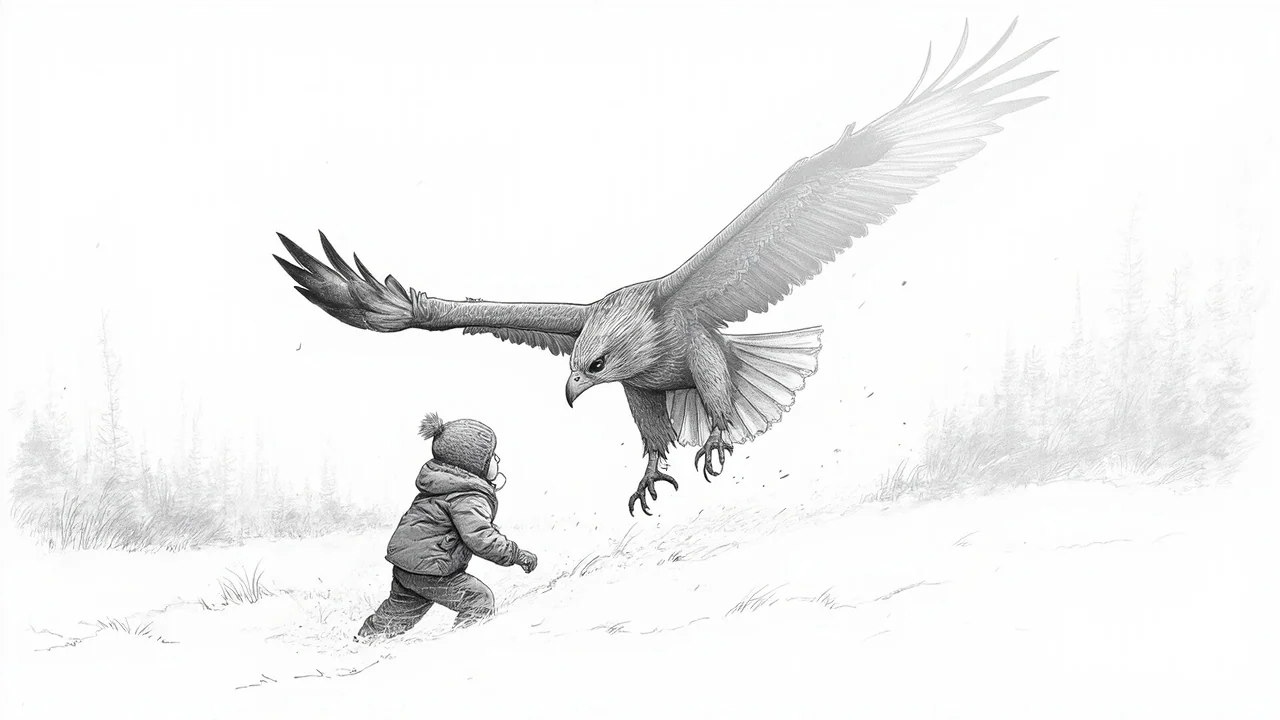
Norway's rare golden eagle attack on a one-year-old girl in September 2024 has exposed a troubling human-wildlife conflict rooted in illegal captivity. The incident, which left the child with head wounds requiring stitches, occurred over five days in Svorkmo where multiple people were targeted by the same emaciated bird. Leading ornithologist Alv Ottar Folkestad states the eagle's behavior was "completely unusual" for a wild predator and points directly to human interference as the cause.
A Predator's Unnatural Behavior
The golden eagle (Aquila chrysaetos) is Norway's largest bird of prey, a symbol of wilderness that typically avoids human contact. Its attack on a toddler represents a profound behavioral anomaly. "This is not an attack in behavioral terms," Folkestad, a recognized eagle expert, clarifies. "This is classic eaglet behavior from a bird raised in captivity, accustomed to receiving food from humans instead of parents." The distinction is critical: the eagle was not hunting but begging, driven by starvation and misplaced association. The bird, which was later euthanized, was found to be at half its normal body weight and nearing death from starvation, a direct result of its inability to fend for itself.
The Aftermath for a Family
For the child's mother, Tonje Jakobsen, the event has been traumatic. "It has been a series of flashbacks for both our oldest son and for me as a mother, but it gets better with time," she recounted. The one-year-old, Oline, required stitches to the back of her head and had scratch marks under her neck and across her face. Remarkably, the child shows no memory of the incident, though the family remains prepared for potential future psychological reactions. The attack's selectivity adds another layer of unease; the eagle targeted Oline but ignored chickens in the family's farmyard, reinforcing expert opinion that it saw humans as a food source, not prey.
Two Theories of Human Failure
Folkestad outlines two plausible, and both illegal, scenarios that led to the eagle's fatal conditioning. The first involves private citizens taking an eaglet from its nest. "People may have taken liberties and gotten a bit excited about taking in an eaglet and feeding it," he explains. "Then it associates food with humans, and over time that can become problematic." The second, more sinister theory points to illegal breeding operations. "It's possible someone released it from captivity and believed that once it was flight-capable, it could manage on its own. Instead, it starved and sought out humans." Both theories highlight a breach of Norway's strict wildlife protection laws, which prohibit the capture or keeping of protected species like the golden eagle without special authorization, which is rarely granted.
A Systemic Problem in Norwegian Wildlife Management
This incident is not an isolated curiosity but a symptom of a broader challenge. Norway's vast, sparsely populated landscapes can foster a sense of detachment from natural laws, where individuals sometimes believe they can intervene in wildlife rearing without consequence. The golden eagle population, while stable, is carefully monitored. Each individual's survival is crucial. An eaglet removed from the wild and improperly reared represents a double loss: one bird potentially doomed and a wild nest failed. The case has sparked local alarm and drawn national attention, forcing a conversation about public education and enforcement. "We think it's a great shame if people go around feeding eagles and meddling with nature," Jakobsen stated, echoing a sentiment shared by conservationists.
The Grim Outcome and Its Implications
The story's conclusion was inevitable from a wildlife management perspective. The starving, behaviorally compromised eagle posed a continued public safety risk and could not be rehabilitated to a wild state. It was euthanized. This outcome underscores the tragic end result of well-intentioned or profit-driven interference: the death of a protected animal and trauma for innocent people. For Norwegian authorities, the case raises difficult questions about monitoring and preventing the illegal wildlife trade and pet-keeping. It also tests the protocols for dealing with "problem animals" whose behavior is a direct result of human error.
Balancing Protection and Public Safety
Norway prides itself on its deep connection to nature and robust environmental protections. The Wildlife Act provides strong safeguards for species like the golden eagle. However, this incident reveals a gap between law and isolated human actions. It calls for a reinforced message from the Norwegian Environment Agency and organizations like the Norwegian Ornithological Society: wild animals are not pets. Their complex survival skills are learned over months of parental care, a process humans cannot replicate. The public must understand that feeding or capturing a raptor is an act of cruelty, not compassion, that jeopardizes both the animal and the community.
A Lasting Shadow in the Mountains
The events in Svorkmo will fade from headlines, but their implications will linger. For the family, the memory of the attack will take time to heal. For Norway's conservation community, it serves as a stark case study. The majestic golden eagle, a national emblem of wild freedom, became a hazard through human dependency. This paradox highlights a fundamental truth: true respect for nature often means leaving it alone. As Folkestad's analysis makes clear, the eagle was not a rogue predator but a victim of human failure. Its story is a cautionary tale for a nation that cherishes its wilderness, reminding all that the line between stewardship and interference is defined by knowledge, humility, and the law.