
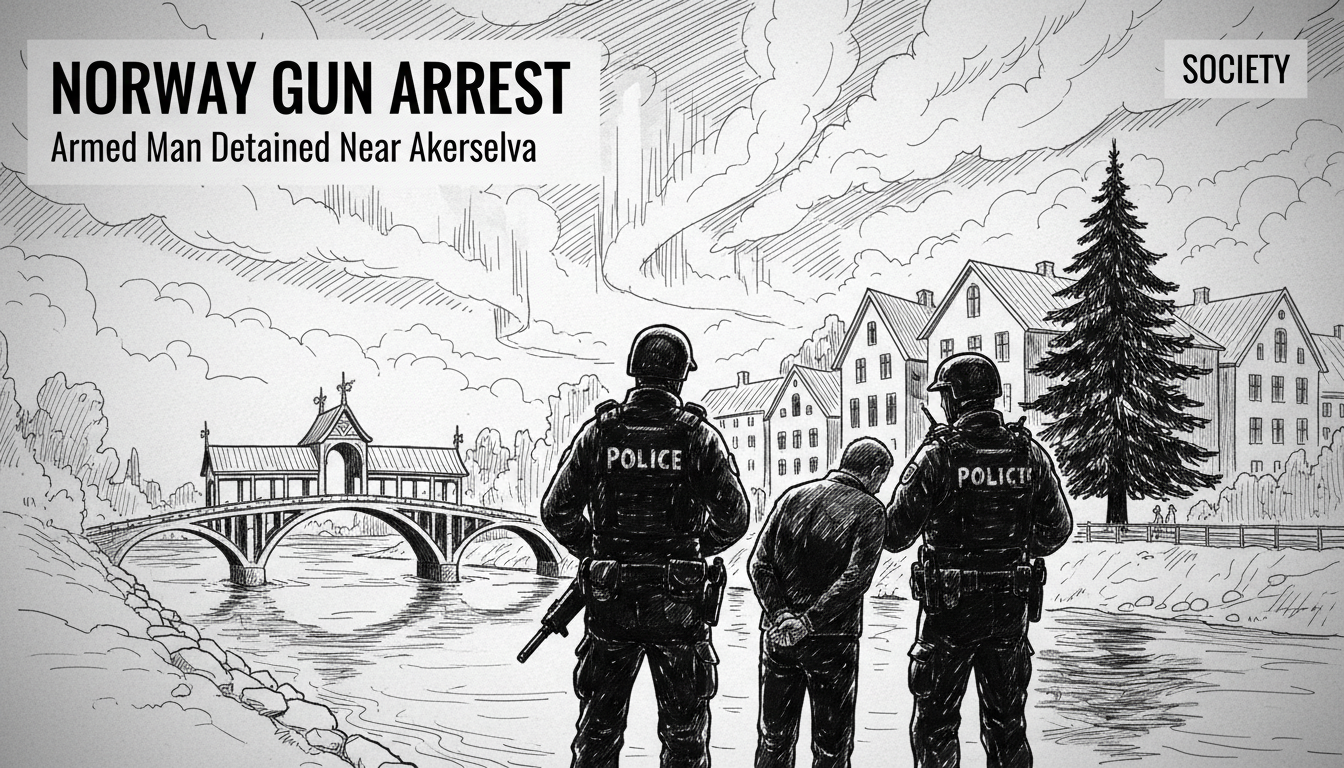
Norway's strict gun control laws faced a public test after police arrested a man carrying a loaded firearm near the Akerselva river in central Oslo. The incident, which triggered a rapid police search and the detention of three individuals, occurred in the popular Grünerløkka district on a weekday evening. While no one was threatened or injured, the discovery of a live weapon in a public urban space has reignited discussions about public safety and illegal arms.
“One of them was carrying a loaded handgun,” said operations leader Bjørn Gunnar Nysæter of the Oslo Police District. Officers moved quickly after reports of loud bangs near the river. They located and apprehended three men within a short time. The armed suspect was taken into custody and the weapon seized. A second man in the group was reported to authorities for carrying a knife in a public area.
A Swift Police Response in a Busy District
The police operation unfolded along the banks of the Akerselva, a waterway that cuts through a densely populated area of cafes, apartments, and parks. Grünerløkka is known for its vibrant street life, making the presence of a firearm particularly alarming for residents. The police have not released a motive for why the man was armed, nor have they specified the type of handgun recovered. An investigation is ongoing.
This type of incident, while rare in the Norwegian context, triggers an immediate and substantial police response. Norwegian law enforcement protocols treat any report of a firearm in public as a high-priority situation. The successful detention without violence or injury highlights the operational training focused on de-escalation. The man arrested for the firearm faces charges of illegal weapons possession, a serious criminal offense.
The Framework of Norwegian Firearm Regulation
To understand the gravity of this arrest, one must examine Norway's comprehensive gun control framework. Ownership is not banned, but it is heavily regulated through a licensing system managed by the police. Applicants must demonstrate a valid purpose, such as hunting, sport shooting, or professional need. Self-defense is not considered a legal grounds for obtaining a firearm permit in Norway.
Prospective owners undergo rigorous background checks, including assessments of criminal records, mental health history, and any history of violence. They must also complete mandatory safety and proficiency courses. All firearms must be stored securely in an approved gun safe, with ammunition stored separately. The laws apply equally to handguns and long guns, making the casual carrying of a loaded pistol a clear and serious breach.
“The system is designed for trust and verification,” explains Lars H. Svendsen, a researcher in criminology at the University of Oslo. “It operates on the principle that firearm ownership is a privilege granted for specific activities, not a universal right. An event like this in central Oslo is shocking precisely because it is so at odds with the normal, regulated environment.”
Statistics in a Nordic Context
Norway has a high rate of legal gun ownership per capita, estimated at around 27 firearms per 100 people according to the Small Arms Survey. This figure is largely driven by the country's strong hunting and sports shooting traditions, particularly in rural areas. However, this does not translate to high rates of gun violence. Homicides involving firearms are statistically low, with most gun deaths attributed to suicide or rare, isolated incidents.
This creates a distinct societal profile: widespread, legally-held firearms in the countryside, contrasted with near-zero tolerance for illegal guns in cities. The arrest at Akerselva represents a breach of that urban norm. Comparative data shows Norway's rates of firearm homicide remain a fraction of those in the United States and are comparable to or lower than several other European nations with stricter ownership models.
Expert Analysis on Urban Security and Illicit Markets
Security analysts point to this incident as a potential indicator of broader concerns. While isolated, the presence of a loaded handgun in a capital city neighborhood suggests some level of illicit arms circulation. “The key question for police will be tracing the origin of this weapon,” says security consultant Anna Pedersen. “Was it smuggled into the country, stolen from a legal owner, or converted from a blank-firing model? The answer determines the scale of the challenge.”
Experts note that most illegal firearms used in crimes in Scandinavia are often old weapons or reactivated models, not new weapons smuggled through organized crime rings on a large scale. However, any breach of the strict control system is treated with utmost seriousness. The police will likely pursue charges to the fullest extent, which can result in significant prison sentences for illegal possession of a firearm in a public place.
Community Reaction and the Balance of Safety
In Grünerløkka, the incident has provoked a mix of reassurance and unease. Residents expressed gratitude for the swift police action but concern that a gun was present at all. “You hear about these things in other countries, but it feels alien here,” said one local shop owner, who declined to give his name. “It’s a reminder that we cannot take our safe society for granted.”
This tension lies at the heart of Norway's approach. The country balances a cultural acceptance of responsible, regulated gun ownership with an uncompromising stance on public safety threats. The system relies on high levels of social trust and compliance. When that compliance breaks down, as in this arrest, the legal and social consequences are severe.
The debate in Norway rarely focuses on dismantling the legal ownership framework for hunters and sport shooters. Instead, it centers on ensuring police have adequate resources to monitor compliance and combat illicit trade. There are also ongoing discussions about tightening regulations around certain types of semi-automatic weapons following past national tragedies, though these are separate from typical criminal possession cases.
Looking Ahead: Investigation and Implications
The immediate next steps lie with the Oslo Police District's investigation. Forensic analysis of the weapon, interviews with the detained individuals, and a review of local CCTV footage will form the core of the case. Prosecutors will decide on formal charges in the coming weeks.
On a policy level, the incident may fuel calls for increased police patrols in urban parks and along recreational waterways like the Akerselva. It may also lead to renewed scrutiny of how well the legal storage requirements for firearms are being enforced nationwide, to prevent thefts that feed the illegal market.
Ultimately, the Akerselva arrest serves as a stark reminder. Even in one of the world's safest nations, the threat of gun violence cannot be entirely eliminated. It underscores the perpetual work required to maintain public security. Norway's model, built on control and consequence, will now be tested in a courtroom, as the state seeks to uphold the rules that define its relationship with firearms. The outcome will send a clear message about the price of violating one of the country's fundamental public safety covenants.