
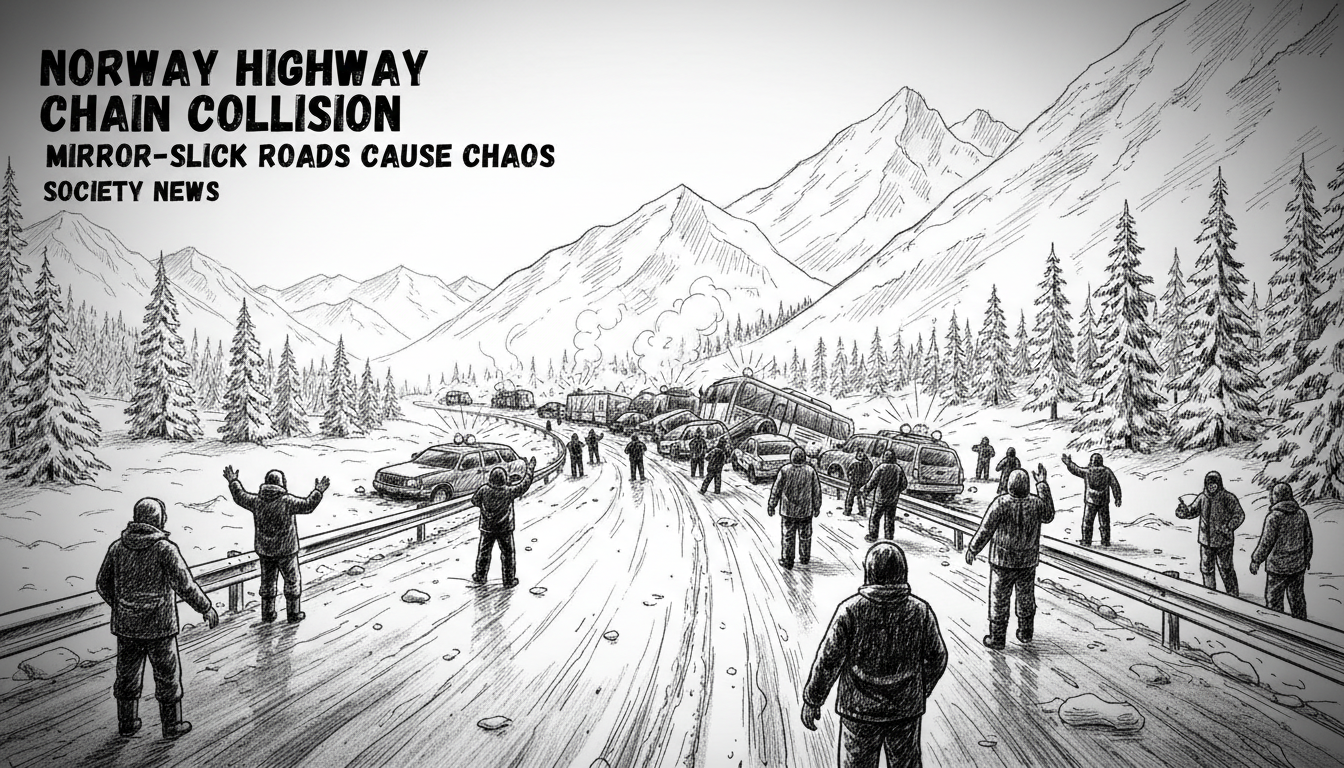
Norway’s Riksveg 4 highway near Gjøvik became the scene of multiple crashes Thursday morning as treacherous, icy conditions took drivers by surprise. A serious chain collision involving a truck and two cars was reported alongside a separate vehicle running off the road, according to traffic authorities who described the surface as 'speilblankt' – mirror-slick.
Trafikkoperatør Jeanette Andresen confirmed the incidents occurred in the southbound lanes roughly four kilometers south of Gjøvik’s center. "We have received several reports from people stating the road is mirror-slick," Andresen said. "We have notified the contractor." The proximity of the two incidents suggests a concentrated stretch of dangerously untreated ice on a major national artery.
Emergency services responded swiftly to the crashes. Initial reports indicated no critical injuries, though such multi-vehicle collisions on high-speed roads carry significant risk. The accidents caused substantial delays during the morning commute, stranding motorists and requiring police and tow trucks to secure the area.
A Recurring Winter Hazard on a Critical Route
Riksveg 4 is no ordinary road. It forms a crucial segment of the primary highway connecting Oslo to Trondheim, threading through the challenging terrain of the Oppland region. The stretch near Gjøvik, a city of approximately 30,000, sees heavy commuter and commercial traffic daily. When conditions deteriorate here, the ripple effects are felt across the regional transport network.
Thursday’s incidents underscore a persistent, annual challenge for Norway. Despite world-class infrastructure and winter preparedness, the battle against ice is relentless. The Norwegian Public Roads Administration, Statens vegvesen, states that road conditions are a direct contributing factor in about 30% of all traffic accidents nationally.
This statistic translates to thousands of incidents each winter. The economic toll is immense. Annual winter road maintenance, encompassing salting, sanding, and plowing operations, costs the Norwegian state billions of kroner. Yet, as this crash demonstrates, localized failures in timing or coverage can have immediate, dangerous consequences.
The Science and Strategy of Fighting Ice
Why do these 'speilblankt' conditions occur, even on maintained roads? Experts point to several factors. A common cause is freezing rain or wet snow that melts on contact with a relatively warm road surface, only to refreeze rapidly as temperatures drop. This creates a thin, transparent layer of ice – black ice – that is notoriously difficult for drivers to spot until it is too late.
Bridges and shaded sections of road, like forested areas near Gjøvik, are particularly susceptible as they lose heat faster than exposed ground. The timing of maintenance is critical. Contractors must anticipate temperature shifts and apply salt or brine solutions proactively; salt loses effectiveness below -7°C to -9°C, necessitating a switch to sand or gravel for pure friction.
"The goal is anti-icing, not just de-icing," explained a veteran road engineer with the administration, speaking on standard protocol. "We aim to prevent the bond between ice and pavement from forming. But weather is unpredictable, and resources are spread across thousands of kilometers. Sometimes, nature wins a round."
Driver Responsibility in the 'Speilblankt' Season
While authorities bear the responsibility for maintenance, road safety experts stress that driver behavior is the final, critical layer of defense. The Norwegian Automobile Federation (NAF) continuously campaigns for three key winter practices: fitting proper winter tires with adequate tread depth, significantly reducing speed in adverse conditions, and dramatically increasing following distance.
On a 'speilblankt' road, stopping distances can increase tenfold compared to dry asphalt. A safe two-second gap becomes utterly insufficient. Many local drivers, while experienced with winter, can become complacent on familiar routes like Riksveg 4.
"Technically, we are required to have winter tires, but the legal minimum is not always the safe minimum," said traffic psychologist, Dr. Lisa Holm. "Adaptation is key. Drivers must understand that the posted speed limit is for ideal conditions. When roads are icy, a safe speed may be half that or less. It’s about control, not just legality."
The chain-reaction nature of Thursday’s collision highlights another peril: even if one driver manages to control their vehicle, they remain at the mercy of those behind them. A single sudden brake check on ice can initiate a catastrophic sequence, especially with a heavy truck in the mix.
A Systemic Pressure Point
The Gjøvik incident reveals a systemic pressure point. Riksveg 4, while a national highway, does not have the same continuous monitoring or intensive treatment schedule as the E6 motorway. It represents a category of essential, yet sometimes secondary, routes where response to rapidly changing conditions can be slower.
Local municipalities and regional road authorities operate with fixed budgets and prioritize based on traffic volume forecasts. A sudden, localized freeze in a specific morning hour can outpace the contractor's schedule. Trafikkoperatør Andresen’s statement about notifying the contractor confirms the reactive phase had begun.
Investments in better weather station networks and road sensors aim to improve forecasting. Some major roads now use automated weather-dependent warning signs. However, covering every vulnerable curve and hollow remains a monumental logistical and financial challenge.
The Aftermath and the Long Road Ahead
Following the crashes, cleanup and investigation commenced. Police will typically determine if excessive speed for conditions or insufficient following distance were formal factors. The road contractor’s logs for salting and sanding on that stretch will be reviewed.
For Norway, a nation rightly proud of its ability to function through long winters, these events are a sobering annual reminder. They spark public debate about maintenance budgets, tire regulations, and the feasibility of even stricter winter driving laws.
The conversation often turns to technology. Could smarter, connected vehicles with ice-detection sensors and automatic emergency braking mitigate such collisions in the future? Perhaps. But for now, the combination of vigilant maintenance, informed driving, and respect for the raw power of winter weather remains the essential formula.
The crashes on Riksveg 4 near Gjøvik were not an anomaly. They are a data point in Norway’s ongoing negotiation with its climate. As the winter deepens, hundreds of similar 'speilblankt' patches will form on roads across the country. The question is not if, but where, the next call will come into the Vegtrafikksentralen.