
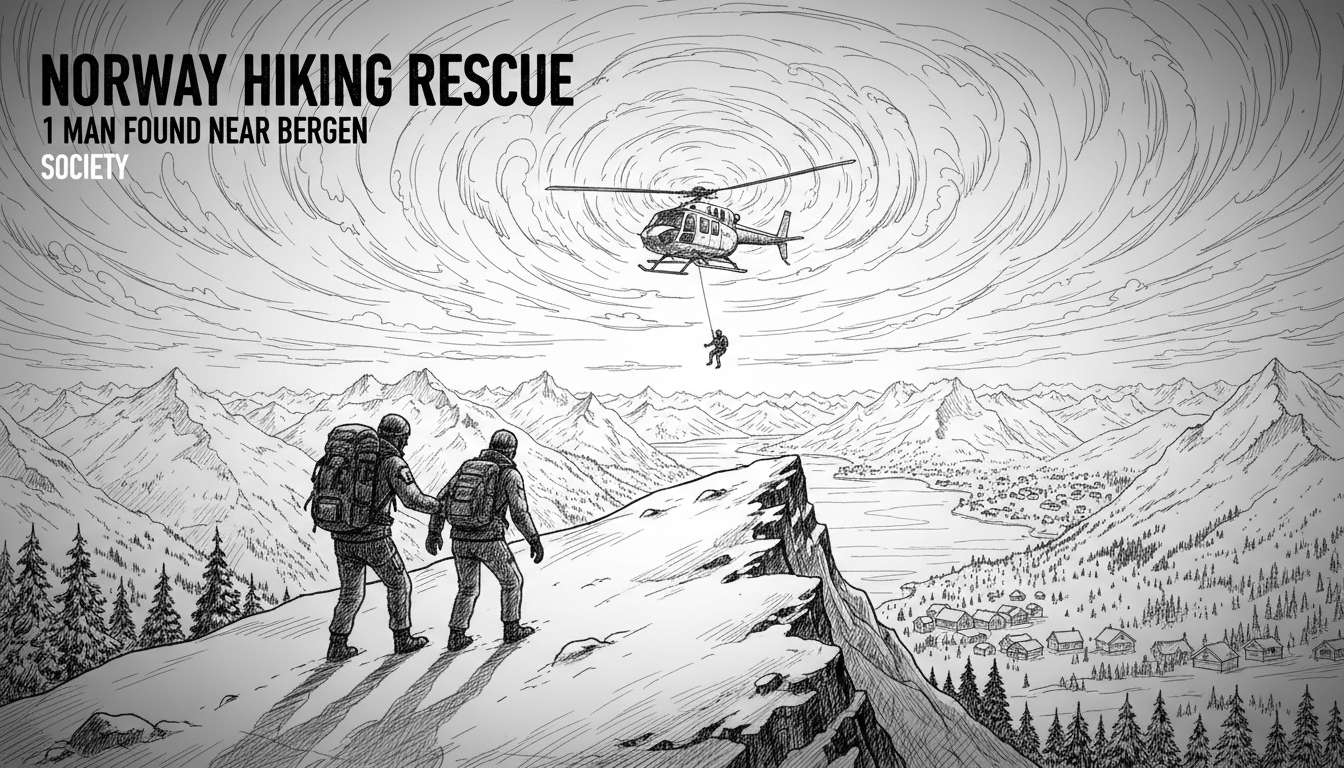
Norway search and rescue teams located a missing hiker Wednesday night in the mountains between Ulriken and Fløyen near Bergen. The man, who called for help himself just after 6:30 PM, was found cold but otherwise unharmed after a three-hour operation involving police, volunteer rescue groups, and dog teams.
"It was the missing person himself who called in just after 6:30 PM," said operations leader Bjarte Rebnord of the West Police District. Rescue personnel made contact with the man by 9:39 PM. "He appears to be cold, but otherwise unharmed," Rebnord wrote in an update. The operation was launched under difficult conditions, with Rebnord earlier reporting poor weather and demanding terrain for rescue crews.
A Coordinated Response in Challenging Terrain
The rescue effort mobilized a swift, multi-agency response characteristic of Norway's integrated emergency system. Alongside a police dog patrol, volunteers from the Norwegian Red Cross (Røde Kors), Norwegian People's Aid (Norsk Folkehjelp), and Norwegian Rescue Dogs (Norske Redningshunder) were deployed. Teams were transported up the mountain using the Ulriksbanen cable car to access the search area more efficiently.
The terrain between Ulriken and Fløyen, two of the iconic 'seven mountains' encircling Bergen, presents specific challenges. While popular with hikers for their panoramic city views, the routes can be deceptive. Weather conditions can deteriorate rapidly, transforming a clear summer path into a foggy, cold, and disorienting landscape. This incident underscores a recurring theme in Norwegian outdoor safety: preparation is non-negotiable, even on trails close to urban centers.
The Backbone of Norwegian Rescue: Volunteers
This operation highlights the critical role of volunteer organizations in Norway's search and rescue (SAR) framework. The Norwegian Red Cross, Norwegian People's Aid, and Norwegian Rescue Dogs are not auxiliary support; they are fundamental operational pillars. These groups provide highly trained personnel, specialized equipment, and invaluable local knowledge.
Their involvement is coordinated through the Joint Rescue Coordination Centres (JRCC), which act as the national nerve center for all SAR operations. In 2022 alone, Norway's JRCCs coordinated over 3,000 search and rescue missions. This high number reflects both Norway's vast, accessible wilderness and its deeply ingrained outdoor culture, where approximately 60% of the population hikes regularly.
"The volunteer effort is what makes the Norwegian system so robust and responsive," says Lars Fjelde, a former JRCC coordinator now teaching emergency management at the University of Stavanger. "These individuals train consistently, often using their own time and resources. When a call comes in, they are ready to deploy alongside police and military assets. It's a seamless public-private partnership that saves lives."
The Hiker's Call: A Critical Decision
A key factor in this successful outcome was the hiker's own action: he called for help. This may seem obvious, but experts note that lost or distressed individuals often delay calling, hoping to rectify the situation themselves until it worsens.
"The moment you realize you are lost or in trouble, that is the time to call for help," advises Kari Nordseth, head of safety training for the Norwegian Trekking Association (DNT). "Battery life on your phone is a critical resource. Use it to make that emergency call to 112, then conserve it by following instructions from rescue coordinators. Trying to 'tough it out' or navigate alone in poor conditions exponentially increases risk."
The hiker's ability to call also suggests he had his mobile phone with him and was within coverage range—a fortunate but not guaranteed circumstance in Norwegian mountains. This incident will likely renew discussions about the importance of carrying additional emergency beacons, such as personal locator beacons (PLBs) or satellite messengers, for ventures into remote terrain, even near cities.
Weather: The Unpredictable Variable
Operations leader Bjarte Rebnord's early report of "poor weather and demanding conditions" is a standard note in Norwegian rescue logs. Bergen's coastal climate is famously wet and changeable. The microclimates on mountains like Ulriken and Fløyen can differ drastically from the weather in the city center below.
A sunny start to a hike can give way to dense fog, driving rain, and plunging temperatures within an hour. This not only increases the risk of hypothermia for an ill-prepared hiker but also complicates search efforts, limiting visibility for both ground teams and any potential aerial support.
"Checking the detailed mountain forecast, not just the city forecast, is a fundamental step too many people skip," Nordseth emphasizes. "You must prepare for the worst conditions possible for that altitude and season, not the conditions you hope for."
Prevention and Preparedness: A National Conversation
Every rescue operation in Norway sparks a parallel public conversation about prevention. The country's 'friluftsliv' (open-air life) tradition is a cherished part of national identity, but it comes with an inherent responsibility.
The core safety advice from all Norwegian authorities remains consistent: 1) Plan your trip and inform someone of your route and return time. 2) Adapt the trip to your ability and the conditions. 3) Pay attention to weather and avalanche forecasts. 4) Be prepared for bad weather and frost, even on short trips. 5) Bring the necessary equipment to help yourself and others.
For a day hike on Bergen's mountains, this essential equipment includes sturdy footwear, wind- and waterproof clothing, extra warm layers, a headlamp, a map and compass (not solely a phone), food and water, and a simple first-aid kit.
The Economic and Human Cost of Rescue
Norway does not typically charge individuals for the cost of rescue operations, a policy grounded in the principle that fear of a bill should never deter someone from calling for help. This philosophy prioritizes human life and enables the swift response seen in the Bergen case.
The costs are instead borne by the public sector and the volunteer organizations themselves, which rely on government grants and private donations. This system reinforces the collective societal commitment to outdoor safety. However, it also places a moral obligation on every hiker to be as prepared as possible, minimizing unnecessary risks that strain these shared resources.
A Successful Outcome with Lasting Lessons
The Bergen rescue concluded successfully. A man was found, cold and likely shaken, but physically unharmed. The system worked as designed: a coordinated, professional, and volunteer-powered response overcame difficult conditions to bring him to safety.
Yet, the incident serves as a timely reminder as the summer hiking season approaches. Norway's breathtaking nature is accessible to all, but it demands respect. The mountains, even those overlooking a bustling city, are not a tame park. They are a wilderness where conditions rule.
As the rescued hiker recovers, the broader lesson resonates for the thousands who will lace up their boots this weekend: the line between a memorable adventure and a emergency call is often drawn by preparation. In a nation defined by its relationship with the outdoors, that preparedness is not just personal responsibility—it's a cultural imperative.