
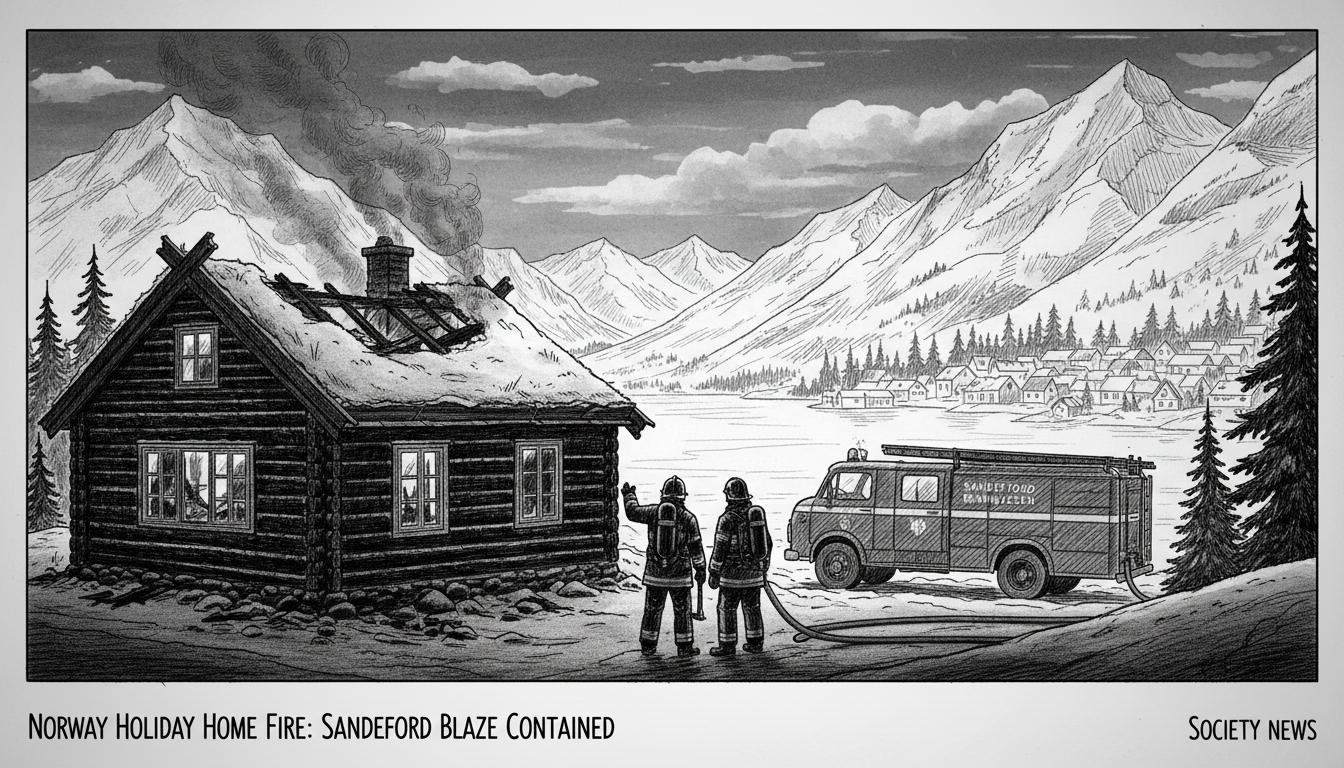
Norway's coastal municipality of Sandefjord saw a holiday home fire in the Asnes area brought under control by emergency services on Tuesday evening. The blaze, which caused significant smoke damage to the property, was extinguished with no injuries reported. Police confirmed the building was unoccupied at the time, averting a potential tragedy in the popular summer destination.
Flames engulfed the wooden structure, prompting a swift response from the Sandefjord Fire and Rescue Service. Operations leader Eskil Hagen Olsen stated the property was a feriebolig, or holiday home, a common feature in Norway's coastal communities. Firefighters conducted a thorough search of the building upon arrival, confirming no persons were inside. The fire was declared under control by 6:18 PM, with the scene secured and the area cordoned off. Police concluded their on-site investigation by 8:43 PM.
A Narrow Escape in a Seasonal Community
The incident highlights a recurring seasonal risk across Norway. Thousands of secondary homes, often constructed from wood and left vacant for long periods, dot the coastline from the Oslofjord to the Arctic north. "A fire in an unoccupied home can develop for a considerable time before detection," said Lars Holm, a former fire safety inspector now with the Norwegian Directorate for Civil Protection (DSB). "This lack of early warning is the greatest danger. The outcome in Sandefjord, with no lives lost, is the best possible scenario under the circumstances."
Initial reports indicate the house sustained primarily smoke damage, though the structural integrity and full extent of the loss remain unconfirmed. The cause of the ignition is unknown and will be subject to a standard investigation. Common culprits in such cases include electrical faults in older wiring, issues with heating systems activated after a winter dormant period, or accidental ignition from nearby sources.
The Unique Fire Risks of Norway's Feriebolig Culture
Norway's tradition of the hytte (cabin) or seaside holiday home is deeply ingrained, but it presents distinct safety challenges. Many such properties are decades old, built to different codes, and located in remote areas with longer emergency response times. They are frequently heated with wood-burning stoves and may have electrical systems that have not been modernized. Furthermore, their intermittent use means potential problems like rodent damage to wiring or faulty appliances can go unnoticed.
"We consistently advise owners to conduct a basic safety check each season," Holm explained. "This includes testing all smoke detectors—which are legally required—inspecting electrical outlets and cords for damage, ensuring heating equipment is clean and functional, and clearing vegetation from around the structure. For a nation that loves its cabins, a small investment in prevention is critical."
Fire safety regulations in Norway mandate interconnected smoke alarms in all residential buildings, including holiday homes. However, compliance and maintenance in seldom-used properties can be inconsistent. The Sandefjord fire will likely renew calls from safety advocates for increased public awareness campaigns targeting secondary homeowners before the peak summer season.
Sandefjord's Maritime Character and Tourist Appeal
The fire occurred in Sandefjord, a municipality in Vestfold county with a storied maritime history. Once a global epicenter of the whaling industry, the city now capitalizes on its coastal charm and ferry connections to Sweden and Denmark as a major tourist draw. The Asnes area, like many parts of the municipality, contains a mix of permanent residences and holiday homes used by locals and visitors from Oslo, just over an hour's drive north.
This incident, while localized, touches on broader issues of property safety and emergency preparedness in Norway's tourist regions. Local municipalities bear the responsibility of maintaining fire services capable of covering both dense urban areas and scattered, remote properties. A fire in a holiday home, if left to spread, could threaten nearby forests or other structures, especially during dry periods.
Investigation and Aftermath: What Comes Next?
With the fire out, the focus shifts to investigation and insurance. A fire technical investigator will examine the scene to determine the point of origin and the likely cause. This process can take days or weeks, depending on the damage. The homeowner will work with their insurance company to assess the loss; most standard Norwegian home insurance policies (innboforsikring and byggforsikring) cover fire damage, even to secondary homes.
The psychological impact of such an event should not be underestimated, even with no physical injuries. "Losing a holiday home is losing a place of memories, family gatherings, and relaxation," noted psychologist Kari Nilsen, who has studied disaster recovery. "It's a deeply personal loss. The sense of safety and retreat associated with that place is violently disrupted."
For the local community in Asnes, the event serves as an unwelcome reminder of vulnerability. Neighbors will likely review their own safety measures, checking detector batteries and considering fire extinguisher placements. The sight of emergency vehicles in a quiet residential area is a jarring one, disrupting the peace that defines these coastal communities.
A National Conversation on Prevention
While this single fire in Sandefjord was efficiently handled, it opens a conversation on a national scale. Does Norway's cherished cabin culture come with acceptable risk? Are regulations for secondary homes stringent enough, and is compliance adequately monitored? The Norwegian Building Authority (DiBK) periodically updates technical regulations, but applying new standards to existing, older structures remains a complex challenge.
Experts suggest practical steps beyond regulation. "Community watch initiatives in holiday home areas can be effective," proposed Lars Holm. "If a neighbor notices something amiss—a broken window, an unusual smell—they should feel empowered to contact the owner or local authorities. It’s about building a culture of collective vigilance."
Technology also offers solutions. Smart smoke detectors that send alerts to a homeowner's phone, regardless of location, are increasingly affordable. Remote monitoring systems for temperature and humidity can also provide early warnings of potential problems like freezing pipes or electrical faults.
The fire in Sandefjord ended as a property damage incident, not a human tragedy. For that, the emergency services deserve credit. But it stands as a cautionary tale for the hundreds of thousands of Norwegians who will soon open their summer homes. The crackle of a welcoming fireplace should never be confused with the sound of something going terribly wrong. As the investigation continues quietly in Asnes, the question for every holiday homeowner is simple: When was the last time you did a safety check?