
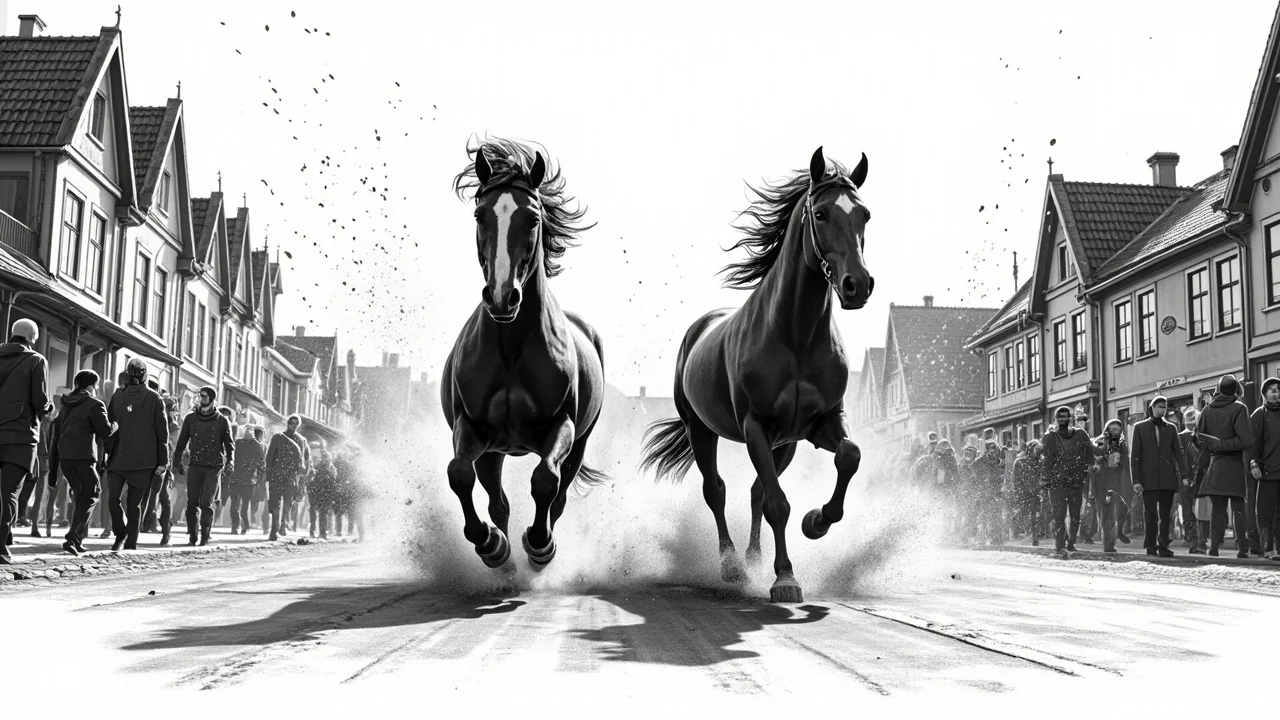
Norway's Saturday evening traffic faced an unusual disruption when two horses escaped their enclosure and ran loose through the streets of Moss. The Øst police district received multiple calls around 6 PM reporting the animals causing trouble near the Rygge Storsenter shopping center. "They are running around and creating trouble in traffic," wrote operations manager Håkon Hatlen in the police log, capturing the immediate concern for both animal and public safety.
The horses, according to police tracking, originated from the Bredsand area and were moving toward the Øreåsen district. For forty-five minutes, the animals navigated the urban landscape of the coastal town, a municipality of over 50,000 residents just south of Oslo. The incident forced drivers to slow down and stop, creating unexpected congestion on what is typically a busy weekend evening. The situation highlighted the unpredictable nature of animal control in communities where urban and semi-rural environments meet.
A Search Concludes at a Preschool
Police located both horses relatively quickly, but the resolution carried a note of irony. One of the escapees sought refuge in a most fitting location: a local barnehage, or preschool, on Øreåsen. Images published by the police showed the horses, seemingly calm but out of place against the backdrop of playground equipment and a quiet residential area. The visual underscored the surreal scene that unfolded in the normally orderly Norwegian community.
With the animals secured but their ownership unknown, police turned to the public. "If anyone knows who owns the horses, it would be good if the police are contacted," Hatlen stated in a follow-up log entry. The appeal was necessary; while microchipping is common for pets like dogs and cats in Norway, the regulations for equine identification are less uniformly enforced for all private owners, creating a potential gap in rapid owner identification.
Owner Located, Questions Remain
The public appeal worked. Shortly after the request, police confirmed they had spoken with the horse's owner. "She is on her way to the site to retrieve the horses," the police reported, bringing the active incident to a close. The owner's arrival likely involved coordinating with local animal handlers or veterinarians to safely transport the animals back to their stable at Bredsand.
While the episode ended without reported injury to the horses, motorists, or pedestrians, it prompts a review of local protocols. The Moss municipality, part of Viken county, has specific regulations concerning livestock and fencing. Incidents like this often trigger inspections by the Mattilsynet, the Norwegian Food Safety Authority, which holds responsibility for animal welfare, to determine if negligence or faulty infrastructure led to the escape.
Analysis: When Rural Life Meets Urban Sprawl
This incident in Moss is not an isolated one in Norway. Similar escapes involving horses, cows, and sheep are reported periodically, particularly in municipalities experiencing growth where former agricultural land is now adjacent to new housing developments and shopping centers. The clash between traditional rural livelihoods and modern suburban expansion creates unique public safety challenges.
"These events serve as a reminder that our infrastructure and emergency response plans must account for more than just human-caused incidents," says Lars Holm, a former police officer and now a security consultant focusing on municipal planning. "For a town like Moss, with its mix of industry, residential areas, and remaining farmland, a loose large animal is a significant traffic hazard that requires specific resources to manage safely."
Police response in such cases is measured. The priority is always to secure public safety by controlling traffic and warning drivers, followed by a calm containment of the animals to prevent them from becoming distressed and causing further danger. Using patrol cars as barriers and employing officers trained in basic animal handling are standard first steps. In more complex cases, they may call upon local farmers or veterinarians with specialized equipment.
The Broader Context of Animal Welfare
Beyond traffic, the escape touches on Norway's strict animal welfare laws. The Animal Welfare Act mandates that owners provide environments that prevent escapes, as a loose animal is at high risk of injury and causes stress. An investigation may assess whether the fencing at the Bredsand property was adequate. If deemed insufficient, the owner could face an order to make improvements or, in rare cases of repeated neglect, a fine.
Norwegians generally hold a deep-seated respect for animals, rooted in both cultural tradition and robust legislation. The public's reaction to such news is typically a blend of concern for the animals' well-being and mild amusement at the disruption to daily order. The sight of a horse outside a preschool captures a whimsical contradiction that resonates in a society highly valuing both safety and a connection to nature.
Looking Ahead: Prevention and Preparedness
The Moss horse escape will likely conclude with the animals safely home and the owner reviewing her fencing. For local authorities, however, it may prompt a brief review. Municipal crisis plans, often focused on floods, fires, or major accidents, rarely detail procedures for loose livestock. Yet, as this event shows, they can effectively halt local traffic and tie up police resources.
Some Norwegian municipalities with significant agricultural presence have informal networks of farmers who can be called upon to assist police. Establishing or formalizing such a volunteer resource is a low-cost measure that enhances community preparedness. Furthermore, ensuring clear communication channels between police, the Mattilsynet, and local riding clubs or agricultural associations can streamline response.
For residents, the incident is a Saturday night story to share. For planners, it is a case study in the complexities of modern community management. The successful resolution—no injuries, owner found, animals safe—demonstrates a system functioning as intended. Yet, it also poses a quiet question: as Norway's urban areas continue to expand, how do communities best preserve their character while mitigating the unique risks that come with it? The image of a horse finding temporary sanctuary in a preschool yard is a poignant symbol of that ongoing negotiation between the old Norway and the new.