
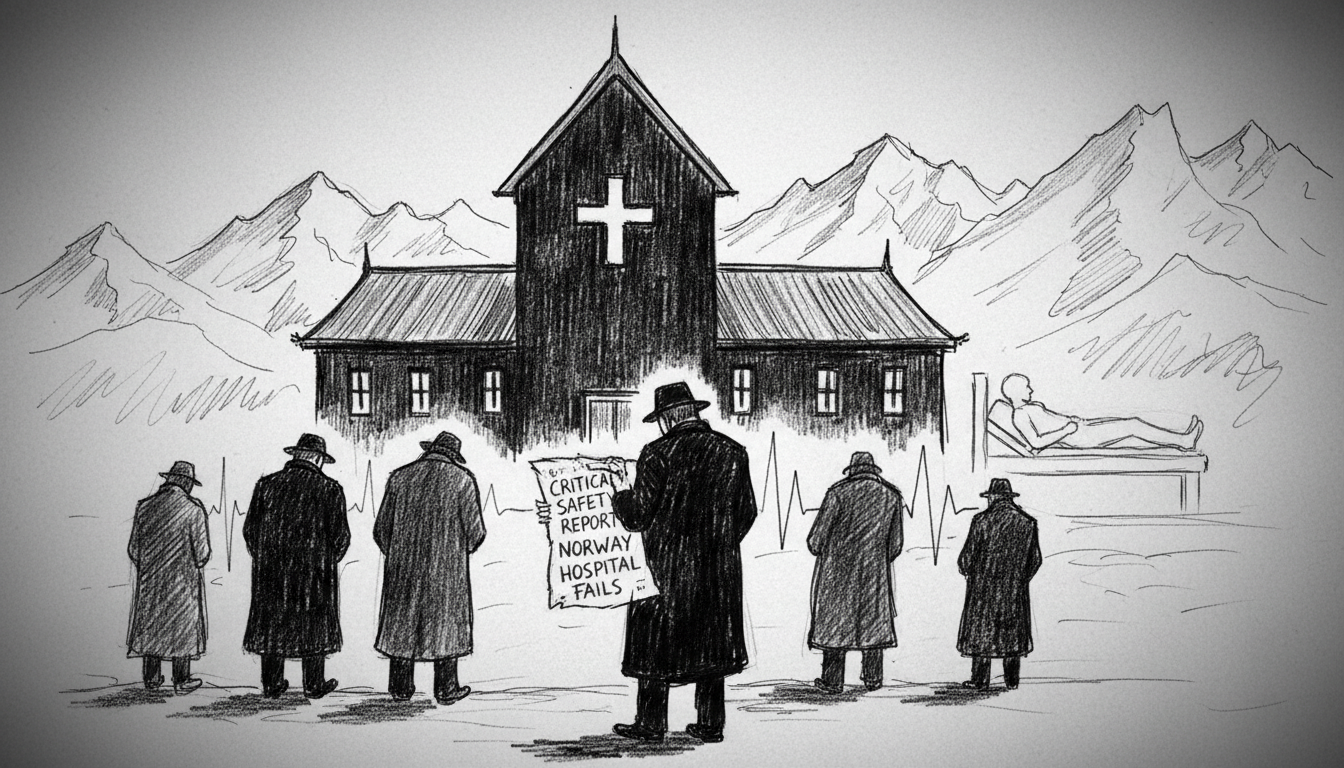
Norway's Sørlandet Hospital has failed to protect patients in Arendal, according to a damning confidential report from the national health watchdog. The Norwegian Board of Health Supervision states the hospital has not learned from a prior major scandal involving an unqualified surgeon, leaving patient safety directly threatened. This conclusion comes from a supervisory report, previously withheld from the public, obtained by press.
The case centers on a long-standing failure at Sørlandet Hospital's gastro-surgical unit in Arendal. For years, a surgeon worked there as a senior consultant in gastro surgery. Hospital management knew the doctor lacked the formal specialist qualification for that specific surgical field. The Norwegian Board of Health Supervision’s new investigation finds the hospital's subsequent reforms and internal controls remain insufficient to prevent similar breaches.
A Scandal Repeated, Not Resolved
This is not the first time Sørlandet Hospital has faced scrutiny over this individual, in what is known locally as the 'Flekkefjord case.' The initial revelation that a surgeon was practicing beyond their certified competence triggered a prior review. The new report delivers a stark verdict: the hospital's promised changes have been inadequate. Systemic weaknesses in management oversight, credential verification, and patient safety culture persist. “The hospital has not learned enough,” the supervisory authority concludes, indicating a breakdown in the fundamental duty of care.
“When a supervisory authority states that patient safety is threatened, it is the strongest possible condemnation of a hospital's management system,” says Lars Håvard Johnsen, a professor of health management at the University of Oslo. “It suggests the problem is not one rogue individual, but a structure that allows such failures to occur and then fails to correct them.” The report implies that the risk of similar incidents remains unacceptably high, eroding the foundational trust in Norway's publicly funded healthcare system.
The Fragility of Public Trust
Norway's healthcare model is built on the principle of equal and safe access for all citizens. Statens helsetilsyn, The Norwegian Board of Health Supervision, acts as the key guardian of that promise. Its reports are meant to be corrective tools. A finding that a hospital has ignored or poorly implemented prior directives strikes at the system's integrity. For patients in the Agder region, the report raises a disturbing question: if management knew about one unqualified surgeon for years, what other systemic checks are missing?
Experts point to a potential cascade of failures. These include human resource departments not rigorously validating qualifications, department heads failing to escalate concerns, and senior management not creating a culture where staff feel safe to report irregularities. “This is a textbook case of organizational failure,” notes Anna Forseth, a patient safety advocate with the Norwegian Association for Patient Safety. “It starts with ignoring a red flag about qualifications, but the real damage is done when the institution chooses to protect itself rather than fully investigate and reform. Transparency is the only antidote.”
The decision to initially keep the latest report from public access, using an exemption clause, adds another layer of concern. While such exemptions can be applied during an ongoing investigation, their use in cases of serious patient safety risks is controversial. It denies the public—and potential patients—the right to informed choice about their care provider.
A National System Under Scrutiny
The Sørlandet case is a litmus test for Norway's much-vaunted healthcare governance. The Board of Health Supervision has the power to issue orders and, in extreme cases, recommend sanctions against management or withdraw an institution's operating license. The report on Sørlandet Hospital will likely force the regional health authority, which oversees the hospital, to intervene more directly. Possible measures could include installing external monitors, mandating specific training for leaders, or demanding a complete overhaul of clinical audit processes.
The financial and human costs are significant. Beyond the immediate threat to patients who may have received care from an improperly qualified surgeon, the hospital faces reputational damage that can affect staff recruitment and public confidence. Past medical procedures may now need to be reviewed, a complex and distressing process for affected patients. The region's taxpayers ultimately bear the cost of investigations, mandated reforms, and potential legal liabilities.
The Path Forward for Sørlandet
For Sørlandet Hospital, the path forward is now prescribed by the supervisory authority. It must move beyond superficial compliance and enact deep cultural and procedural change. This involves not just rewriting protocols, but demonstrating that those protocols are alive in daily practice. Independent audits of staff qualifications across all specialist units would be a logical first step to restore confidence. Establishing a truly anonymous and protected internal reporting system for staff is another critical component.
The hospital's leadership faces intense pressure to communicate its corrective action plan clearly and publicly. “Management must now show not just that they are sorry, but that they are competent to fix this,” says Professor Johnsen. “That requires humility, clear timelines, and measurable goals. The next report from Helsetilsynet will not be about promises, but about verified results.”
The case underscores a universal challenge in healthcare: systems are only as strong as their weakest control. Norway’s system, often ranked among the world's best, is shown to be vulnerable when institutional complacency sets in. The patients in Arendal, and across Norway, rely on a chain of trust that links national policy to individual clinical practice. At Sørlandet Hospital, that chain has broken. Repairing it will require more than a new policy document; it demands a relentless, transparent commitment to putting patient safety above all else, starting today. Can a public hospital rebuild shattered trust, or will this case become a recurring footnote in Norway's healthcare history?