
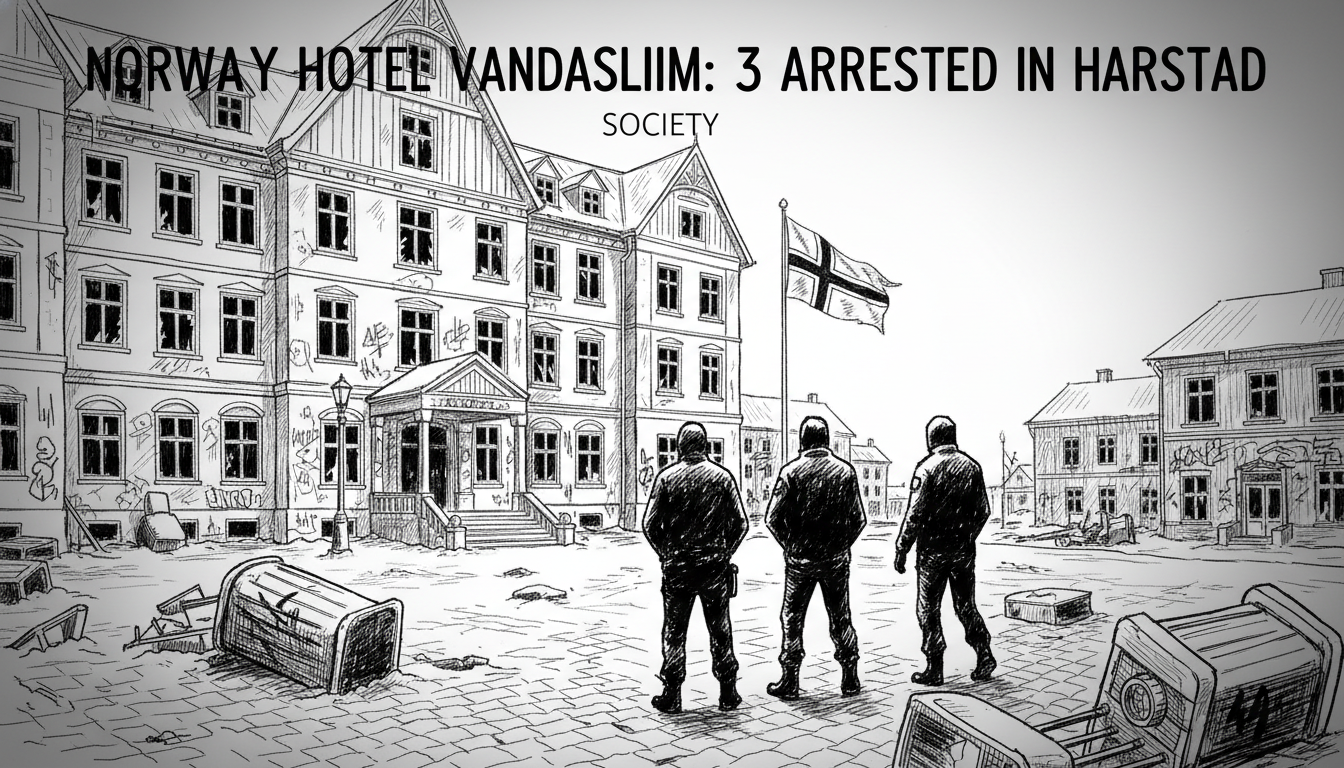
Norwegian police arrested three individuals after a birthday celebration at an F2 Hotel escalated into significant property damage, including a television thrown from a fourth-floor window. The incident occurred in Harstad, a key regional center in Northern Norway, challenging the area's reputation for low crime and public order.
Operational leader Karl Erik Thomassen from the Troms Police District confirmed the arrests in a statement. "We have reports of smashed furniture on several floors and a TV thrown from a window on the fourth floor," Thomassen said. "What we know so far is that there was a party on at least two rooms." Police patrols were on the scene at the hotel late Friday night, responding to multiple noise complaints throughout the evening. Thomassen indicated the police had been present earlier without incident before the situation intensified. "According to accounts, it was a birthday celebration that got out of hand," he added.
A Party Gone Wrong
The disturbance represents a stark departure from typical nighttime incidents in Norway's northern communities. Harstad, with a population of nearly 25,000, is better known for its maritime industries and scenic coastal setting than for violent hotel vandalism. The F2 Hotel, part of a larger chain, is a modern establishment catering to both business and leisure travelers. Damage extending across multiple floors suggests a level of disruption that went far beyond a simple noise complaint. The act of throwing a heavy object like a television from a significant height poses serious safety risks to anyone below, elevating the incident from mere mischief to a potentially dangerous public order offense.
The Police Response
The Troms Police District's log details a coordinated response. Authorities moved from handling initial noise complaints to making arrests and securing the premises. The swift detention of three suspects points to police finding clear evidence of involvement upon arrival. In Norway, vandalism ("skadeverk") is prosecuted under the Penal Code and can result in fines or imprisonment depending on the severity and value of the damage. The police did not immediately release the identities of those arrested or specify the exact charges, though investigations into the full extent of the damage are ongoing. Hotel management has not yet issued a public statement on the cost of repairs or operational impact.
Harstad: A Northern Hub
To understand the context, one must look at Harstad itself. The city is situated on Hinnøya island in Troms og Finnmark county. It serves as an important commercial and service hub for the region, hosting the annual Norwegian Festival of Chamber Music and possessing a robust coastal economy linked to fisheries, offshore supply, and lately, green energy projects. The community is generally tight-knit, with crime statistics far lower than international averages. Such a public and destructive event therefore resonates more deeply locally, raising questions about seasonal tourist behavior and local nightlife oversight.
Expert Perspective on Norwegian Crime
"This type of incident is statistically rare in Norway, particularly outside major urban centers like Oslo or Bergen," notes Dr. Lena Larsen, a criminologist at the University of Tromsø. "Norway's crime rates are consistently among the lowest in the world, with a strong emphasis on public safety and social order. When isolated events like this occur, they often involve a confluence of factors—typically alcohol consumption, group dynamics, and a failure of private security or personal restraint." Dr. Larsen points out that hotel vandalism carries substantial financial penalties for perpetrators, as Norwegian law requires full compensation for damages. "The response is typically swift and pragmatic: apprehend those responsible, assess the costs, and restore order. The system is designed to be efficient rather than overly punitive, but it does not tolerate property destruction."
Alcohol and Disorder
While not explicitly confirmed by police in the initial report, expert context strongly suggests alcohol was a factor in the escalating birthday festivities. Norway maintains strict regulations on alcohol sales through the state-owned monopoly Vinmonopolet for spirits and regulated hours for beer sales. However, consumption in private settings, such as hotel rooms, is less controlled. "There's a recognized pattern where gatherings intended as private celebrations spill over into public nuisance and damage," says Harald Jensen, a former police officer and security consultant for the hospitality sector. "Hotels face a constant challenge in monitoring guest behavior without infringing on privacy. This incident will likely prompt reviews of security protocols and guest supervision during late hours, even in smaller cities."
Community and Commercial Fallout
The incident's impact extends beyond police logs. For local residents, it tarnishes the quiet reputation of their community. For the hotel brand, it involves insurance claims, repair work, and potential reputational damage that could concern future guests. The F2 Hotel chain, which operates several properties across Norway, now must manage the fallout. Tourism in Northern Norway, a growing sector centered on Northern Lights viewing and Arctic adventures, relies heavily on perceptions of safety and tranquility. A viral story about chaotic vandalism runs counter to that marketed serenity.
Norway's approach to such incidents blends judicial consequence with restorative principles. The arrested individuals will likely face charges of vandalism and disturbing public order. They will be held financially liable for all damages, a sum that could reach tens of thousands of kroner given the description of "smashed furniture" on multiple floors and the destroyed television. This emphasis on restitution is a cornerstone of the Norwegian justice system.
As the police investigation continues, the story serves as a reminder that even in societies with remarkably low crime, human behavior can sometimes defy the norm. The quiet streets of Harstad witnessed an unusually disruptive night, prompting a firm institutional response. The event will likely become a case study for local hoteliers and police on coordinating to prevent private parties from becoming public problems. For now, the community awaits the full accounting of the damage and the judicial process for those involved, hoping this remains an isolated deviation from the peaceful Arctic norm.
What does this rare breach of Norway's famed public order reveal about the challenges of maintaining social harmony in an era of increasing tourism and private celebration? Only the consistent application of law and community standards ensures that the answer remains reassuring.