
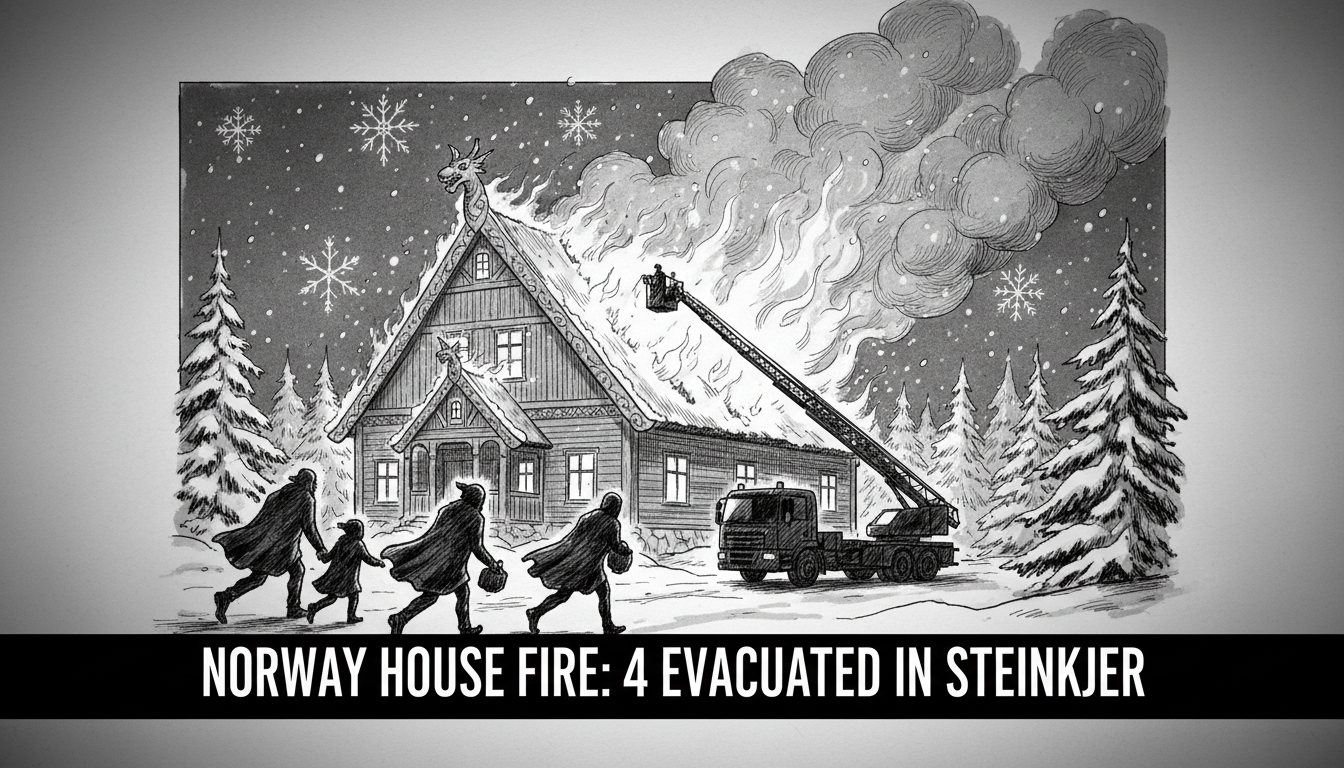
Norway house fire in Steinkjer led to the evacuation of four residents early Monday morning. The blaze, which started in a laundry room of a residential building, was extinguished by emergency services before it could spread to neighboring properties. Police in Trøndelag confirmed no other buildings required evacuation, and the incident is now under investigation.
A Nighttime Emergency in Trøndelag
The call came in during the early hours, a disruptive alarm in the quiet municipality of Steinkjer. Located at the head of the Trondheimsfjord, this administrative center is more accustomed to political debate in its county buildings than the flash of emergency lights. Fire crews responded swiftly to the address, finding the laundry room well alight. Their priority was ensuring all occupants were safely out of the building. The successful evacuation of four individuals, without injury, marks the primary success of the response. Police have not released the identities of those evacuated or the specific cause of the laundry room ignition, stating an investigation is standard procedure.
The Unseen Danger in Utility Rooms
While dramatic fires often capture headlines, experts note that the most common starting points are frequently the most mundane. Laundry rooms, with their combination of electrical appliances, heating elements, and sometimes stored chemicals, present a notable cluster of risk factors. "A residential laundry room contains several potential ignition sources in one confined space," explained Lars Holm, a fire safety engineer with over twenty years of experience. "We have washing machines and dryers, which involve motors, heating, and significant electrical loads. Lint accumulation in dryers is a classic and serious fire hazard that many homeowners underestimate."
Holm emphasized that these appliances, often left running overnight or while residents are out, can develop faults that lead to smoldering fires. These may go undetected until they breach the appliance casing, at which point they can rapidly involve other materials in the room, such as laundry detergents, fabric softeners, or stored items. The Steinkjer incident serves as a stark, localized reminder of this national safety concern.
Norway's Residential Fire Safety Landscape
This event in Trøndelag fits into a broader pattern across Norway. According to data from the Directorate for Civil Protection (DSB), Norwegian fire departments respond to approximately 11,000 building fires annually, with a significant majority occurring in residential properties. The winter months typically see a rise in incidents, correlating with increased use of heating systems, electrical blankets, and indoor lighting. However, fires originating from household appliances like dryers and dishwashers are a year-round concern.
Norwegian building codes are stringent, mandating interconnected smoke alarms in all homes. Since 2010, it has been a legal requirement to have at least one smoke alarm on each floor of a dwelling. Yet, compliance and maintenance are ongoing challenges. "The technology is there, but its effectiveness depends entirely on the human element," Holm noted. "A smoke alarm with a dead battery is nothing but a plastic shell. We must move from simply having alarms to actively practicing fire safety—checking alarms monthly, cleaning dryer vents seasonally, and not overloading electrical circuits."
The Critical Role of Evacuation Plans
The safe outcome in Steinkjer underscores a vital component of home safety that extends beyond prevention: preparedness. Fire and rescue services consistently advocate for households to develop and practice a home evacuation plan. This involves identifying two escape routes from every room, establishing a designated meeting point outside the home, and ensuring all family members, including children, understand the plan.
In a nighttime fire, when disorientation is common and visibility low, a practiced plan can be the difference between a close call and a tragedy. The four evacuated individuals in Steinkjer were fortunate, but their experience highlights a universal need. "An evacuation plan takes five minutes to discuss but can save lives," said a representative from the Trøndelag Fire and Rescue Service. "It should be as routine as checking the batteries in your smoke detector. Know how you will get out, and where you will go."
Lessons from the Fjord to the Capital
While the fire in Steinkjer was contained, it sends a ripple of caution across the country. For policymakers in Oslo, it reinforces the importance of continuous public safety campaigning. For insurance companies, it is a reminder of the costly claims stemming from preventable appliance fires. For the average Norwegian in Bergen, Stavanger, or Tromsø, it is a prompt to look at their own homes with a more critical eye.
The incident also showcases the efficiency of Norway's decentralized emergency response. Even in a municipality like Steinkjer, with a population just over 20,000, a rapid and effective intervention prevented property damage from escalating and ensured no lives were lost. This integrated system of police, fire, and medical response is a cornerstone of Norwegian public safety, tested in real-time by events like this.
A Call for Proactive Prevention
As the investigation into the specific cause continues, the broader takeaway is clear. Fire safety is a continuous practice, not a one-time installation. Experts recommend a simple seasonal checklist: test smoke alarms, inspect electrical cords for damage, clean dryer lint traps and exhaust ducts thoroughly, ensure space heaters are kept clear of combustibles, and review the home's escape routes.
Manufacturers also bear responsibility. There is a growing push for smarter appliances with built-in safety shut-offs and for clearer maintenance instructions for consumers. The humble laundry room, often a forgotten utility space, demands a higher level of respect and care.
The four residents evacuated in Steinkjer can return to a sobering reality. Their home, a place of security, was briefly a place of danger. Their story, while ending safely, is a potent reminder for every household along Norway's extensive coastline and in its deep valleys. Will this near-miss inspire others to audit their own homes, or will the routine of daily life once again obscure the silent risks hiding in plain sight?