
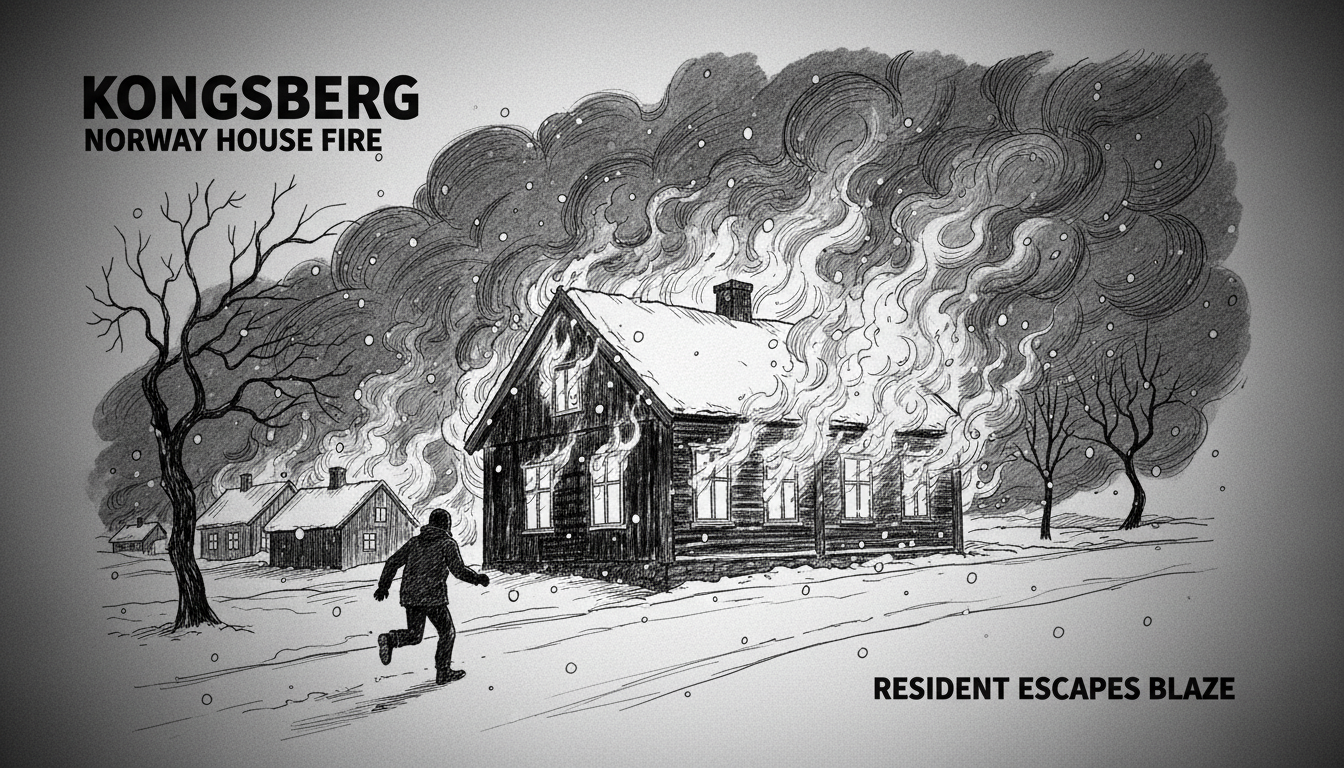
Norway house fire in Kongsberg saw one resident escape unharmed as emergency services battled smoke and flames in the Skollenborg district early Sunday morning. The incident, reported just before 4 a.m., highlights the ever-present domestic risks in Norwegian communities, even as national fire safety standards remain high.
Fire crews from Kongsberg Fire and Rescue Service arrived at the residential property to find significant smoke but no visible flames. Operations leader Jan Kristian Johnsrud from the South-East Police District confirmed the situation in an early statement. "The fire service is on site, and there is a lot of smoke in the area," Johnsrud reported. The sole occupant of the house had already evacuated safely before firefighters arrived, preventing a potential tragedy.
Using powerful ventilation fans, crews worked to clear the dense smoke from the building after confirming the fire itself was out. By 4:02 a.m., police announced the blaze was extinguished, though smoke logging remained a serious issue inside the structure. The rapid response and effective smoke ventilation likely prevented extensive smoke damage throughout the home.
A Swift Emergency Response
The operational timeline for this fire demonstrates the efficiency of Norway's municipal emergency services. From the initial alarm to confirmation of extinguishment, the event was contained within approximately twenty minutes. This speed is critical, as the first few minutes of a house fire often determine its ultimate destructiveness and risk to life.
Kongsberg's fire service, like others across Norway, operates under a model of professional and volunteer responders. Their preparedness for nighttime calls in residential areas is a cornerstone of public safety. The use of tactical ventilation—deploying fans to channel smoke out of a structure—is a standard procedure. It improves visibility for firefighters, reduces heat, and helps locate any remaining hot spots.
"The priority is always life safety, followed by property conservation," said a veteran fire officer from the region, speaking on standard protocol. "When a resident is confirmed safe, crews can focus on aggressive fire attack and ventilation to minimize loss." The successful evacuation before arrival allowed firefighters to operate with maximum effectiveness.
The Hidden Danger of Smoke
While the flames were quickly controlled, the persistent smoke mentioned in police reports points to a major danger in residential fires. Smoke inhalation causes more fire-related deaths than burns do. It contains a toxic mix of carbon monoxide, hydrogen cyanide, and other poisonous gases produced from burning modern household materials like plastics, foams, and synthetic fabrics.
Fire safety experts consistently stress that smoke is a silent, swift killer. "People often underestimate how fast smoke can fill a home and how disorienting and deadly it is," explained Dr. Ingrid Holm, a fire safety researcher at the Norwegian Institute of Public Health. "Even after a fire is out, residual smoke particles and gases pose a health risk and require proper clearing with professional equipment."
This incident underscores the critical importance of working smoke detectors, which provide the earliest possible warning. Norwegian law requires smoke detectors in all homes, and their widespread use is credited with significantly reducing fire fatalities over recent decades. A detector's alarm provides those crucial extra seconds to escape before smoke incapacitates occupants.
Kongsberg: An Industrial Town with Tight-Knit Communities
The fire occurred in Skollenborg, a residential area a few kilometers from Kongsberg's historic center. Kongsberg itself is a municipality of around 28,000 people in Viken county, renowned for its deep industrial roots. Founded in 1624 after the discovery of silver deposits, the town's legacy shifted in the 19th century toward advanced engineering and defence.
Today, Kongsberg is synonymous with Kongsberg Gruppen, a major international technology corporation specializing in defence, maritime, and aerospace systems. This high-tech industrial presence coexists with quiet, family-oriented neighbourhoods like Skollenborg. Such communities typify Norwegian suburban living, where detached and semi-detached houses are common.
These residential areas, while generally safe, are not immune to the common causes of house fires. Statistics from the Norwegian Directorate for Civil Protection (DSB) indicate that most residential fires start in kitchens, often from cooking left unattended. Electrical faults, fireplaces, and careless handling of smoking materials are other frequent causes.
Analysis: Prevention and Preparedness in Norwegian Homes
Norway has one of the lowest rates of fire deaths per capita in the world, a testament to strong building codes, public education, and effective emergency services. Building regulations mandate slow-burning materials and compartmentalization to slow fire spread. The cultural emphasis on "dugnad"—community self-help—often extends to neighbours assisting each other in emergencies before professionals arrive.
However, experts warn against complacency. "Our systems are good, but safety is a daily practice," Dr. Holm noted. "This means testing smoke alarms monthly, having an escape plan with two ways out of every room, and never disabling safety devices." She also highlighted the risk from older electrical installations in some homes, which may not meet current load demands from modern appliances.
For a single occupant, as in this Kongsberg case, the risks are nuanced. There is no one else in the home to raise an alarm if they are asleep or in another part of the house. This makes properly installed and maintained smoke detectors even more vital. The fact that the individual in this fire escaped unharmed suggests they were alerted in time, either by an alarm or their own senses, and knew to get out immediately.
The Aftermath and Investigation
Following the extinguishment, the process of investigation and recovery begins. Fire investigators will work to determine the fire's origin and cause. This is a standard forensic procedure, not necessarily implying suspicion of crime. Understanding how and where a fire started provides data to prevent similar incidents.
The resident will now face the challenging process of dealing with insurance, assessing damage, and arranging repairs. Smoke damage can be pervasive, requiring professional cleaning of walls, furnishings, and personal belongings. Even if the fire was small, the cost and disruption of smoke remediation can be substantial.
Local community networks often mobilize in such situations, offering temporary housing, meals, or support to those affected. This social resilience is a key part of Norway's disaster response, complementing the official government and insurance systems.
A Reminder of Universal Vulnerability
The Kongsberg house fire, while minor in outcome, serves as a stark reminder. It shows that domestic fire risk exists in every community, regardless of national safety records or economic status. It reinforces non-negotiable safety steps: install smoke alarms, plan escape routes, and never re-enter a burning building.
The incident ended as best as possible—with a life saved and property damage limited. It showcased a well-functioning emergency response chain, from the resident's correct action to flee, to the police communication, to the firefighters' effective suppression and ventilation tactics.
Yet, it prompts a sobering question for every homeowner and tenant, in Norway and abroad: When was the last time you tested your smoke alarm? The answer could make all the difference when seconds count.