
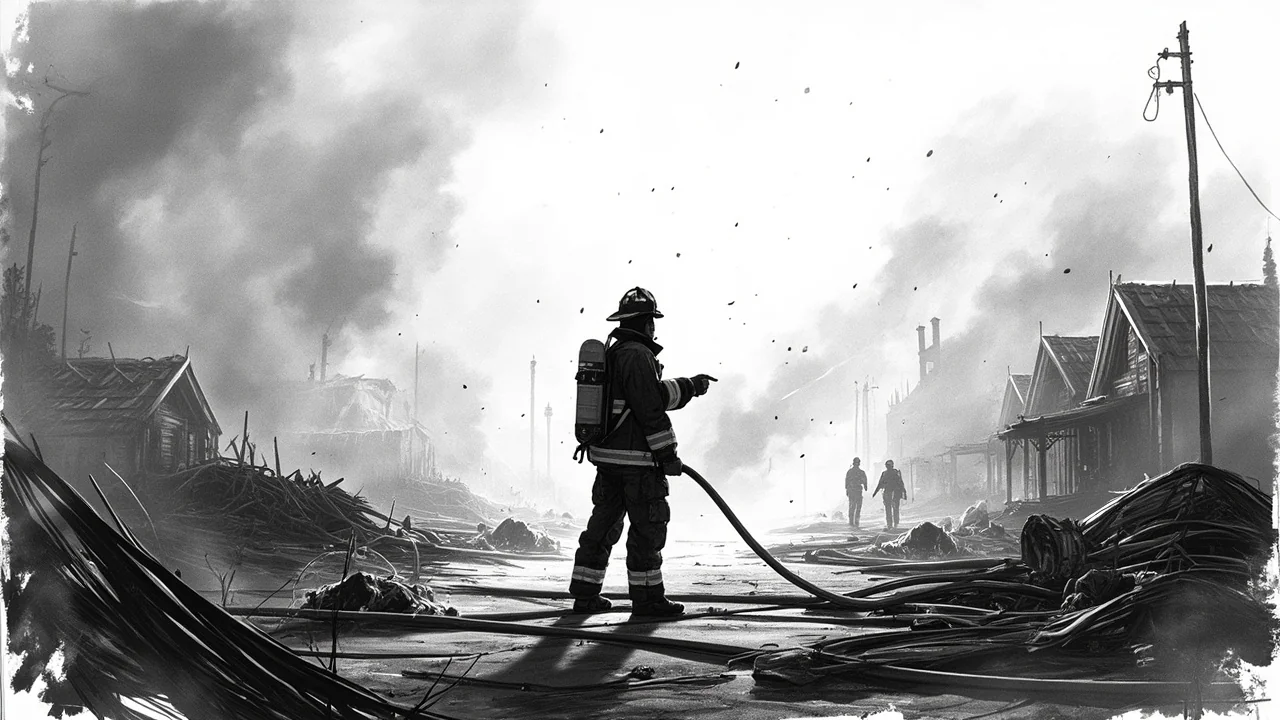
Norway's emergency services faced a critical test in Vennesla this week as a house fire forced one resident into a dramatic rooftop evacuation. The incident, which saw firefighters rescue a person from the roof of a burning home, has ignited a broader conversation about national fire safety standards and rural response capabilities. While all occupants survived, the event exposes persistent challenges in Norway's building safety landscape.
Flames engulfed a residential property in the Agder county municipality of Vennesla, prompting a large-scale emergency response. Police confirmed the fire service was on scene quickly. Initial reports indicated most occupants had escaped the structure. One individual, however, was forced into a desperate retreat upwards, evacuating to the roof to escape the advancing fire and smoke below.
A Tense Rescue Operation
The situation created a complex rescue scenario for the responding crews. Firefighters had to simultaneously attack the blaze to prevent its spread while deploying ladders or aerial equipment to reach the stranded person. The operation required precise coordination under significant time pressure. Successful extraction from a roof often depends on the structural integrity of the building beneath the flames, adding a layer of risk for both the occupant and rescue personnel.
This type of evacuation, while rare, highlights a worst-case scenario in residential fires. When traditional escape routes through doors and stairwells are blocked by heat and smoke, occupants can become trapped. Norwegian fire safety regulations emphasize multiple escape routes, but in older or single-staircase buildings, options can quickly vanish.
Norway's Fire Safety Paradox
Norway maintains generally high building and safety standards, yet residential fires remain a persistent cause of injury and death. The country has seen a long-term decline in fire fatalities, a trend attributed to increased use of smoke detectors and stricter building codes. However, isolated incidents like the Vennesla fire reveal vulnerabilities. Many communities, particularly in rural areas like those in Agder, rely on volunteer fire brigades who may face longer travel times.
"Every rescue from a serious house fire is a success, but every such fire is also a failure of prevention," says Lars Ingeberg, a former chief fire officer and now a safety consultant. "We have excellent reactive services, but the national focus must remain on proactive measures—ensuring working smoke alarms, clear escape plans, and public awareness about fire risks in the home."
The building's age and construction materials are now key questions for investigators. Modern Norwegian homes are built with fire-resistant materials and compartmentalization to slow a fire's growth. Older wooden homes, common in many Norwegian towns, can burn faster and more intensely, leaving less time for escape.
The Human Factor in Emergency Response
Beyond the physical rescue, the psychological impact of such an event is profound. Being driven to a roof by flames is a traumatic experience. Norway's municipal health services typically follow up after major incidents to offer crisis support to victims and sometimes to first responders. The speed of the initial alarm is also critical. The widespread adoption of interconnected smoke alarms, which alert all occupants simultaneously, has been a major advancement in Norwegian fire safety.
Neighbor response often plays an unsung role in these crises. In close-knit communities, neighbors are frequently the first to notice a fire and call for help. They may also attempt initial assistance before professionals arrive. This community resilience is a cornerstone of safety in Norway's smaller towns and rural districts.
Policy Implications and Prevention Focus
The Vennesla incident will likely prompt local reviews, but it also touches on national policy debates. There is an ongoing discussion about mandating more comprehensive fire sprinkler systems in certain types of housing, though cost remains a significant barrier. Another focus is on the electrical systems in older homes, a common cause of ignition.
Fire services also continuously train for technical rescues, including those from heights and confined spaces. The investment in equipment like turntable ladders and thermal imaging cameras is essential for managing the complex scenarios that house fires can present. Municipal budgets for fire and rescue services are a perennial topic in local government, balancing the need for advanced capabilities against other public spending priorities.
For the average Norwegian, the takeaway is a sobering reminder to test smoke alarms monthly and to practice a home escape plan with all family members. Knowing two ways out of every room, including how to safely access and use escape ladders from upper floors, can make the difference between a close call and a tragedy.
The resident on the roof in Vennesla survived. Their home did not. This stark outcome underscores a simple truth: Norway's fire safety ecosystem is a chain with many links—from construction codes and product standards to vigilant homeowners and well-equipped responders. When one link weakens, the entire system is tested. This week, in Vennesla, the system held, but the alarm it sounds is for everyone to listen.