
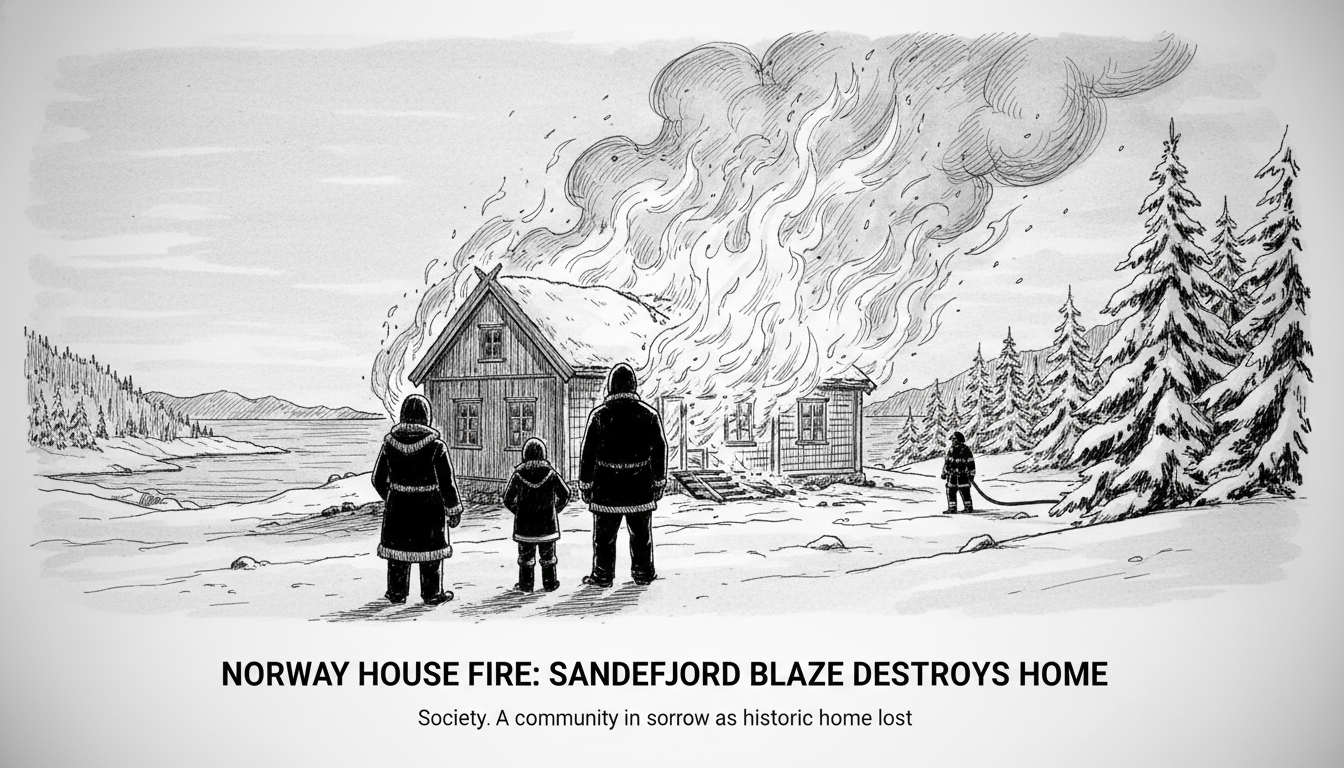
Norway emergency services battled a fierce house fire in Sandefjord overnight, with police confirming the older wooden structure was completely destroyed. The detached house, known locally as an 'enebolig', was fully engulfed when firefighters arrived. Authorities have been unable to contact the single resident registered at the address, raising immediate concerns for their welfare.
Operational commander Jan Kristian Johnsrud from the Southeast Police District described the scene. "There was a full blaze in the house when emergency services arrived at the scene," he said in an early morning statement. The police were notified of the fire in Sandefjord over an hour before that initial report, indicating the fire had a significant head start.
Police stated plainly that the house, an old timber building, would burn down. The rapid consumption of the structure highlights the acute danger posed by fires in Norway's abundant wooden homes. Investigators are now working to locate the missing resident and determine the fire's origin.
A Rapid and Destructive Blaze
The fire's intensity points to the vulnerabilities of Norway's traditional building stock. Sandefjord, a coastal city in Vestfold county famed for its whaling history and summer tourism, contains many older wooden dwellings. These structures, while charming, can become infernos within minutes under the right conditions.
Dry timber acts as a perfect fuel, allowing flames to spread quickly through walls and attics. Modern building codes mandate better compartmentalization and fire-resistant materials, but older homes built before these regulations are at higher risk. The speed of this fire left little opportunity for intervention once it took hold.
"We are still working to find out where the person might be," Commander Johnsrud stated, underscoring the primary focus of the ongoing operation. The lack of contact with the resident transforms the incident from a property disaster into a potential human tragedy. Police procedures in such cases involve checking with family, friends, and hospitals while forensic teams await safe access to the site.
The Persistent Threat of Building Fires
This incident is not an isolated event but part of a recurring national challenge. According to the Norwegian Directorate for Civil Protection (DSB), Norway recorded 2,763 building fires in 2022. Each represents a potential loss of life, history, and property.
Detached houses, or 'eneboliger', are the most common dwelling type in Norway, as reported by Statistics Norway (SSB). This prevalence means a significant portion of the population lives in structures that, especially if older, are susceptible to fast-moving fires. The risk profile varies with construction date, maintenance, and the presence of safety devices.
Fire safety experts consistently stress a few critical measures. Functional smoke detectors are the first and most crucial line of defense, providing early warning to occupants. Regular checks of electrical systems, careful use of heating appliances like wood stoves, and clear escape plans are also fundamental. For heritage wooden homes, additional considerations like sprinkler systems or fire-retardant treatments are often discussed, though cost can be a barrier.
Investigation and Community Impact
The investigation into the Sandefjord fire will follow a standard but meticulous protocol. Once the site cools sufficiently, fire investigation specialists will examine the scene. They will search for the point of origin and try to identify an ignition source. Common causes include electrical faults, cooking accidents, heating appliances, or improperly discarded smoking materials.
The age and materials of the building will be a central factor in the investigation. Older wiring may have degraded, and vintage construction techniques might have created hidden voids where fire could spread unseen. Police will also work to formally account for the missing resident, a process that may require detailed forensic examination.
For the local community in Sandefjord, a house fire resonates deeply. In close-knit neighborhoods, the loss is felt collectively. The sight of a home destroyed—a place of memories and family life—serves as a sobering reminder of vulnerability. Neighbors often rally around those affected, providing support even as official investigations proceed.
National Context and Safety Priorities
Norway's authorities maintain a strong focus on fire prevention through public information campaigns and regulation. The DSB regularly issues advice, particularly during winter when the use of candles and fireplaces increases. The goal is to shift the culture from mere response to proactive prevention.
Despite high safety standards, the fundamental physics of fire remain. Wooden houses, which constitute a large part of Norway's architectural identity and housing market, burn. This creates a tension between preserving cultural heritage and ensuring modern safety. Retrofitting old homes with new safety features is encouraged, but not always mandatory, leaving room for variable risk.
Insurance companies also play a role, often incentivizing safety upgrades through policy terms. A confirmed working smoke detector is typically a basic requirement for coverage. After a major loss, insurers will conduct their own inquiries alongside the police investigation to determine liability and coverage.
Looking Forward: Lessons from Loss
The final chapter of this fire in Sandefjord is yet to be written. The critical question of the resident's whereabouts hangs over the smoldering ruins. The community awaits answers, hoping for a positive resolution but preparing for grim possibilities.
This event will inevitably prompt local reflections on safety. Neighbors might check their own smoke detector batteries. Families may revisit their fire escape plans. It underscores a harsh reality: safety is a continuous practice, not a one-time achievement.
For Norway, each fire provides data and, unfortunately, lessons. It reinforces the need for sustained investment in public safety education and support for homeowners to upgrade older properties. The charm of a wooden house carries with it a responsibility for vigilance. As the investigation in Sandefjord continues, the broader conversation about how to protect Norway's wooden heart from its oldest threat is reignited once more. The ultimate cost of this fire, beyond the lost structure, remains to be seen.