
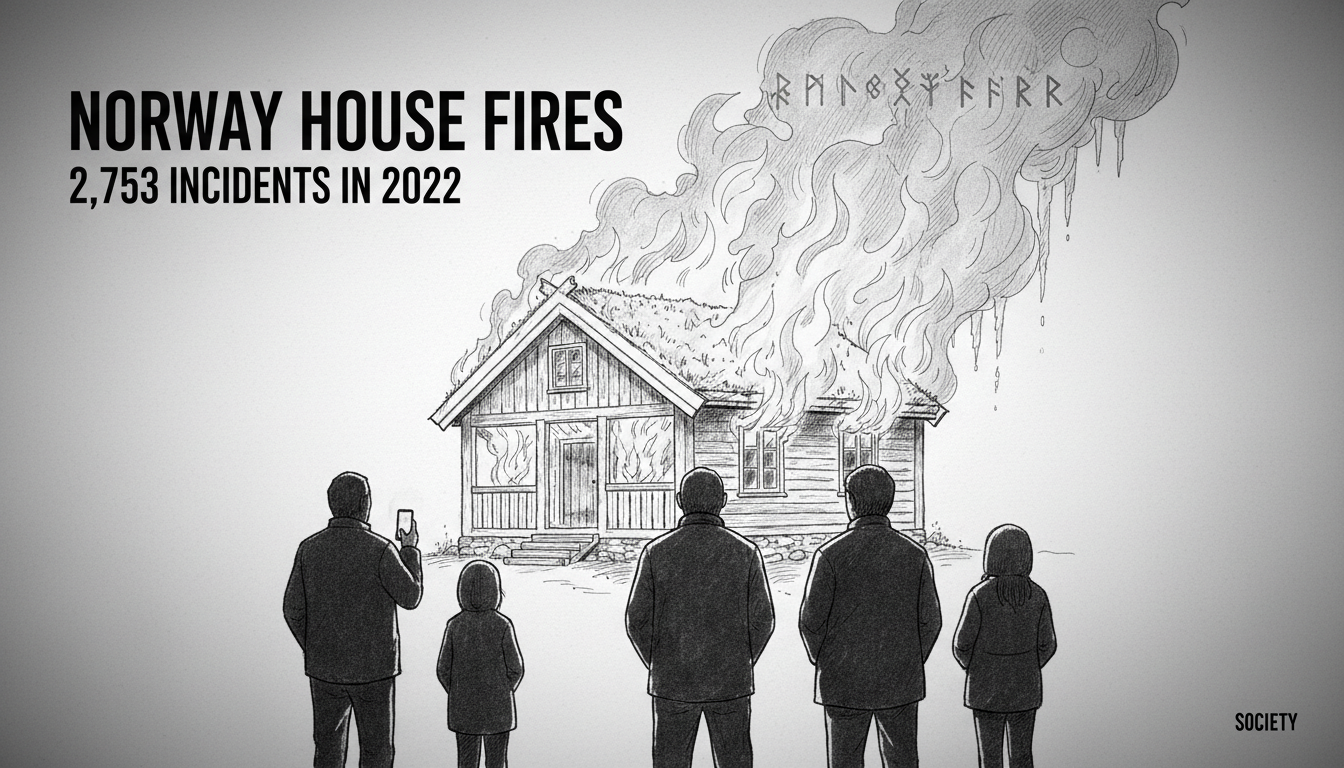
Norway house fires accounted for 2,753 building blazes in 2022, a stark statistic that turned personal for one Sandefjord resident this weekend. Emergency services received the call in the early hours of Saturday morning, finding a detached house fully engulfed. Police have yet to make contact with the person registered at the address, casting a shadow over the otherwise efficient response from local fire and rescue teams.
The incident underscores a persistent national challenge despite Norway's strict building codes. Fire crews from Sandefjord municipality arrived at the scene after 3:30 AM, confronting intense flames. ‘Full fyr i huset,’ or ‘full fire in the house,’ was the stark log entry by operations leader Jan Kristian Johnsrud of the Southeast Police District. The phrase captures the severity first responders faced upon arrival at the residential property.
A Midnight Response in Vestfold
Sandefjord, a coastal city in Vestfold county known for its maritime history, became the site of a rapid nighttime emergency mobilization. The response involved coordinated efforts between police, fire, and medical units. Their primary objectives were containing the blaze to prevent spread to neighboring properties and searching for potential occupants. The use of thermal imaging cameras and systematic search patterns is standard in such scenarios, though the intensity of a ‘full fire’ complicates these operations significantly. The physical structure of a detached house, or enebolig, presents specific challenges, including rapid fire spread through voids and attic spaces.
The National Picture of Residential Blazes
Data from the Directorate for Social Security and Emergency Preparedness (DSB) provides critical context. The 2,753 building fires reported in 2022 represent a significant number for a nation of 5.4 million people. Residential buildings constitute a large majority of these incidents. While Norway's fire fatality rate per capita is relatively low compared to some countries, each fire represents substantial property damage, emotional trauma, and risk to life. ‘Every fire call is a race against time, and the first minutes are decisive,’ a veteran fire safety instructor from the Norwegian Fire Academy explained. ‘Prevention is always superior to suppression.’
Common causes in Norwegian homes include electrical faults, often related to older installations or the use of multiple high-power appliances. Kitchen fires, frequently caused by unattended cooking, are another leading contributor. The increasing number of lithium-ion batteries in homes, from e-bikes to tools, also presents a new and growing fire risk that safety regulations are struggling to keep pace with.
| Common Causes of Residential Fires in Norway | Typical Contributing Factors |
|---|---|
| Electrical Faults | Aging wiring, overloaded circuits, faulty appliances. |
| Kitchen Fires | Unattended cooking, grease ignition. |
| Heating Sources | Wood-burning stoves, portable heaters placed too close to combustibles. |
| Smoking Materials | Improperly discarded cigarettes. |
| Lithium-ion Batteries | Thermal runaway in damaged or poor-quality batteries. |
Safety Regulations and Human Vulnerability
Norway enforces rigorous building codes mandating fire-resistant materials in certain structures, compartmentalization to slow fire spread, and mandatory smoke alarms in all homes. The effectiveness of these measures, however, depends on proper maintenance and resident awareness. A smoke alarm with a depleted battery offers no protection. ‘The technology is there, but human behavior is the variable,’ the safety instructor noted. For vulnerable individuals, including the elderly or those living alone, the risk is compounded. The Sandefjord case, where police have not confirmed contact with the resident, highlights this acute concern.
Emergency services across Norway train extensively for residential fire scenarios. The protocol involves an immediate risk assessment, rapid deployment of hose lines for containment, and a simultaneous primary search if conditions allow. In coastal towns like Sandefjord, response times can be affected by geography, though municipal services are strategically located to cover their districts effectively. The collaboration between police and fire crews is seamless; police often secure the perimeter, manage crowds, and initiate preliminary investigations once the fire is under control.
The Aftermath and Investigation
Once extinguished, the scene transitions from an emergency response to a forensic investigation. Fire investigators will work to determine the point of origin and the cause of the blaze. This process can take days or weeks, especially if the structural damage is severe. Police will continue efforts to locate and account for the registered resident. The psychological and community impact of such an event is lasting. Neighbors witness not just property loss but a profound violation of domestic safety, a feeling that resonates deeply in Norway’s close-knit residential areas.
The Sandefjord fire is a single entry in the annual national statistics. Yet it represents the culmination of multiple factors—possibly a technical failure, a moment of human error, or an unforeseen accident. It tests the readiness of local emergency systems and the resilience of building safety standards. For the neighbors on that quiet street, it is a frightening reminder of vulnerability. For the fire crews, it was another night applying their training under extreme conditions.
A Preventable Tragedy?
As the investigation proceeds, the core question for safety officials will be whether this fire was preventable. Could different building materials have slowed its growth? Were functioning smoke alarms present? Did the occupant have a clear escape route? The answers inform future public safety campaigns and potential regulatory tweaks. Norway’s approach to samfunnssikkerhet, or societal safety, is proactive, yet it relies on constant refinement based on real-world events.
The house in Sandefjord now stands as a charred shell, an artifact of a few hours of destruction. The national data for 2024 will soon include this incident. The ultimate cost, measured in more than kroner, remains uncertain pending news of the resident. This single fire, one of thousands yearly, encapsulates the ongoing battle between controlled modern living and the elemental hazard of flame. How many more entries like ‘full fyr i huset’ will fill the police logs before winter ends?