
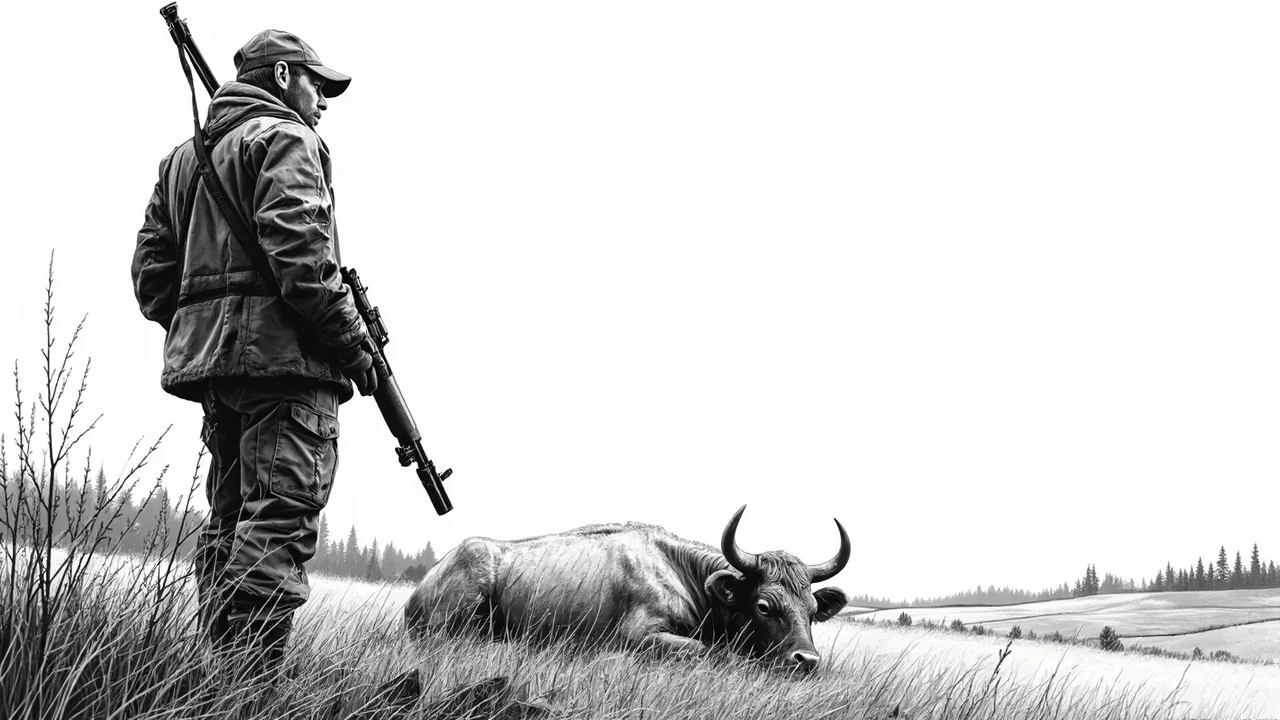
Norway's hunting regulations face scrutiny after a novice hunter in Vanylven municipality shot and killed a dairy cow he mistook for a deer. The incident occurred last autumn during an evening hunt on the Sunnmøre coast, highlighting the risks associated with modern hunting technology and inexperience. Police have concluded the case with a 10,000 kroner fine for the hunter, citing a violation of wildlife laws that endangered livestock.
A Fateful Mistake in the Moonlight
The hunt took place in the twilight hours of an autumn evening. Conditions were dark but moonlit, according to local reports. The two hunters, both described as inexperienced, were pursuing deer across both cultivated and uncultivated land. They were equipped with advanced optical and thermal sights, devices that allow hunters to detect animal heat signatures over long distances in complete darkness. At one point, the group observed several deer moving into a wooded area. Ten minutes later, the novice hunter saw another animal in his sights. Believing it to be a deer that had re-emerged, he fired a single shot. The target was not a wild animal, but a domestic cow grazing in an outlying field.
Police prosecutor Arnt Erik Oust confirmed the details of the case in a statement. "The matter has been resolved by the suspect accepting a fine," Oust said. The charge was based on the hunter conducting the hunt in a manner that posed a danger to livestock, a clear breach of Norway's Wildlife Act. The prosecutor emphasized the role of the hunter's inexperience in the official response. "It was the first time the hunter had been on a hunt, and that has some bearing on the reaction he has received," Oust noted. "If it had been an experienced hunter, there would have been a stricter reaction."
The Price of a Modern Hunting Error
The financial and social repercussions of the mistake were significant, though contained through private settlement. The hunter received a 10,000 kroner fine from authorities for the legal violation. Separately, the hunter and the owner of the cow reached a private financial agreement to compensate for the loss of the animal. This dual-layer resolution is common in such cases, where a statutory penalty addresses the breach of public law, while civil negotiation handles private property damage. The case did not escalate to a court hearing because the hunter accepted the summary fine, a common procedure for lesser wildlife offenses.
This incident opens a window into the practical challenges of Norwegian hunting culture, where access to nature is broad but responsibilities are heavy. Hunting is a popular activity in Norway, deeply woven into rural life and traditions. However, the right to hunt comes with stringent requirements, including mandatory hunter education courses that cover law, ethics, firearm safety, and species identification. The Vanylven case suggests a potential gap between theoretical knowledge gained in a course and the high-pressure, low-visibility decisions made in the field, especially when aided by technology that can sometimes distort context.
Technology Versus Traditional Knowledge
The use of thermal and optical sights represents a growing trend in hunting. These tools provide a significant advantage in Scandinavia's long, dark winters and during dawn or dusk hunts when game is most active. A thermal sight detects heat, making living creatures stand out vividly against a cooler background, regardless of foliage or darkness. However, these devices typically display images in monochrome—shades of gray, black, and white—or in false-color palettes like orange or green. They do not provide the detailed visual morphology, color, or context a hunter would see in daylight. A large, warm-bodied animal like a cow or a horse, viewed through such a sight in a murky field, can be tragically misidentified as a deer or moose.
This creates a modern paradox. The very technology designed to make hunting more precise and safe by extending visibility can, in the hands of an inexperienced user, create a dangerous disconnect. The hunter sees a glowing shape, not an animal in its full environmental setting. The cognitive load shifts from broad situational awareness to focused targeting. Veteran hunters and instructors often stress that technology is an aid, not a replacement for fundamental skills: knowing the terrain, understanding animal behavior, and positively identifying the target beyond any doubt before squeezing the trigger. The Vanylven incident serves as a stark case study in what happens when that principle fails.
A Broader Look at Hunting Safety and Ethics
While shooting livestock is fortunately rare, accidental shootings involving hunters do occur in Norway. Statistics from the Norwegian Environment Agency show that most hunting accidents involve self-inflicted wounds or incidents between members of a hunting party. Mistaking a person for game is the most catastrophic error, and such tragedies have led to continuous tightening of safety regulations, including mandatory use of high-visibility clothing during certain seasons. The shooting of domestic animals sits in a middle ground—a serious property crime and a safety failure, but one that typically does not involve human injury.
The ethical dimension is profound. Hunting in Norway is managed under the principle of "reasonable use" of natural resources, balanced with strict animal welfare and property rights considerations. A core tenet is ensuring a quick, humane death for the game animal. Shooting the wrong animal violates every aspect of this ethic: it causes suffering to an animal that was never intended to be quarry, it violates the trust inherent in the rural landscape where livestock graze, and it damages the public perception of hunting. For the hunting community, such incidents are a source of deep embarrassment and are taken very seriously by organizations like the Norwegian Hunters and Anglers Association (NJFF), which promotes extensive training and safety.
Lessons from a Costly Mistake
The resolution of this case offers clear lessons. First, the legal system demonstrated proportionality. The hunter's novice status was a mitigating factor, but the violation was still punished with a meaningful fine. This reinforces that ignorance is not an excuse, but the context of the error matters. Second, the private settlement between the hunter and the farmer underscores the importance of personal responsibility and community repair in rural Norway. Conflicts are often resolved directly, preserving social cohesion.
For prospective hunters, the message is unambiguous. Passing the hunter's exam is just the first step. Gaining practical experience under the supervision of a seasoned mentor is invaluable. One must learn to use advanced technology as a tool within a broader skill set, not as a crutch that replaces judgment. Finally, the oldest rule in the book remains the most vital: if you cannot identify your target with absolute certainty, do not shoot. The echo of that single mistaken shot in Vanylven is a costly reminder, measured in kroner, reputation, and the life of an innocent animal. It asks a difficult question of all who take up the rifle: in the pursuit of tradition and sport, are we allowing technology to outpace our own fundamental awareness and respect for the landscape we share?