
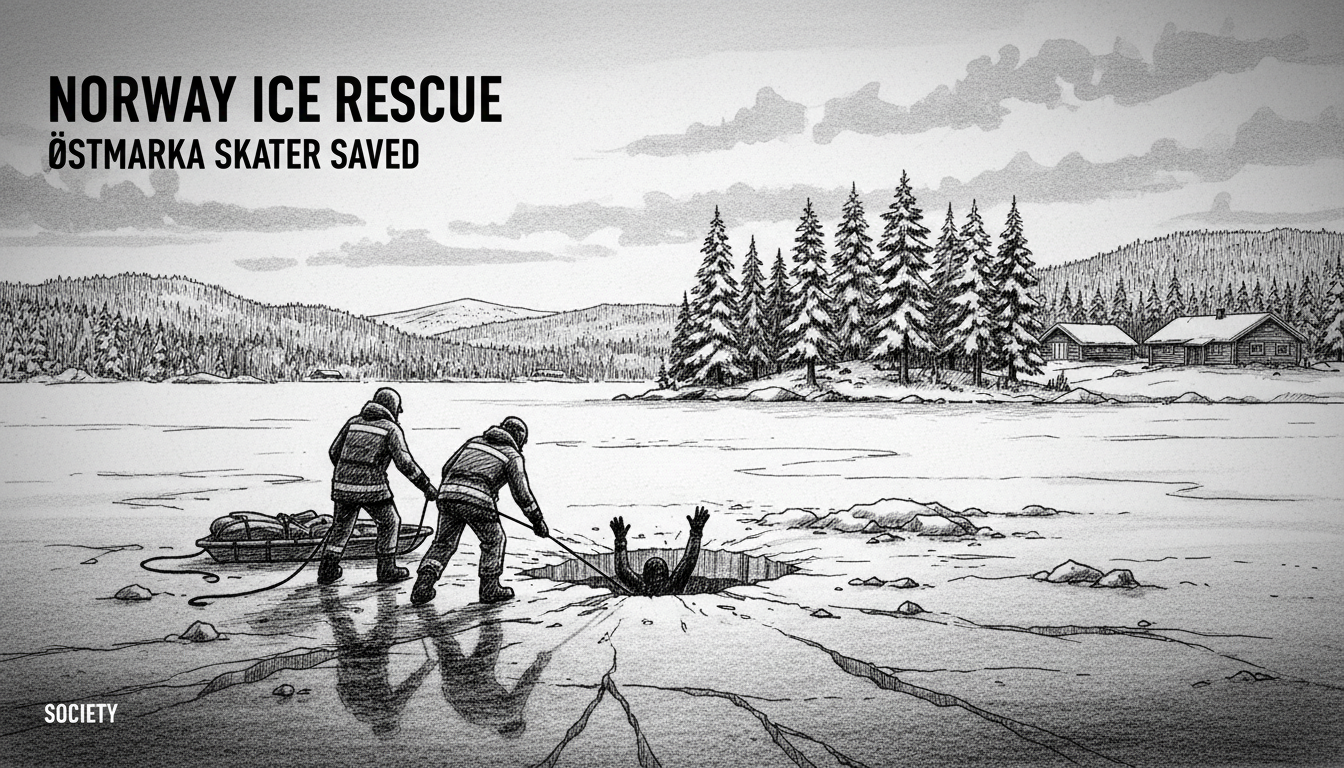
Norway's popular winter recreation areas pose a hidden danger as a person fell through the ice in Oslo's Østmarka forest. The individual was rescued by companions using a safety line and was conscious when emergency services arrived. This incident highlights the unpredictable nature of ice conditions even in areas frequented by locals.
Police operations leader Gabriel Langfeldt confirmed the rescue in a statement. "Police are on site and have made contact with the person, who is conscious and awake. An ambulance is on the way," he said. The immediate focus, according to Langfeldt, was providing the victim with warm clothing and blankets before investigating the incident's cause.
The rescue succeeded because someone present had proper safety equipment. "One of the people present had a rescue line available which was used to pull the person up from the water," Langfeldt noted in the police log. This detail proves crucial—having the right gear prevented a tragedy.
The Thin Line Between Recreation and Risk
Østmarka represents the quintessential Norwegian relationship with nature. This vast forested area east of Oslo provides immediate access to skiing trails, frozen lakes, and winter hiking paths for the capital's residents. Its popularity makes such incidents particularly jarring. They occur not in remote wilderness, but in the city's backyard.
Winter activities on ice are deeply embedded in Scandinavian culture. Yet this tradition carries inherent risks that many underestimate. Ice thickness can vary dramatically due to underwater currents, springs, or snow cover acting as insulation. A lake that appears uniformly frozen can have weak spots invisible from the surface.
"This rescue is a best-case scenario that could have ended very differently," says Lars Holm, a safety instructor with the Norwegian Trekking Association. "It shows both the value of being prepared and the ever-present danger. The ice is never 100% safe."
The Critical Role of Preparedness
The Østmarka incident demonstrates a textbook rescue. The group was equipped with a rescue line, a simple piece of safety gear that made the difference between a scare and a fatality. Experts consistently emphasize a basic kit for anyone venturing onto frozen water.
This includes ice claws worn around the neck to grip the ice and pull oneself out, a throwable floatation device, and a rope. Perhaps most importantly, experts advise never going out alone. The presence of others who can call for help and assist in a rescue is the most fundamental safety measure.
Local municipalities and the Norwegian Water Resources and Energy Directorate (NVE) often issue public warnings about ice conditions. These advisories are based on temperature data, snow reports, and sometimes direct measurements. However, compliance relies on individual responsibility.
"People see others on the ice and assume it's safe," Holm explains. "But conditions can change over just a few meters. A spot that was solid yesterday can be weak today after a slight temperature rise or snowfall. There is no substitute for local knowledge and extreme caution."
A Systemic Approach to Winter Safety
While Norway has no widespread, formal ice thickness monitoring system for recreational areas, safety information is disseminated through multiple channels. The Norwegian Trekking Association (DNT) runs regular courses on winter safety. The Norwegian Society for Sea Rescue (RS) also promotes ice safety awareness, despite its maritime focus.
The response protocol worked efficiently in this case. Police, ambulance, and potentially fire and rescue services coordinated the operation. The victim received immediate care on-site to prevent hypothermia, which sets in rapidly in Norway's cold waters.
This incident occurs almost every winter somewhere in Norway. The pattern is familiar: a period of stable cold creates seemingly solid ice, followed by an accident that shocks the local community. The discussion then turns to whether more should be done—signage, regular ice measurements on popular lakes, or stricter advisories.
Balancing Freedom and Safety in Friluftsliv
The Norwegian concept of "friluftsliv," or open-air living, emphasizes free access to nature. This philosophy generally discourages over-regulation and barriers. The approach to safety is typically educational rather than prohibitive. Authorities provide information and warnings, but citizens are expected to exercise judgment.
This ethos places a significant burden on individual competence. It requires people to understand risks, check conditions, and carry appropriate equipment. The Østmarka rescue suggests this model can work when people are properly prepared. The group had the necessary gear and knowledge to execute a rescue.
However, it also raises questions about those who venture out less prepared. Tourists unfamiliar with Nordic winters, or locals lulled into complacency by familiarity, may not take adequate precautions. Public awareness campaigns therefore target these groups ahead of the winter season.
The Aftermath and Lessons for the Season
The rescued individual in Østmarka received medical attention, with the full extent of their condition not disclosed. Physically, recovery from cold water immersion can be swift if rescue is prompt. The psychological impact, however, can be lasting for both the victim and the rescuers.
For the broader public, the incident serves as a timely winter reminder. As days grow longer and temperatures fluctuate in late winter and early spring, ice becomes increasingly unstable. This period often sees a spike in incidents as people attempt to enjoy the last of the winter ice.
Safety experts reiterate core advice: avoid ice near inlets, outlets, or over moving water; be wary of ice covered with snow; always go with others; and carry safety equipment. They also recommend checking with local sources, like sports clubs or cabin associations, for the latest ice condition reports.
Norway's relationship with its winter landscape is one of respect earned through experience. The Østmarka rescue ended well because preparation met challenge. It underscores that in the Nordic winter, the margin for error is thin, and the responsibility for safety ultimately rests on the shoulders of those who choose to walk—or skate—on nature's frozen surface. Will this close call lead to greater caution, or will the allure of the ice continue to tempt fate?