
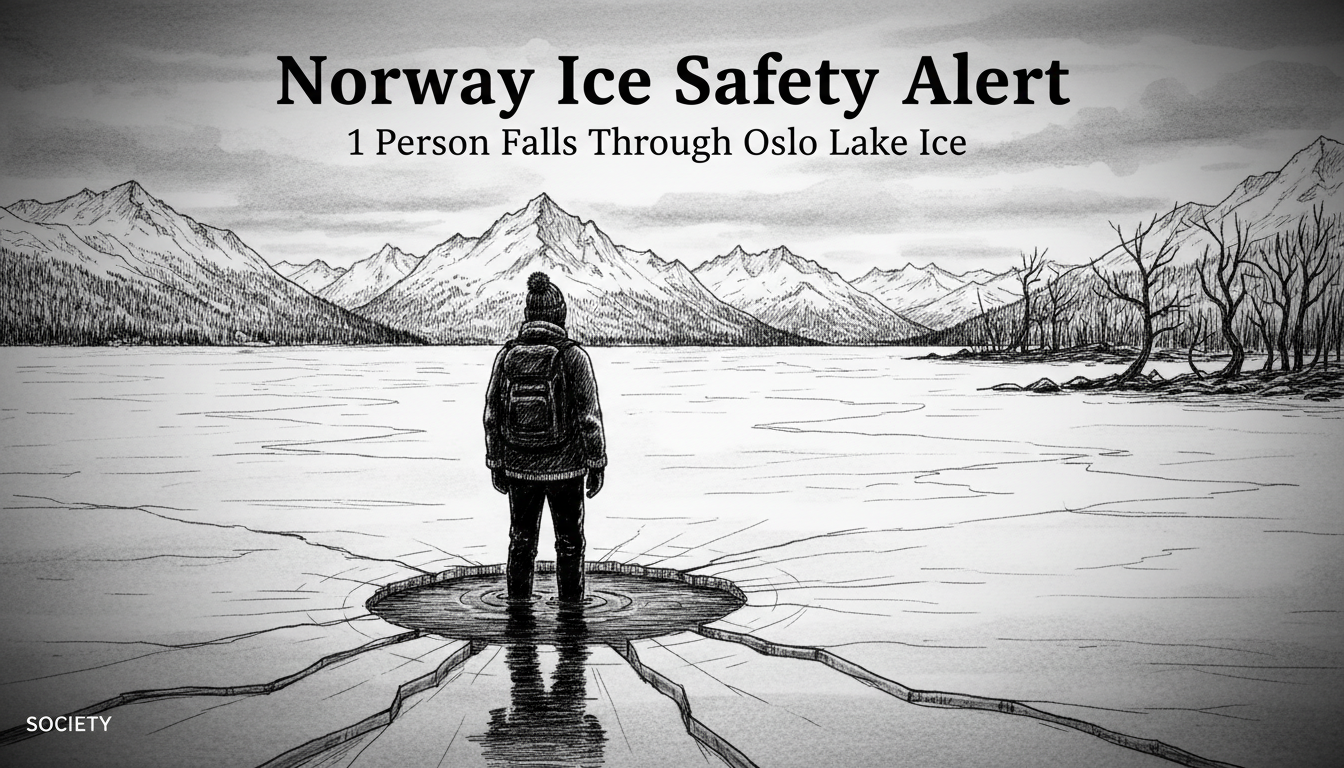
Norway's popular winter recreation areas face renewed safety warnings after a person fell through the ice on Nøklevann lake in Oslo. Emergency services confirmed the individual was pulled from the frigid water by companions using a rescue line and was conscious and in stable condition upon reaching land. The incident, occurring in the heavily forested Østmarka area east of the capital, highlights persistent dangers despite widespread public awareness campaigns. Oslo police immediately reiterated their standard winter warning, stating the ice remains unsafe and caution is essential on all lakes in the Oslo, Asker, and Bærum regions.
A Narrow Escape in Østmarka
The rescue unfolded quickly due to the preparedness of the group. According to police reports, several people were present when the ice gave way. One member of the party had a rescue line readily available, which was deployed to pull the victim from the water. This prompt action likely prevented a more severe outcome. Oslo Fire and Rescue Services along with other emergency responders arrived on scene to provide necessary medical assistance. The lake, Nøklevann, is a known recreational spot for hiking, skiing, and, when conditions are deemed safe, ice skating. Its depth reaches a maximum of 23 meters, meaning water underneath the ice is profoundly cold and poses a significant risk of cold shock and hypothermia.
The Unpredictable Nature of Winter Ice
Ice safety experts consistently stress that ice thickness is never uniform across a lake. "Conditions can change dramatically over a short distance due to underwater springs, currents, shifting snow cover, or variations in water depth," explains a veteran ice rescue instructor with the Norwegian Rescue Society. The standard guideline for safe ice is a minimum clear, solid ice thickness of 10-15 centimeters for walking or skating. For activities like ice fishing or group gatherings, 20-25 centimeters is recommended. Authorities never advise driving vehicles onto lake ice. "The problem," the instructor notes, "is that these are just guidelines. Ice that appears solid can be weakened from below or be 'rotten' despite its thickness. Local knowledge and constant, careful assessment are irreplaceable."
Winter in the Nordic region creates a powerful cultural draw to frozen lakes and fjords. The tradition of 'friluftsliv' – open-air living – pushes Norwegians outdoors in all seasons. This deep-seated cultural norm sometimes clashes with the physical realities of a warming climate and variable winter conditions. Incidents like the one at Nøklevann serve as annual reminders that nature does not compromise. While municipal authorities in Oslo and surrounding areas monitor popular water bodies and issue general advisories, the ultimate responsibility for safety rests with the individual. There is no official certification or guarantee of ice safety on natural bodies of water.
Official Warnings and Public Responsibility
The police statement following the Nøklevann incident was clear and direct, mirroring annual public safety messaging. It serves as the primary tool for authorities, who lack the resources to physically patrol and measure every lake and pond. The messaging focuses on personal responsibility: individuals must possess the knowledge to evaluate risks themselves. Oslo Fire and Rescue Services supplement this with educational resources on their websites, detailing how to check ice thickness safely—by drilling test holes and measuring—and what equipment to carry, such as ice picks and throw lines.
However, experts point to a gap between awareness and behavior. "Many people know the rules," says a safety researcher at the Norwegian University of Science and Technology, "but in the moment, seeing others on the ice or being eager to enjoy a beautiful winter day can lead to risk assessment shortcuts. The 'it won't happen to me' mentality is a powerful force." This is compounded by social media, where picturesque images of people on frozen lakes can create a false perception of universal safety.
The Physiology of Cold Water Immersion
The successful rescue at Nøklevann prevented the victim from experiencing the full, deadly progression of cold water immersion. The initial shock of entering water near freezing causes an involuntary gasp reflex, which can lead to drowning if the head is submerged. Within minutes, muscle cooling leads to incapacitation, making self-rescue impossible. Even after rescue, the threat continues as cold blood from the extremities can rush back to the core upon movement, causing a dangerous drop in core body temperature known as afterdrop. This is why emergency responders handle rescued victims gently and focus on gradual warming. The fact the Nøklevann victim was reported conscious and in good form is a testament to the rapid extraction from the water.
A Broader Pattern in a Changing Climate
While isolated incidents occur every winter, safety organizations are observing broader patterns. Climate change is contributing to more volatile winter conditions across Scandinavia. Periods of mild weather and rain can interrupt deep freeze cycles, creating weaker, layered ice that is particularly treacherous. "We are seeing more freeze-thaw cycles within a single season," notes a climatologist with the Norwegian Meteorological Institute. "This can create ice that looks thick but is structurally unsound. The traditional calendar for 'safe ice' is becoming less reliable." This environmental shift places an even greater burden on individuals to seek out current, localized condition reports rather than relying on seasonal assumptions.
Lessons from a Near-Tragedy
The Nøklevann event ended as a close call, a safety drill made real. It underscores the critical importance of going prepared. The presence of a rescue line within the group was the decisive factor that turned a potential tragedy into a manageable emergency. Safety kits for winter lake travel should include not only rescue lines but also ice claws or picks worn around the neck to grip the ice for self-extraction, a whistle, and a dry set of clothes in a waterproof bag. Experts also advise never going onto the ice alone and always informing someone of your planned route and return time.
For the municipal authorities, the incident is a data point reinforcing existing policy. There are no immediate calls for increased regulation or patrolling of natural areas, as the Norwegian approach to 'friluftsliv' heavily emphasizes personal freedom and responsibility. The strategy remains one of education and clear warning. The challenge is making that warning resonate against the powerful call of a sunny winter day on a frozen lake.
As the winter season continues, the image of a rescue line being thrown onto the fragile ice of Nøklevann should linger. It represents both the risk inherent in the Norwegian winter landscape and the simple, effective preparedness that can mean the difference between a story told and a life lost. The ice will remain, and so will the temptation. The question is whether the collective commitment to safety will harden alongside it.