
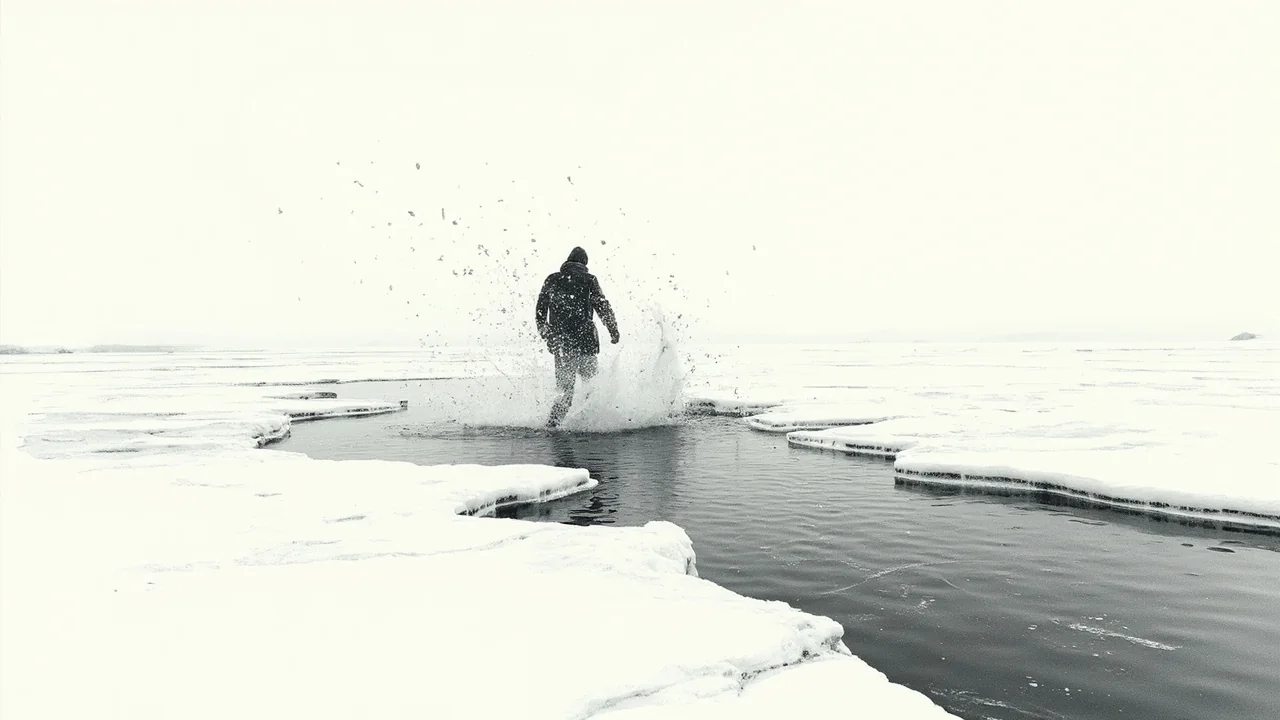
Norway's emergency services are issuing urgent warnings after a man in his 60s fell through the ice at Tveitavannet lake in Alver municipality. The incident occurred Saturday morning, with police receiving the alert at 12:40 PM on Sunday. The man was in the freezing water for 10-15 minutes before other people on the ice helped pull him to safety. He was conscious, walking on his own, but wet and suffering from hypothermia, according to police operations leader Knut Dahl-Michelsen.
This near-tragedy has triggered a widespread safety alert across western Norway. Police confirm they received multiple concern reports about people on ice throughout the weekend across the entire Vest police district. The warning comes as temperatures rise, creating deceptive and dangerous conditions on lakes and coastal waters.
A Close Call on Thin Ice
The rescue was a community effort. The man, who was not alone on the ice, shouted for help after breaking through. His companions managed to assist him out of the water. "He has been on the ice together with others, who helped him up," Dahl-Michelsen stated. This detail highlights a critical safety rule: never venture onto ice alone. The man's condition, while serious, could have been far worse without immediate assistance. Emergency responders stress that time is the enemy in cold water immersion. Even a few minutes can lead to incapacitation and drowning.
Vaktleder Stian Kvam at the 110 emergency center was blunt in his assessment. "When there is a change in the weather and it gets mild, we advise against going out on the ice if you haven't measured it yourself, preferably in several places," he said. His advice is straightforward: "People must be careful. If they have no idea, they should avoid going out on the ice." He specifically warned about the rapid effect of warmer air on sea ice compared to freshwater lakes.
The Deceptive Danger of Warming Trends
Norway is experiencing a shift in weather patterns, with milder temperatures following a prolonged cold spell. This creates a false sense of security. Thick, stable ice formed over weeks can weaken dramatically in just days or even hours under plus-degree temperatures and sunlight. The ice near shores, around inlets, or over moving water is often the first to become unstable.
Police operations leader Dahl-Michelsen expressed a nuanced concern. "Yes and no," he replied when asked if the rising temperature was a major worry. He emphasized personal responsibility. "It is up to people themselves to make risk assessments before they go out. It has been cold for a long time, so many places will probably still be safe. But then you get situations like this, where someone falls through and it wasn't so safe after all." His statement captures the central dilemma: generalized warnings are difficult when conditions vary from one pond to the next.
The Science of Ice and Human Risk
Understanding ice safety requires basic knowledge. Clear, blue ice is generally the strongest. White, opaque, or "snow ice" is weaker because it contains air pockets. Ice over flowing water, near streams, or where underwater springs exist is always hazardous. The standard safety guideline in Norway is that ice should be at least 10 centimeters thick for walking, and significantly more for groups or activities like ice fishing. Crucially, thickness is never uniform. It must be checked frequently by drilling test holes along the intended route.
Experts point out that the human body's reaction to cold water shock is a primary killer. The initial gasp reflex can cause inhalation of water. Within minutes, muscle control fails, making self-rescue nearly impossible. This makes the presence of companions, safety spikes, and a rope essential for anyone venturing onto frozen surfaces. The rescued man's 10-15 minute immersion represents an extremely dangerous timeframe.
Community Guidelines and Official Advice
Local municipalities, including Bergen, have published clear guidelines for ice travel. They recommend avoiding ice altogether unless its thickness and quality have been professionally assessed or meticulously self-measured. Key advice includes: never go alone, inform someone of your route and return time, carry safety equipment (ice picks, rope, a life jacket), and spread out when in a group to distribute weight.
Parents are specifically urged to supervise children closely near frozen water. The natural attraction of a smooth ice surface for play is a perennial concern for emergency services. The police statement included a direct appeal: "adults must keep an eye on children." Public awareness campaigns often highlight that snow cover can insulate ice, preventing further thickening, and can hide cracks and weak spots.
A Broader Pattern of Winter Risk
This incident is not isolated. Every year, Norwegian rescue services respond to multiple calls involving people and vehicles breaking through ice. While many end with a scare and a warning, some result in fatalities. These events peak during transitional weather periods—early winter when ice is forming and late winter/early spring when it is decaying. The current warning period is particularly perilous because people have grown accustomed to stable winter conditions.
Fire and rescue services (Brannvesenet) often lead these rescue operations, which are high-risk for the responders themselves. Special suits, sleds, and protocols are required to perform ice rescues without creating additional victims. Their public warnings are born from direct, often traumatic, experience.
Analysis: Balancing Freedom and Safety
Norway's relationship with nature, or friluftsliv, is central to its national identity. The right to roam freely is cherished. This creates a cultural tension when authorities must issue restrictive warnings. The approach, as seen in the police statements, tends to emphasize informed personal judgment rather than outright bans. The message is not "don't go," but "go only if you are competent, equipped, and have verified the conditions."
This philosophy places a significant burden on individual knowledge and preparation. It assumes people can accurately assess complex natural hazards. The man who fell through the ice at Tveitavannet likely believed the ice was safe, based on recent cold weather. His misjudgment is a common one. The challenge for safety agencies is to make technical knowledge about ice formation and decay more accessible and actionable for the general public.
The Path Forward: Education and Preparedness
The solution lies in sustained education. This includes teaching ice safety in schools, providing clear, map-based information on local ice conditions where possible, and promoting the use of simple safety gear. Retailers selling winter sports equipment could play a role by bundling ice picks with skates or sleds.
Technology may also offer tools. Some Nordic communities use online portals where trained volunteers report ice thickness measurements at popular locations. While not an official guarantee, such crowd-sourced data can inform better decisions. Ultimately, fostering a culture where checking ice with an auger and spud is as routine as checking the weather forecast could save lives.
The man from Alver municipality is fortunate. His story is a warning that resonated across police districts. It underscores a simple, vital truth: ice is always dynamic and often deceptive. Respect for its power is the first and most important piece of safety equipment anyone can possess. As the Norwegian winter continues its transition toward spring, that respect will be the key determinant between a safe adventure and a desperate call to the 110 emergency line.