
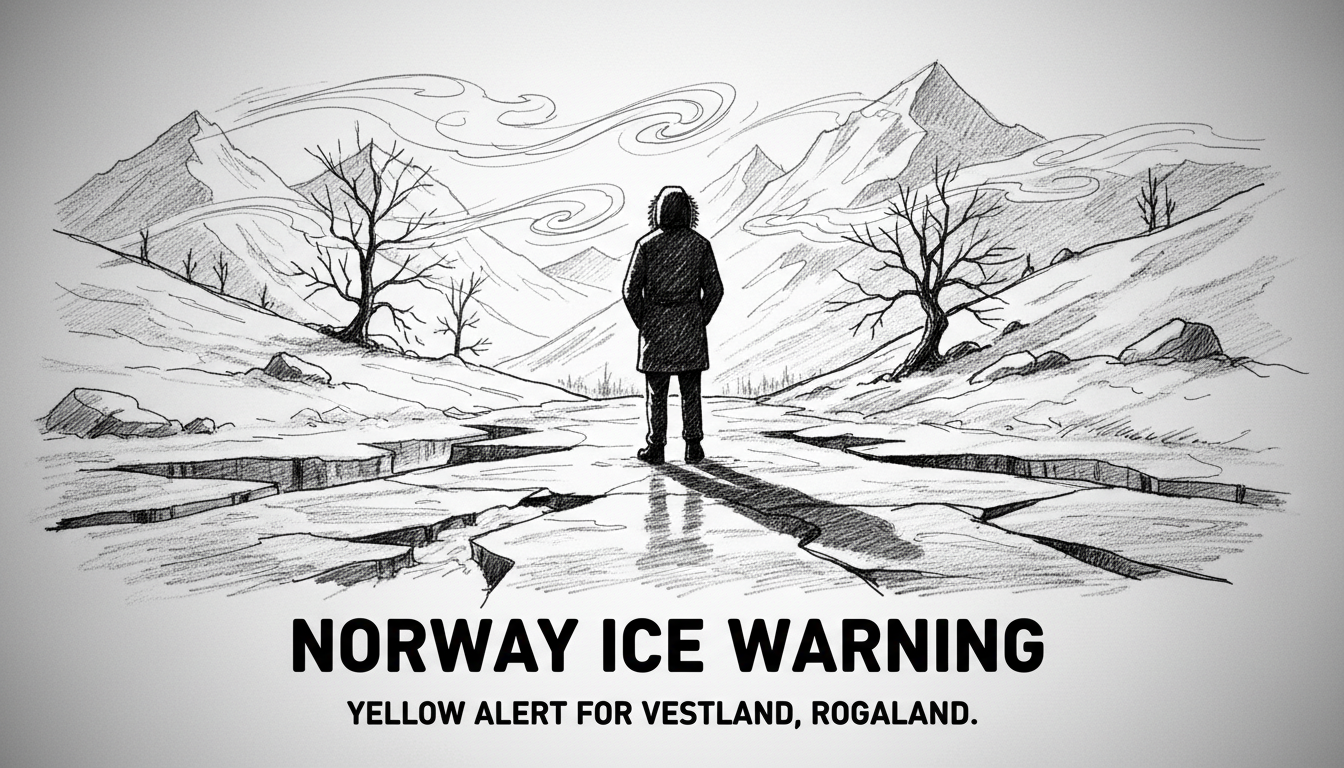
Norway's Meteorological Institute has issued a yellow ice warning for Vestland and northern Rogaland, creating hazardous driving conditions from Wednesday morning. The alert covers municipalities including Haugesund, Sauda, and Suldal, where a shift to milder weather brings rain that freezes on cold ground. This creates a treacherous layer of black ice, difficult for drivers to see and anticipate.
Meteorologists warn precipitation may start as snow or sleet before transitioning to freezing rain. The primary risk period begins Wednesday morning, with conditions expected to deteriorate rapidly as temperatures hover near freezing. Local transport services, including buses and ferries serving coastal communities, could face delays or cancellations.
"We strongly advise people to allow extra time for travel and to ensure their vehicle is equipped with proper winter tires," a meteorologist from the Institute said in a statement. "The ice can be very difficult to see, especially in the early morning or evening light."
A Familiar Yet Dangerous Winter Hazard
This type of weather event is a common but perilous feature of Norwegian winters, particularly in coastal and fjord regions. The phenomenon occurs when a layer of mild, moist air moves over cold air trapped at the surface, often in valleys and near fjords. Rain falls through the mild layer but freezes instantly upon hitting the cold ground or road surfaces.
The resulting glaze ice, often called "black ice," provides almost no traction. It is especially dangerous on bridges, shaded forest roads, and higher elevation stretches of the E39 and E134 highways in the affected regions. The topography of western Norway, with its deep valleys and steep gradients, can turn a routine commute into a significant challenge during such warnings.
"These conditions catch even experienced drivers off guard," said Lars Moe, a senior advisor at the Norwegian Public Roads Administration (Statens vegvesen). "The road might look merely wet, but it's actually a sheet of ice. We see a marked increase in single-vehicle accidents where cars simply slide off the road."
Economic and Logistical Ripple Effects
Beyond immediate safety concerns, yellow ice warnings trigger a cascade of logistical adjustments. Freight transport along the vital coastal corridor can slow, impacting supply chains. School bus routes in rural parts of Rogaland and Vestland are often evaluated on a case-by-case basis, with parents advised to check local updates.
For businesses, the warning means employees may arrive late or need to work remotely. The Norwegian Labour Inspection Authority (Arbeidstilsynet) emphasizes that employers have a responsibility to account for weather warnings in their workplace safety assessments. This is particularly relevant for sectors like construction, home healthcare, and offshore supply where travel is non-negotiable.
Insurance companies also note these official warnings. In the event of an accident during an active weather alert, insurers may scrutinize whether the driver took adequate precautions, such as fitting approved winter tires, which are legally required in Norway from November to Easter.
"A yellow warning means the hazard is predictable," explained Kari Solberg, a risk analyst with If Forsikring. "It strengthens the expectation that drivers will adjust their behavior. Not doing so could be considered contributory negligence in an insurance claim."
Preparedness and Public Response
The Norwegian response to such warnings is shaped by a culture of preparedness known as "dugnad" – a collective effort. Local emergency services, including the Norwegian Red Cross and volunteer rescue organizations (Redningsselskapet), often place extra teams on standby. Municipalities activate their winter road maintenance plans, focusing on spreading gravel and salt on priority routes.
However, resources are stretched thin across vast, sparsely populated areas. Treating every secondary road and rural lane is impossible. This reality places the onus squarely on individual preparedness. The Meteorological Institute's advice is straightforward: calculate extra travel time, use the correct tires, and drive according to the conditions, not the speed limit.
Many Norwegians use the official weather app "Yr" or listen to radio broadcasts for the latest updates. The app provides detailed, location-specific forecasts and warning maps, allowing residents in affected valleys to make informed decisions about their day.
The Broader Climate Context
While icy conditions are a staple of Norwegian winters, meteorologists are studying potential shifts in their frequency and intensity due to a changing climate. Warmer global temperatures can lead to more volatile weather patterns, including increased instances of winter precipitation falling as rain rather than snow in coastal areas.
This particular event, with its transition from cold to mild air, fits into a pattern of increased weather variability. Research from the Bjerknes Centre for Climate Research suggests that while winters may become milder on average, the incidence of freeze-thaw cycles and ice formation on roads could remain a persistent, or even growing, challenge in certain regions.
"We're not saying winters will disappear," said climate researcher Dr. Ingrid H. Onarheim in a recent briefing. "We're saying the character of winter weather is becoming more complex. Periods of severe cold can still be followed by rapid warming and precipitation, which is exactly the recipe for dangerous ice."
Navigating the Invisible Threat
As the yellow warning takes effect, the most critical message remains focused on visibility—or the lack thereof. Black ice blends seamlessly with asphalt, making advanced detection nearly impossible. Drivers are advised to watch for signs like a lack of spray from other vehicles, a sudden quieting of tire noise, or subtle, unexplained steering wheel movements.
In the rugged terrain of Vestland and Rogaland, a simple slide can have serious consequences, leading vehicles into ditches, rock faces, or fjords. The warning serves as an official reminder that Norway's dramatic landscape demands respect, especially in winter. The coming days will test the routine preparedness of western Norway, as communities from Haugesund to the inner fjords navigate the invisible hazard coating their roads.
Will this yellow warning pass as a minor disruption, or will the freezing rain leave a more significant mark on the region's roads and routines? The answer lies in the delicate and dangerous balance between the air above and the frozen ground below.