
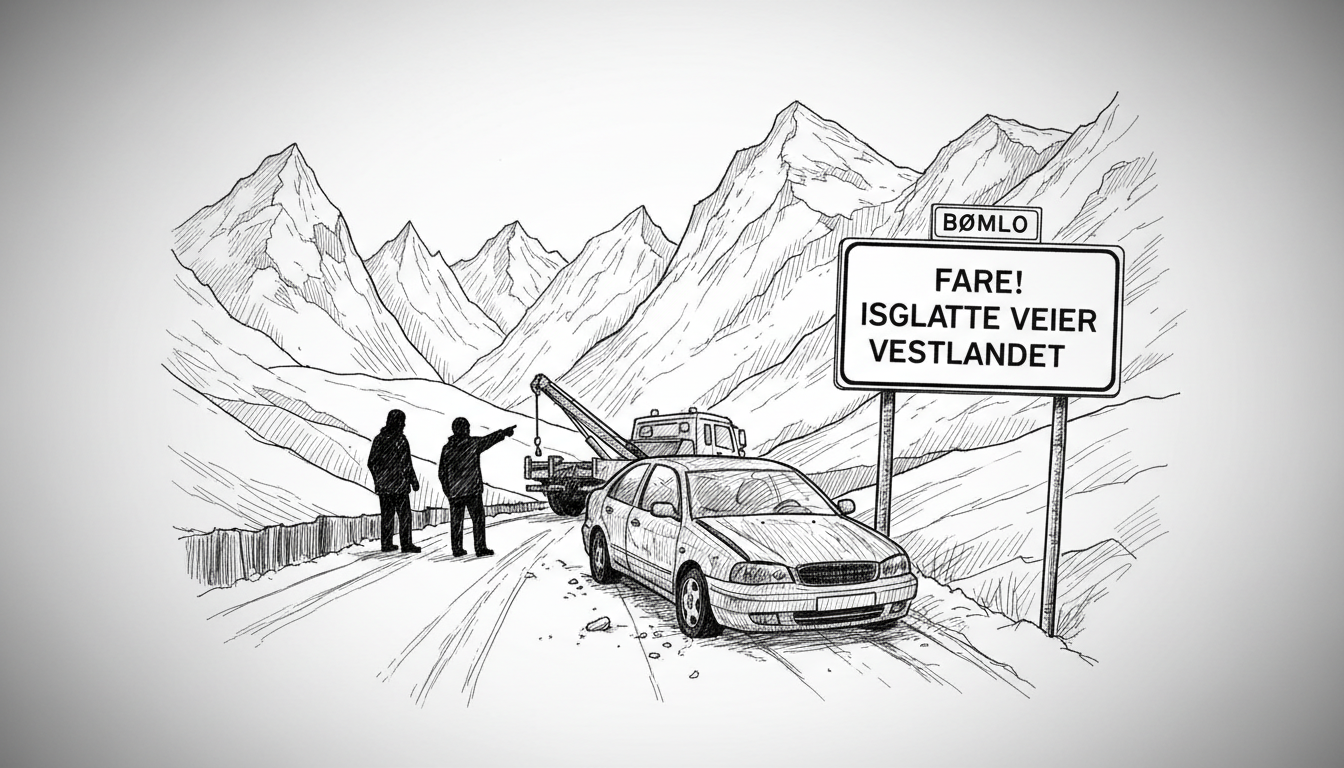
Norway's treacherous winter roads have claimed another victim, with a car flipping onto its roof near the Bømlo bridge on Wednesday morning. Police reported 'extremely slippery' conditions at the scene, noting several other vehicles nearly skidded off the road while emergency services were present. The incident triggered a cascade of warnings across Vestlandet, highlighting the perennial battle between Norwegian infrastructure and the country's harsh coastal climate.
"We have crews out and hope it will subside during the day," said Andreas Rasmussen at the West Road Traffic Centre. His statement, "We hope it will subside," underscores the reactive nature of managing these sudden, dangerous weather shifts. Crews were dispatched to salt and grit affected roads, but the accident served as a stark reminder of the limits of such measures.
A Coastal Weather Trap
The Bømlo accident was not an isolated event. The Norwegian Meteorological Institute issued a yellow-level danger warning for ice across parts of Vestlandet. Meteorologists pointed to a classic and dangerous coastal weather pattern: a transition to milder air and rain falling onto frozen ground. This creates a nearly invisible layer of black ice, or "glattis," which is particularly deceptive and hazardous for drivers.
"Precipitation may in some places start as snow or sleet," the forecast noted. The warning advised drivers to allocate extra time for travel, use correct tires, and adjust their speed to the conditions. This scenario is familiar to residents of Western Norway, where fjords and maritime influences cause rapid temperature fluctuations. One moment the road is wet; the next, it is an ice rink.
The Human Factor in Winter Driving
While authorities scramble to treat roads, experts consistently point to driver behavior as the critical variable. The driver of the overturned car was reportedly conscious and alert after the accident, a fortunate outcome in such a severe crash. This incident, however, forces a recurring question: are public awareness campaigns and legal requirements for winter tires enough?
Road safety organizations in Norway tirelessly emphasize the 'three-second rule' for increased following distance on winter roads, along with smooth, gentle inputs for steering and braking. Yet, as this crash demonstrates, theory often collides with reality on a slick curve. The pressure of daily commutes, overconfidence in vehicle technology, and the simple misjudgment of a road's surface can have immediate consequences.
Infrastructure and Response Under Scrutiny
The response to the Bømlo incident followed a well-rehearsed protocol. Police secured the scene, the road traffic centre was notified, and contractors were sent to salt the area. This system is generally effective, but it is fundamentally reactive. The challenge lies in predicting exactly where and when ice will form with enough lead time to prevent accidents.
Bømlo, an island municipality connected by bridges, presents a specific vulnerability. Bridges and elevated road sections freeze faster than regular roads, a fact known to both engineers and drivers. The accident site near the Bømlo bridge is a textbook example of such a high-risk zone. The question for transportation authorities is whether additional proactive measures—like automated anti-icing systems or more dynamic warning signs—are warranted at known blackspots.
A Regional Warning with National Relevance
While Vestlandet grappled with ice, other parts of Norway faced different winter threats. Meteorologists also warned of significant snowfall, between 10 to 20 centimetres, in the Trøndelag region. They cautioned about difficult driving conditions, delays, and the possibility of reduced visibility and closed roads due to blowing snow.
This dual threat of ice on the coast and heavy snow inland typifies a Norwegian winter. It stretches resources and demands versatility from both road maintenance crews and drivers. The situation in Vestlandet acts as a case study for the entire country, demonstrating how quickly conditions can deteriorate and how vital preparedness is.
The Economic and Social Cost of Winter
Beyond the immediate danger to life and limb, these weather disruptions carry a significant economic toll. Delayed freight, missed work hours, and increased strain on emergency services all accumulate cost. For communities on islands like Bømlo, where bridge connections are lifelines, even a temporary degradation in road safety can feel isolating.
It also tests the social contract in a country where personal mobility is often essential. Drivers are expected to equip their vehicles with proper winter tires, studded or high-quality friction tires, and to drive with utmost care. In return, the state is expected to maintain roads to a safe standard. Incidents like the Bømlo crash occur when this contract breaks down, whether due to weather outstripping response times or human error.
Looking Ahead: Adaptation or Acceptance?
As the crews finished salting the roads around Bømlo and the damaged car was towed away, the broader conversation continues. Norway has some of the world's most experienced winter road managers and a population skilled in cold-weather driving. Yet, accidents persist. Climate change introduces new variables, with potential for more frequent freeze-thaw cycles in coastal regions.
The path forward likely involves a combination of sharper technology—such as more precise, hyper-local weather forecasting for road networks—and a cultural reinforcement of defensive driving. The hope that dangerous conditions "will subside," as the traffic centre official expressed, is a natural one. But for the thousands of Norwegians who must travel on days like these, hope is not a strategy. It must be paired with caution, preparation, and respect for the immense power of a Nordic winter.
The final question remains whether this seasonal dance with danger on icy roads is a manageable risk or an inevitable price of living in a nation whose beauty is matched by its climatic severity. The answer, for now, lies in the careful hands of every driver navigating the glistening, potentially treacherous, asphalt home.