
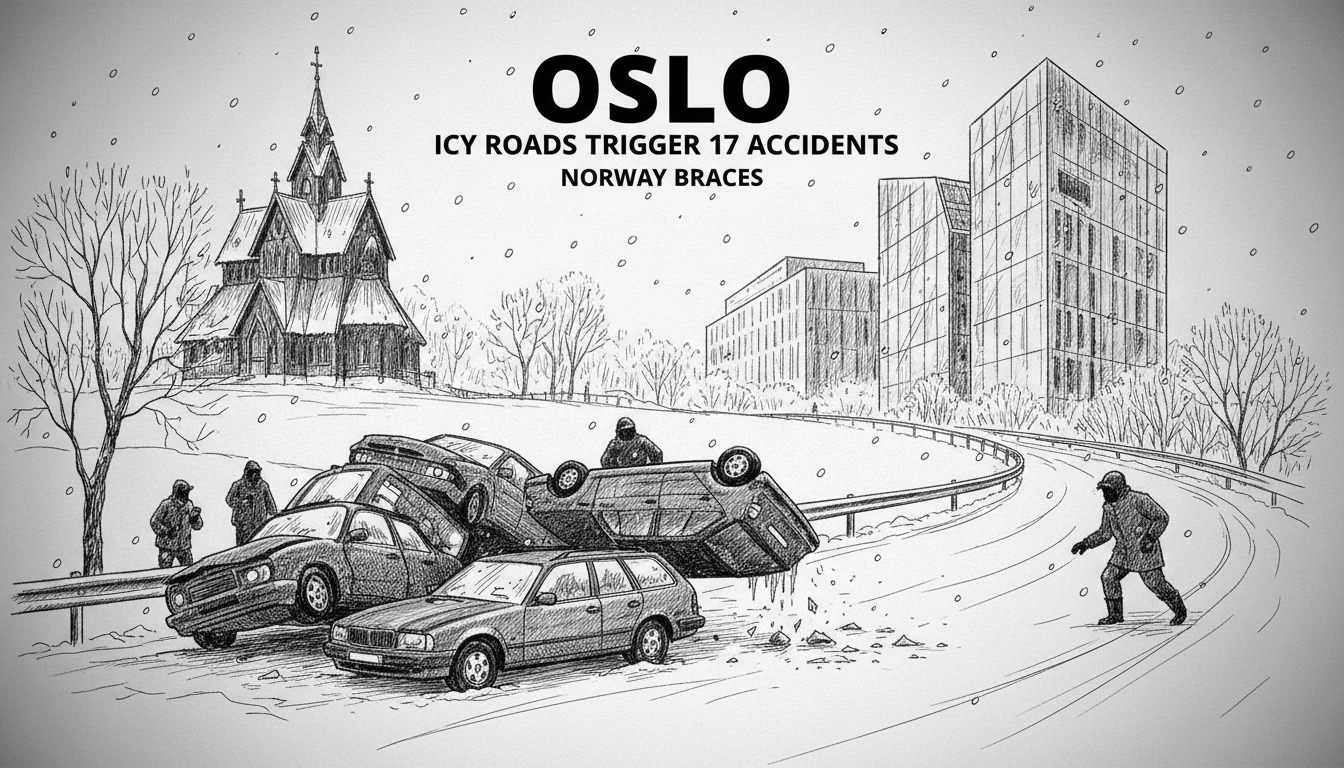
Norway winter driving conditions deteriorated sharply across the south and east Tuesday evening, triggering at least 17 minor traffic accidents as ice coated major roadways. Emergency services responded to incidents from the inner fjords of Østfold to the coastal bends of Telemark, highlighting the perennial seasonal challenge of maintaining safe passage on Norway's extensive road network.
A car slid into a ditch along Skiptvedtveien in Våler, Østfold, just before 7:00 PM. Earlier in the evening, another vehicle collided with a guardrail on the European route near Kragerø, sending two individuals to a local emergency clinic for evaluation. Police reports from the Sør-Østlandet and Vestlandet regions described a pattern of slippery surfaces and loss-of-control incidents, though no fatalities were immediately reported.
A Predictable Yet Persistent Hazard
This week's incidents are not an anomaly but a feature of the Norwegian winter. According to annual data from Statistics Norway (SSB), road traffic accidents increase by a significant margin during the winter months, primarily due to slippery conditions. The transition periods between autumn and winter, and winter and spring, are particularly hazardous. Black ice, which forms when moisture freezes on seemingly dry asphalt, poses the greatest threat, often catching drivers unaware on shaded stretches of road or bridges.
“The first major freeze of the season always catches some people out,” said Lars Holm, a senior advisor with the Norwegian Public Roads Administration (Statens vegvesen). “Drivers may have grown accustomed to autumn conditions and haven't fully adjusted their behavior or ensured their vehicle is prepared for winter.” The agency maintains a detailed online road condition map, which showed widespread yellow and red warnings for ice across southeastern Norway throughout Tuesday.
The Critical Role of Infrastructure and Preparedness
Municipalities and the national roads administration operate a fleet of plows and salting trucks, but their effectiveness depends on timing and resources. Pre-emptive salting before a freeze can prevent ice bonding to the road surface. However, heavy snowfall followed by a temperature drop can overwhelm response teams. The geography of regions like Østfold, with its mix of forest roads and open agricultural land, and the coastal hills around Kragerø, creates microclimates where conditions can change rapidly over short distances.
Road safety experts consistently emphasize a three-part strategy for winter driving: proper equipment, adjusted behavior, and increased awareness. “Winter tires are a legal requirement in Norway for a reason, but they are not magic,” explained traffic safety researcher Kari Nilsen. “They provide significantly better grip on snow and ice than summer tires, but drivers must still reduce their speed and increase their following distance. On ice, stopping distances can be ten times longer than on dry asphalt.”
Many of the accidents reported, like the one on the European route near Kragerø, occur on major roads where drivers may feel overly confident and maintain higher speeds. The European routes, while generally well-maintained, are not immune to sudden icy patches, especially near coastal areas where damp air freezes.
Economic and Social Ripple Effects
Beyond the immediate risk to life and limb, these seasonal accident clusters have broader implications. They strain local emergency medical services and police resources. Each incident requires a response team, potentially diverting attention from other emergencies. For the individuals involved, even a minor collision can mean vehicle repair costs, insurance claims, and personal injury.
The Norwegian economy also feels the impact. Transportation delays caused by accidents and cautionary road closures affect logistics and commuting. In a country where personal vehicle travel is often essential outside major urban centers, unreliable winter road conditions can disrupt daily life, from getting to work to accessing services.
Some communities, particularly in the mountainous inland and northern regions, have adapted with a higher cultural acceptance of winter road risks and preparedness. However, in more populous southern regions like where Tuesday's accidents occurred, higher traffic volumes combine with variable conditions to create a significant hazard. The Norwegian Council for Road Safety (Trygg Trafikk) runs annual winter awareness campaigns, but the message competes with the daily routines of millions of drivers.
A Look at Policy and Technology
Authorities continually assess methods to improve winter road safety. Research is ongoing into more effective and environmentally friendly de-icing agents. Road engineering also plays a part; improving drainage to prevent water pooling and freezing is a constant focus. There is also a push for broader adoption of advanced driver-assistance systems (ADAS), like electronic stability control, which can help mitigate skids.
However, policy debates often arise regarding resource allocation. Is more funding needed for road maintenance, or should investment focus on public transportation alternatives to get people off the roads during the worst conditions? In cities like Oslo, the expansion of winter cycling infrastructure, with cleared and salted bike paths, offers one alternative for shorter journeys.
For now, the responsibility remains a shared one. Statens vegvesen must provide accurate, timely information and efficient road clearing. Municipalities must execute local maintenance plans. And ultimately, individual drivers must make the choice to fit proper tires, slow down, and pay full attention to the road ahead.
The Human Factor in a Harsh Climate
The incidents in Våler and Kragerø ended with property damage and minor injuries—a fortunate outcome. They serve as an annual reminder of the power of nature in a country that, despite its wealth and technological prowess, remains at the mercy of its climate. Norway has mastered living with winter in many ways, from its insulated homes to its thriving winter sports industry. Yet the simple act of driving from point A to point B during a freeze continues to present a formidable and sometimes deadly challenge.
As the winter deepens, the pattern seen Tuesday will likely repeat. The question for Norwegian authorities and drivers is not if, but when and where the next cluster of icy road accidents will occur—and whether the lessons from this week's skids will be remembered before the next freeze sets in.