
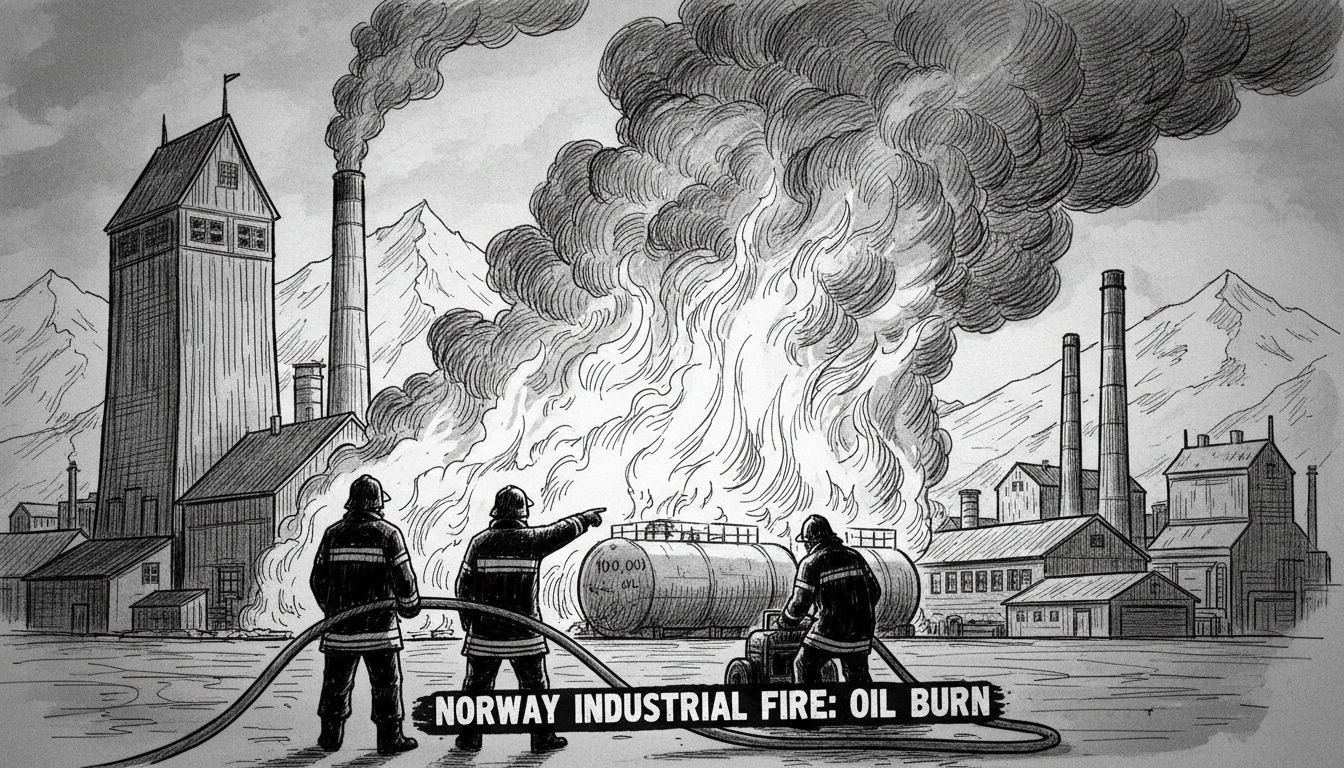
Norway's Hol and Ål municipalities are battling a major industrial fire involving a critical piece of electrical infrastructure. A transformer station at Kleivi Næringspark, on the border between the two municipalities, erupted in flames with an estimated 100,000 liters of transformer oil fueling the blaze. The fire is expected to burn for several hours, causing power outages and raising significant environmental concerns.
“There are 100,000 liters of transformer oil there. It is burning inside a concrete construction, and this is open at the top. It has burned so intensely that cables running over the station have collapsed,” said incident commander Atle Kleivdal of Hol Fire and Rescue. The fire is contained within a fenced area, but its intensity has severed power lines, leaving parts of the industrial park without electricity.
A Complex and Hazardous Firefighting Operation
Firefighters from Hol and neighboring Ål municipalities face a difficult and protracted operation. Transformer oil, or mineral insulating oil, is highly flammable and can burn at extreme temperatures. The fact that the fire is burning within a concrete enclosure with an open top presents a specific challenge; it contains the immediate spread but can also intensify heat and complicate direct firefighting efforts.
“This is not a fire you simply put out with water,” explained Lars Mikkelsen, a former fire safety engineer with the Norwegian Directorate for Civil Protection (DSB). “The primary goals are containment and controlled burn. You must prevent the oil from escaping the containment area, which could create a larger surface fire or cause severe environmental damage. The strategy will involve cooling surrounding structures and allowing the fuel within the sealed section to burn out under supervision.”
The collapse of overhead power cables, as reported by the incident commander, underscores the fire's ferocity. It also creates an additional safety hazard for emergency crews and complicates restoration of power to the affected industrial units.
Power Grid Vulnerability and Economic Impact
While Norway's grid is famously resilient due to its distributed hydroelectric network, local transformer stations are crucial nodes. They step down high-voltage electricity from main transmission lines to lower voltages suitable for factories and businesses. The outage at Kleivi Næringspark halts operations for an unknown number of businesses, causing immediate economic losses.
The duration of the power cut will depend on how quickly the fire is secured and damage assessed. Replacing a large transformer and associated switchgear is not a quick task; lead times for major electrical components can stretch for months. Grid operator Bane NOR, responsible for the power supply in the area, may need to reroute power or install temporary substations to restore electricity if the damage is severe.
This incident highlights a often-overlooked vulnerability: concentrated industrial zones are dependent on single points of failure like a primary transformer station. A prolonged outage here could force smaller firms, without backup generation, to suspend production entirely.
Environmental Risks in a Sensitive Region
The environmental dimension of this fire is a major concern for local authorities. Hallingdal, where Hol and Ål are located, is a region defined by its natural beauty, with rivers, forests, and agricultural land. Transformer oil, if not contained, can contaminate soil and groundwater with hydrocarbons and, in older transformers, potentially with PCBs (polychlorinated biphenyls), though their use has been phased out.
“The concrete bunding around the transformer is the first line of defense,” said Dr. Ingrid Selmer, an environmental chemist at the University of Oslo. “If that integrity is compromised by the heat, or if firefighting water becomes contaminated and runs off, there is a real risk of pollution. The next 24 hours are critical. Authorities will need to monitor air quality for particulates and toxins, and immediately begin assessing soil and water samples downstream.”
The Norwegian Environment Agency (Miljødirektoratet) will likely be involved in the aftermath. The cost of environmental remediation following such fires can far exceed the cost of replacing the electrical equipment itself.
Questions of Safety and Infrastructure Maintenance
As the emergency response continues, questions will inevitably turn to prevention. Transformer fires, while not everyday occurrences, are a known risk in electrical engineering. The cause of this blaze is unknown and will be the subject of a thorough investigation by the Norwegian Safety Investigation Authority (NSIA) or local fire inspectors.
Key lines of inquiry will include the age and maintenance history of the transformer, the adequacy of the fire containment systems in place, and whether any recent work or faults preceded the incident. Industrial parks, especially those housing essential infrastructure, are expected to have robust fire detection and suppression plans.
“This event should serve as a check for municipalities and industrial park managers across Norway,” noted Mikkelsen. “It tests the local emergency response plans, the coordination between fire brigades from different communes, and the protocols for protecting critical infrastructure. The response in Hol and Ål will be studied.”
A Long Night Ahead for Hallingdal
For residents and business owners in the affected areas, the immediate reality is one of disruption and uncertainty. The glow from the industrial park will be visible for miles, a stark reminder of the latent energy that powers modern society and the chaos unleashed when it is uncontrolled.
The fire crews on site face a long and dangerous night. Their success will be measured not only in extinguishing the flames but in preventing an environmental incident that could linger long after the smoke clears. The true cost of the Kleivi Næringspark fire—in kroner, in lost productivity, and in environmental impact—will take weeks or months to fully calculate.
This blaze in the quiet borderland between Hol and Ål is more than a local incident; it is a case study in managing complex technological risks in a country whose wealth and way of life are built on the controlled harnessing of immense natural forces. When that control slips, even for a few hours, the consequences are immediate and severe.