
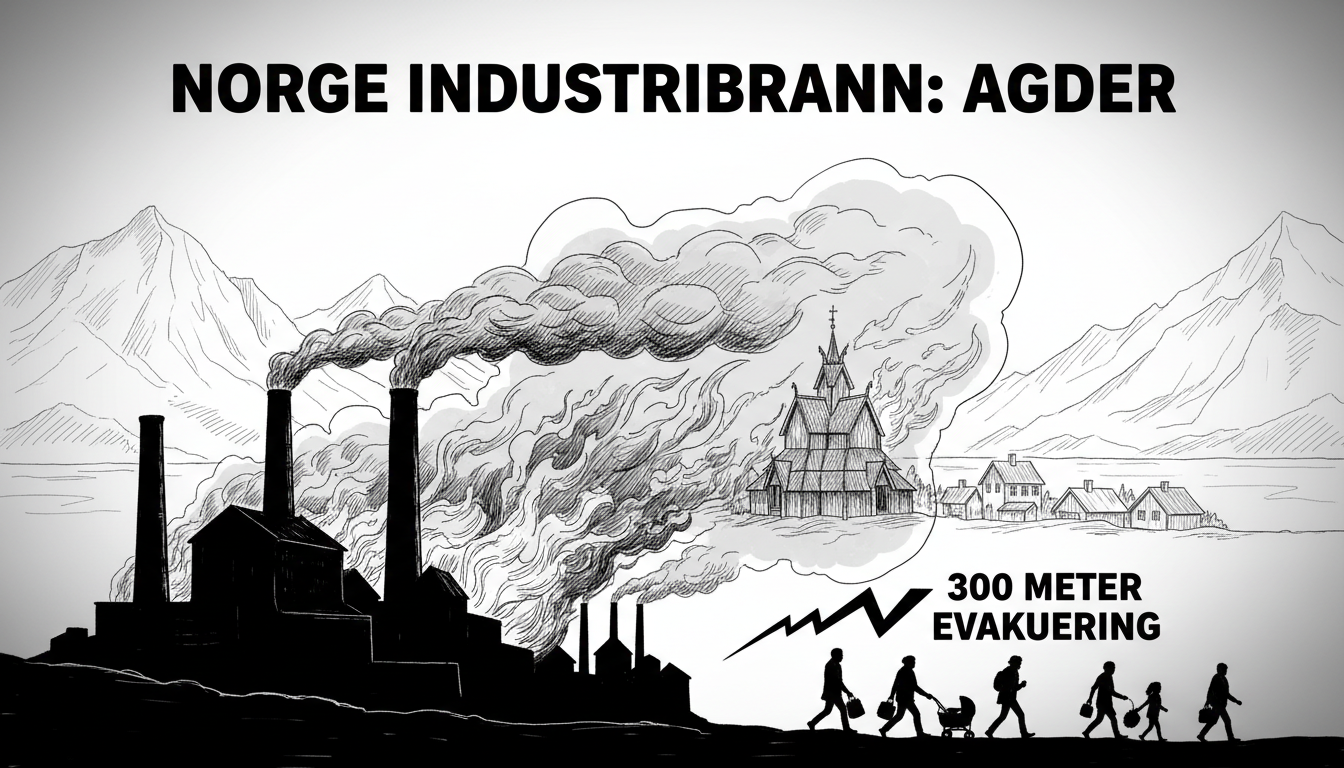
Norway's emergency services are responding to a major warehouse fire in the Agder county industrial area of Austerudsmoen. A 300-meter safety zone has been established and nearby residents are being evacuated due to the confirmed presence of stored gas and equipment inside the burning building. The fire was reported to Agder police district at 5:49 AM, with the structure now fully engulfed in flames.
Operational leader Arve Johan Myklebust confirmed the evacuation measures. "Some people who live nearby will be evacuated," Myklebust said in a statement. Firefighters report the blaze involves a significant overfire, but currently poses no immediate risk of spreading to adjacent buildings on the industrial estate.
The incident tests Norway's stringent industrial safety protocols, particularly for sites handling hazardous materials. Agder, formed in 2020 from the merger of Aust-Agder and Vest-Agder counties, hosts numerous industrial facilities subject to the country's strict regulatory framework.
Emergency Response and Evacuation Protocols
Establishing a 300-meter perimeter is a standard but serious precaution for fires involving potential explosives or toxic materials. This distance is designed to protect both emergency personnel and the public from secondary explosions or hazardous plume exposure. The decision to evacuate residents, rather than simply advise sheltering in place, indicates authorities are treating the stored materials as a credible threat.
Norwegian industrial fire response typically involves coordinated teams from multiple municipalities, especially for complexes like Austerudsmoen. The presence of gas, even in limited quantities, elevates the risk category significantly. Firefighting in such conditions often focuses on containment and cooling adjacent structures rather than aggressive interior attack, due to the instability of burning pressurized containers.
"When a safety zone of this scale is declared, it means the incident commander has identified specific explosion or toxicity hazards," explained Lars Holmen, a former chief of the Norwegian Directorate for Civil Protection. "The priority shifts from asset protection to life safety and preventing a domino effect."
Industrial Safety in Norwegian Context
Norway maintains some of Europe's most comprehensive regulations for industrial site safety, governed by the Framework Regulation of the Working Environment Act and the Fire and Explosion Prevention Act. Facilities storing hazardous materials must submit detailed risk assessments and emergency plans to local authorities. Regular inspections by the Norwegian Labour Inspection Authority are mandatory.
Industrial areas like Austerudsmoen are zoned specifically to separate high-risk activities from residential neighborhoods. However, the expansion of towns and cities sometimes creates proximity issues over time. The evacuation order suggests some residential dwellings fall within the potential hazard radius of this industrial zone.
Companies operating warehouses with hazardous materials must implement specific technical and organizational measures. These include specialized ventilation systems, explosion-proof electrical installations, and strict controls on ignition sources. The cause of this morning's fire will be a primary focus for investigators from the Norwegian Safety Investigation Authority, who will likely examine compliance with all these requirements.
Environmental and Economic Implications
Beyond the immediate danger, industrial fires in Norway carry significant environmental concerns. Agder's southern coastline features sensitive fjord ecosystems, including the nearby Topdalsfjorden. Runoff from firefighting water can carry contaminants into waterways, prompting involvement from the Norwegian Environment Agency in containment efforts.
Firefighting foam, particularly older types containing PFAS chemicals, presents its own environmental hazard. Norwegian fire departments have been phasing out PFAS-containing foams, but their use in an emergency involving flammable gases remains a possibility. The environmental impact will be monitored in the coming days.
The economic disruption from a major warehouse fire can be substantial. Austerudsmoen hosts various businesses, and the destruction of a storage facility can sever supply chains for regional industries. Loss of specialized equipment, as indicated in the initial report, can be particularly damaging for smaller firms operating in sectors like maritime services or engineering, which are prominent in Agder's economy.
Community Impact and Recovery
For evacuated residents, the incident creates immediate disruption and anxiety. Norwegian municipalities have protocols for providing temporary shelter, often in local schools or community centers. The Agder police district will manage the evacuation logistics while fire services contain the blaze.
Long-term community concerns often focus on air quality after such fires. The burning of synthetic materials and industrial chemicals can release particulate matter and toxic compounds. Health officials typically advise vulnerable groups, like those with respiratory conditions, to remain indoors with windows closed even after the visible smoke clears.
Insurance and reconstruction processes in Norway are generally efficient, but investigations into the fire's cause can delay rebuilding. If regulatory violations are found, the business owner could face substantial penalties and increased insurance premiums. The Norwegian system emphasizes learning from such incidents to prevent recurrence, often leading to nationwide safety bulletins.
Analysis: A Test for Integrated Emergency Systems
This fire represents a real-time test of Norway's much-praised integrated emergency response system. The model, which emphasizes coordination between police, fire, health, and environmental agencies, is designed for exactly this type of multi-faceted incident. The early establishment of a clear safety perimeter and evacuation order demonstrates this command structure in action.
However, challenges remain. Industrial areas increasingly store a complex mix of materials, sometimes beyond the scope of original risk assessments. The transition to new energy technologies means warehouses might contain lithium-ion batteries, hydrogen fuel cells, or other modern hazards alongside traditional chemicals. Fire services must continuously adapt their tactics and training.
The incident also highlights the tension between industrial activity and community safety in growing regions. As Agder develops, pressure on land use may bring housing closer to existing industrial zones. Municipal planners face difficult decisions balancing economic activity with residential safety, requiring robust zoning buffers and emergency planning.
Norway's response will be watched by safety professionals across the Nordic region. The country's low frequency of major industrial accidents is attributed to its preventive culture and strict regulation. How effectively this incident is contained, investigated, and used to improve future safety will be the true measure of that system's strength. The priority now remains the safety of responders and the community, but the lessons learned will resonate far beyond the borders of Agder county.