
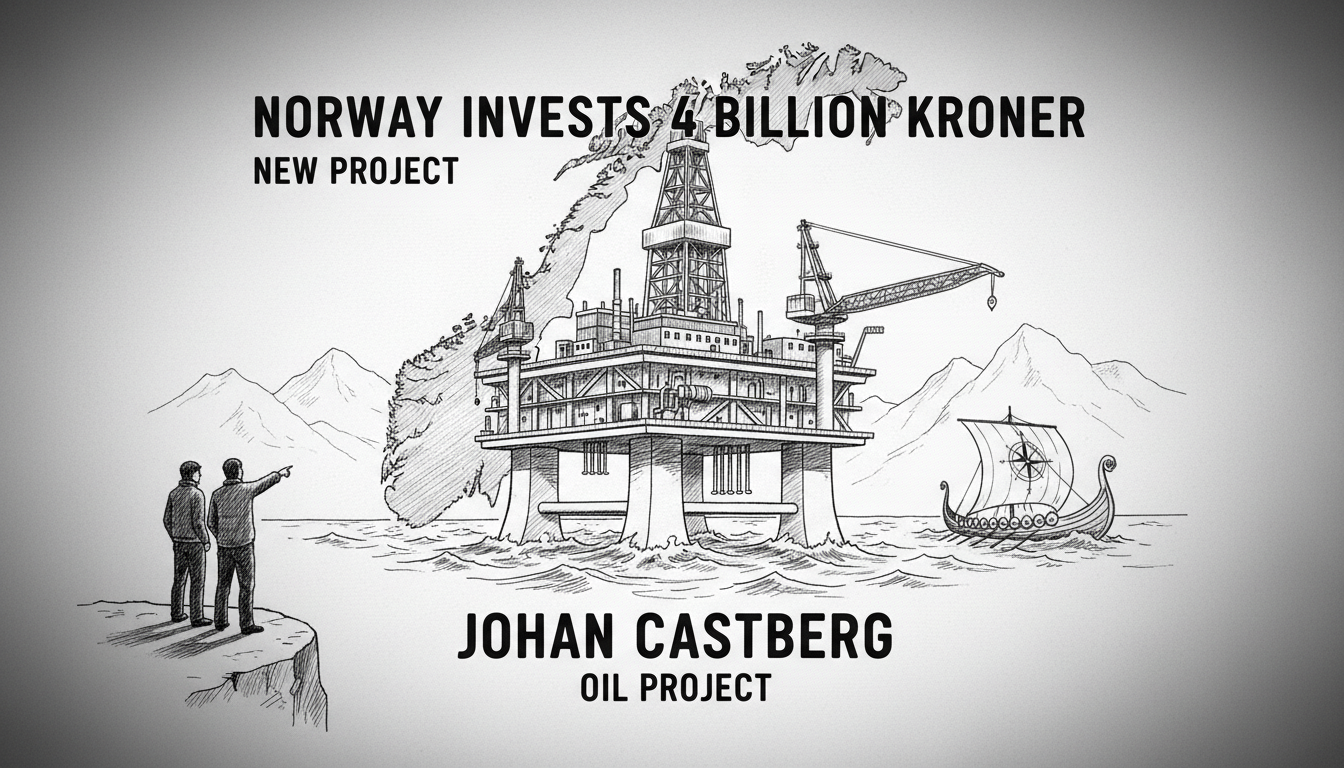
Norway's oil giants Equinor, Vår Energi, and Petoro will invest over four billion kroner ($370 million) in the first satellite discovery tied to the giant Johan Castberg field in the Barents Sea, just eight months after the field began production. This swift investment decision signals a strategic push to maximize output from Norway's northernmost oil province while facing intensifying global climate pressures. The new subsea development, known as the Isflak discovery, holds an estimated 46 million barrels of recoverable oil and is scheduled to start production in late 2028.
Trond Bokn, Equinor's director for project development, said the rapid timeline is possible due to standardized solutions copied from the main Johan Castberg platform. "The reservoir is in the same license and resembles previous developments, allowing us to replicate equipment and well solutions," Bokn stated. "Johan Castberg was developed as a future hub for the area. The Isflak discovery from 2021 is the first of several finds now maturing as additional volumes. This will create ripple effects for Norwegian suppliers."
A Hub Strategy in a Harsh Sea
The Johan Castberg field is the newest cornerstone of Norway's offshore oil industry, representing the nation's continued northward expansion. Located about 240 kilometers north of Hammerfest, it began production in March 2024 and currently pumps 220,000 barrels per day from the Snøhvit gas field area. The total recoverable resources for the main field are estimated between 450 and 650 million barrels. This new investment aims to extend the plateau production period and boost ultimate recovery.
Norwegian Continental Shelf policy is undergoing a significant shift. Future developments increasingly involve smaller, faster-tied satellite finds rather than massive standalone projects. This approach uses existing infrastructure—like the Johan Castberg floating production vessel—to reduce costs, cut development time, and minimize the environmental footprint per barrel. It also prolongs the economic life of major installations and their associated jobs.
"The Norwegian shelf is changing," a statement from the partners noted. "Many future developments are smaller discoveries that can be quickly tied to existing infrastructure and larger fields. This can reduce costs and environmental impact, extend value creation and jobs, and maintain Norway's role as a reliable, long-term energy supplier."
Economic Engine and Political Paradox
This investment underscores a central paradox in Norwegian policy: aggressive pursuit of offshore oil revenues alongside a stated commitment to steep emissions cuts. Norway is Western Europe's largest oil and gas producer, with total output around 1.8 million barrels of oil equivalent per day in 2023. Revenue from the state's direct financial interest and taxes funds the world's largest sovereign wealth fund, valued at over $1.6 trillion.
Extending the life of fields like Johan Castberg secures decades of future cash flow and high-skilled jobs, particularly in northern Norway. The supplier ripple effects Bokn mentioned are crucial for coastal communities from Stavanger to Hammerfest. Shipyards, engineering firms, and logistics companies depend on these serial development projects.
"Each decision like this is a microcosm of Norway's national dilemma," said Dr. Lena Sørensen, an energy policy analyst at the Oslo-based Institute for Energy Studies. "The government justifies continued Arctic exploration on the grounds of energy security for Europe and optimal resource management. Yet, every new barrel makes the eventual transition away from fossil fuels more complex, both economically and politically."
The Arctic Frontier's Environmental Calculus
Development in the Barents Sea carries unique environmental risks and operational challenges. The region is ecologically sensitive, with rich fisheries and a vulnerable Arctic ecosystem. Spill response in icy, remote conditions is notoriously difficult. However, proponents argue that Norway's strict regulatory framework and high technological standards make its operations among the cleanest globally.
Modern subsea tie-back projects, like the Isflak development, generally have a lower carbon footprint per barrel than building new platforms. They utilize shared processing and power. Equinor has also stated that the Johan Castberg field itself is electrification-ready, meaning future power could come from shore rather than gas turbines, slashing operational emissions.
"The industry's argument is one of comparative ethics," noted maritime lawyer Erik Thorsen. "They contend that if Europe needs oil during its transition, it is better sourced from a highly regulated, transparent operator like Norway than from jurisdictions with poorer environmental and human rights records. This logic fuels the political consensus for continued Barents Sea activity."
Expert Analysis: Between Transition and Tradition
Energy economists see the Isflak investment as a textbook example of Norway's "tail-end" strategy. "The era of megaprojects like Statfjord is over," explained Professor Arne Kalland at the Norwegian School of Economics. "The new model is about sweating the existing assets. You build a major hub like Johan Castberg, and then you spend the next 20-30 years connecting every feasible small discovery to it. This maximizes return on the initial infrastructure investment and keeps the supply chain alive."
This strategy has implications for Norway's climate commitments. While the country champions electric vehicles and funds global renewable projects through its wealth fund, its domestic carbon footprint is heavily tied to oil and gas extraction emissions. The government's updated climate action plan relies heavily on carbon capture and storage (CCS) technology to offset continued fossil fuel production.
"The political settlement is fragile," said Dr. Sørensen. "The Labour-led government maintains a parliamentary majority for this development path, but it is contingent on demonstrating tangible progress on CCS and electrification of platforms. If those technologies stall, public and international pressure will mount significantly."
The Road to 2028 and Beyond
The plan calls for the Isflak subsea system to be installed and operational in the fourth quarter of 2028. This aggressive schedule depends on efficient project execution and favorable ice conditions in the Barents Sea. The development will consist of two wells tied back to the Johan Castberg floating production, storage, and offloading vessel (FPSO).
Success here paves the way for more satellite tie-backs. Several other discoveries in the surrounding licenses are under evaluation. Johan Castberg could become a processing hub for a significant portion of the southeastern Barents Sea, extending its economic lifespan well beyond mid-century.
Norway's latest billion-kroner bet in the far north reveals a nation steadfastly committed to its oil and gas identity, even as the world's climate clock ticks louder. The Johan Castberg hub is now active, and its first satellite is funded. The question for Norway is not just how much oil it can recover, but how long its dual identity as a climate leader and hydrocarbon powerhouse can politically endure.