
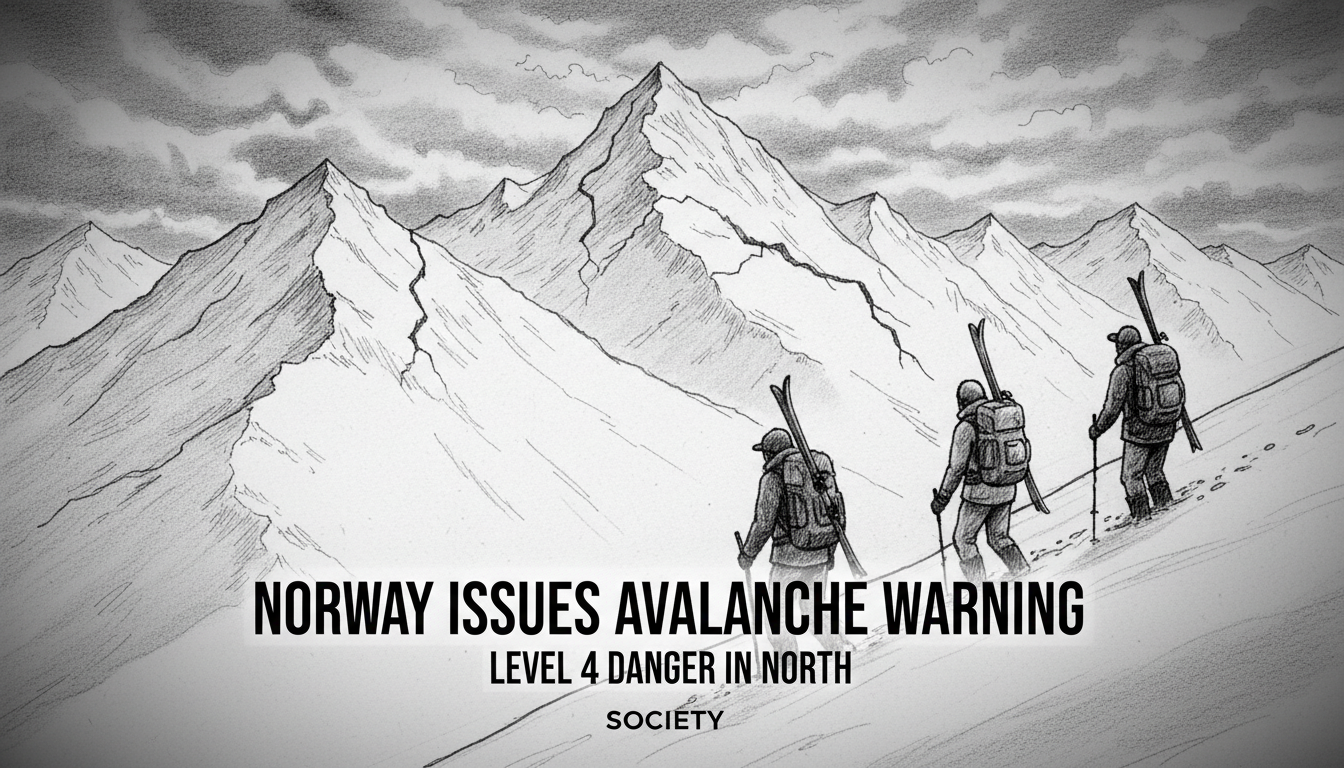
Norway's northern counties face a severe natural hazard threat over the Christmas holiday, with authorities issuing their second-highest avalanche warning and urging immediate public action. The Norwegian Water Resources and Energy Directorate (NVE) has declared a level 4 avalanche danger for parts of Nordland and yellow-level warnings for flooding in Troms and landslides around Bodø. This dangerous combination of heavy rain, strong winds, and snowmelt creates a perfect storm for potential disaster on Christmas Eve and Christmas Day.
“We ask residents and the emergency preparedness officials in the municipality to be prepared for the weather and natural hazards expected, and to assess the need for preventative measures,” said duty officer Torill Engen Skaugen at NVE in a public statement. The agency's direct warning underscores the seriousness of the situation. Forecasters predict mild weather will accelerate snowmelt, while substantial new rainfall threatens to overwhelm the ground's capacity to absorb water.
A Dangerous Holiday Forecast
The immediate cause is a powerful low-pressure system moving across the Norwegian Sea. It brings with it unseasonably warm air, driving temperatures above freezing even at higher elevations. This warmth attacks the existing snowpack, which NVE describes as "weak" in the mountains. The result is a highly unstable base layer. New snow and rain act as a heavy trigger on this fragile foundation, making large, spontaneous avalanches likely. In the valleys and coastal areas, the same rainfall, combined with rapid meltwater, pushes rivers and streams toward flood stage. The water's force also increases the risk of erosion, where riverbanks and the ground around building foundations are literally washed away.
Norway's avalanche danger scale runs from 1 (low) to 5 (very high). A level 4 warning signifies "high" danger, where natural avalanches are probable and human-triggered avalanches are very likely. Travel in avalanche terrain is not recommended, and experts often advise against any unnecessary backcountry activity. “A level 4 is a serious warning that demands respect and decisive action from both the public and local authorities,” explains Lars Henrik Aas, a veteran avalanche forecaster and consultant. “It often necessitates pre-emptive evacuations in the most exposed areas and means all recreational skiing in uncontrolled terrain should be cancelled.”
The Climate Change Context
While Norway is no stranger to harsh winter weather, scientists point to a troubling pattern intensifying these events. Climate change contributes to more frequent and intense bouts of extreme precipitation in Northern Norway. Warmer atmospheric temperatures hold more moisture, which then gets dumped as rain or snow during storms. Perhaps more critically, the warming climate leads to more precipitation falling as rain rather than snow at mid-elevations, even in winter. This rain-on-snow event is precisely what is forecast for Christmas—a phenomenon known to dramatically accelerate runoff and flood risk.
“What we are observing aligns with climate model projections for our region,” says Dr. Kari Eikenes, a climate researcher at the University of Tromsø. “The Arctic is warming at a rate three to four times the global average. This doesn't just mean less sea ice; it means our winter precipitation patterns are becoming more volatile. We see more of these abrupt shifts from cold to warm, with heavy rainfall destabilizing the snowpack. It creates a new and complex hazard landscape.” This evolving threat challenges traditional preparedness models and forces agencies like NVE to constantly adapt their forecasting.
Local Preparedness and Public Response
In response to the NVE warnings, municipal emergency services across Nordland and Troms have shifted to a heightened state of alert. The focus is on protecting life and property. Local authorities are identifying the most vulnerable areas—typically homes near steep slopes, in historical avalanche paths, or close to swelling rivers. In some communities, officials are going door-to-door to advise residents and recommend temporary evacuation. The national public warning website, Varsom.no, carries the blunt instruction to the public: secure property and clear drainage ditches before the severe weather hits in earnest.
Securing property involves moving vehicles, equipment, and outdoor valuables to higher ground. Clearing drainage ditches and culverts is a critical, simple step to prevent water from pooling and causing localised flooding. Residents are also advised to have emergency kits ready, including medications, important documents, warm clothing, and food supplies for at least 72 hours. For those in remote cabins or areas with a history of landslides, the advice is clear: consider leaving before conditions deteriorate on December 24th.
The Strain on Emergency Services
The timing of this event—spanning Christmas Eve and Christmas Day—presents a unique logistical challenge. It is a period when many Norwegians travel to be with family, filling mountain passes and secondary roads. It is also when emergency service staffing is often at a minimum, operating on holiday schedules. This requires meticulous pre-planning and coordination between county, municipal, and national agencies. The Norwegian Public Roads Administration is on standby to close roads pre-emptively if avalanche or flood risks become too great, a common measure on routes like the E6 and E10 in the north.
“Our biggest concern is always public complacency,” says Einar Jensen, a regional coordinator for the Norwegian Civil Defence. “People are at home celebrating, they feel safe, and they might underestimate how quickly a situation can develop. A blocked drain can flood a basement in an hour. A small stream can become a torrent that undermles a road. We rely on people heeding the warnings and taking those simple, proactive steps themselves.” The coordinated response involves continuous monitoring by NVE hydrologists and avalanche forecasters, with updates issued directly to municipal crisis teams and the public.
Looking Beyond the Holiday Storm
This Christmas warning is not an isolated incident. It fits into a broader trend of increasingly complex natural hazards facing Norway. The country's dramatic geography of steep mountains, deep fjords, and populated valleys makes it inherently susceptible to slides and floods. A warming climate acts as a force multiplier. In response, the Norwegian government has increased funding for hazard mapping and mitigation infrastructure, such as avalanche fences, retention dams, and improved drainage systems. However, the scale of the challenge is vast.
The ultimate goal is to move from pure response to greater resilience. This includes stricter zoning laws to prevent building in high-risk areas, investing in early warning technology, and maintaining public awareness campaigns. For now, the immediate focus remains on the communities of Nordland and Troms as they brace for a turbulent Christmas. The success of the response will be measured in empty avalanche paths, contained rivers, and families safe in their homes—a quiet Christmas being the best possible outcome under the circumstances. The storm will pass, but the questions it raises about living safely in Norway's majestic but demanding landscape will remain long after the floodwaters recede.