
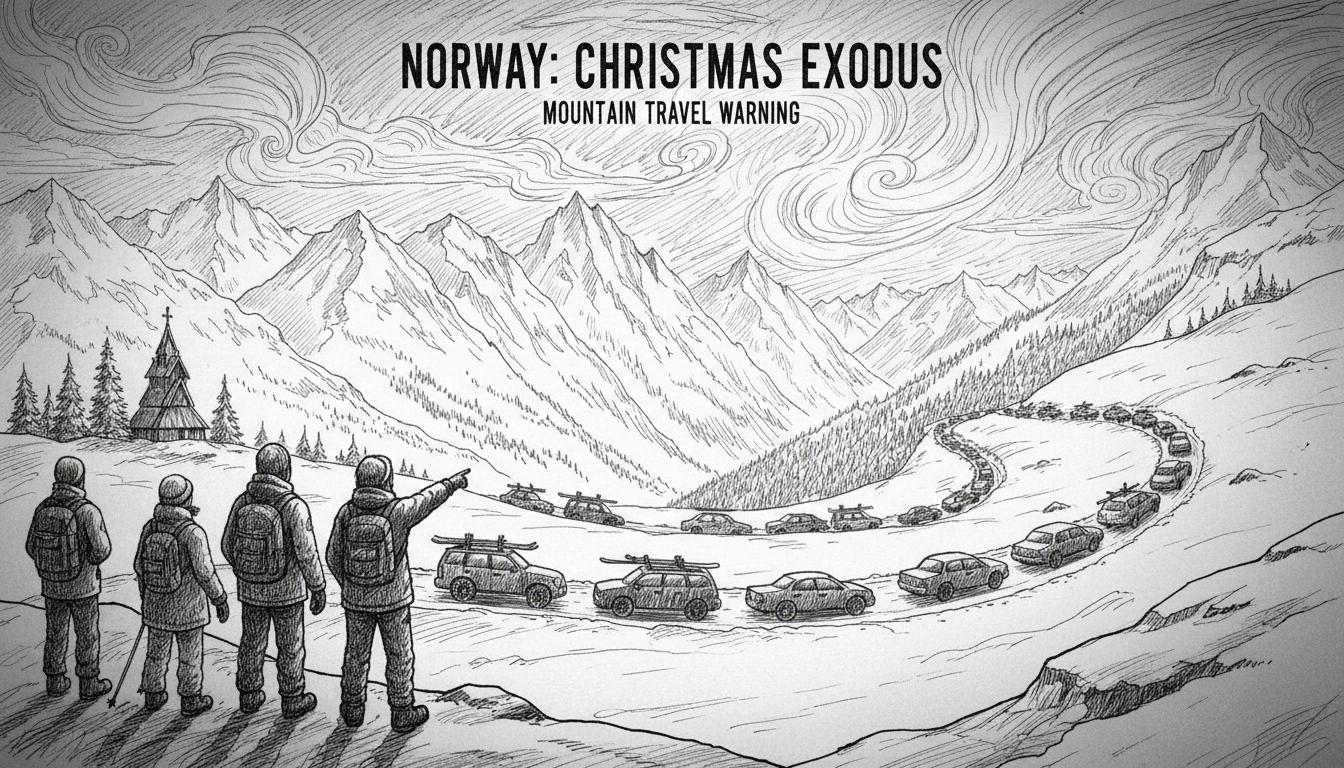
Norway's mountainous southern regions face hazardous driving conditions as the Christmas holiday travel period begins. The Norwegian Meteorological Institute has issued a yellow-level danger warning for localized snowdrifts, known as 'snøfokk,' starting Thursday evening and lasting through Friday afternoon. The warning covers mountain passes where strong winds are forecast to reduce visibility and cause snow to accumulate on roadways, creating a significant risk for drivers.
This annual pre-Christmas travel surge, termed 'juleutfarten,' sees thousands of Norwegians heading to mountain cabins or family gatherings. The convergence of heavy traffic and severe weather presents a perennial challenge for authorities. The yellow warning indicates a moderate level of danger, signaling that the public should be alert, plan extra travel time, and reconsider non-essential journeys through affected areas.
A Perilous Convergence of Weather and Tradition
The timing of this weather system is particularly problematic. It coincides with the start of one of the busiest travel weekends of the year. For many Norwegians, traveling to a 'hytte' or cabin in the mountains is a cherished Christmas tradition. This mass migration puts a strain on key mountain roads like the E134 over Haukelifjell, the E6 over Dovrefjell, and the RV7 over Hardangervidda. These high-altitude routes are exposed and especially vulnerable to sudden changes in weather.
Snøfokk is a uniquely dangerous phenomenon. It is not merely heavy snowfall. It involves strong winds picking up existing snow from the ground, creating a blinding, horizontal stream that drastically reduces visibility. It also leads to rapid and uneven snow accumulation on roads, creating drifts and making it difficult for drivers to discern the edge of the roadway. "The danger increases from Thursday evening around 10 PM and decreases from Friday at 1 PM," the Meteorological Institute stated in its alert, providing a critical window for travelers to avoid.
The Science and Strategy Behind the Warning
The Norwegian Meteorological Institute operates one of Europe's most sophisticated weather monitoring networks, crucial for a nation with such varied and often extreme terrain. A yellow warning is the second level in a three-tier system (yellow, orange, red). It triggers specific protocols for road authorities and emergency services. "We advise people to plan extra time for transport and driving," the Institute's warning explicitly states. It also urges the public to "avoid traveling in exposed places unless necessary."
Meteorologists point to the combination of moist air masses and strong pressure gradients that create these conditions. As low-pressure systems move across the North Sea and encounter Norway's mountainous spine, winds accelerate through valleys and over passes. When temperatures are below freezing, this results in snøfokk. The Institute's forecasts rely on data from weather stations, satellite imagery, and advanced computer models to predict the intensity and location of these events with increasing accuracy.
Expert analysis emphasizes that the hazard is dynamic. Conditions can deteriorate from manageable to treacherous in a matter of minutes on a mountain pass. "Checking the updated weather forecast and road conditions from the Norwegian Public Roads Administration is not just advice; it's a necessity for winter mountain travel," says a veteran meteorologist familiar with southern Norway's patterns. "A yellow warning means the situation requires your active attention and preparedness."
The Ripple Effect on Infrastructure and Response
The warning activates a coordinated response. The Norwegian Public Roads Administration (Statens vegvesen) deploys its fleet of snowplows and graders to keep major arteries open. However, during active snøfokk, plowing can become ineffective or even dangerous, as visibility drops to near zero. In severe cases, convoys led by snowplows may be organized, or roads may be temporarily closed. The priority shifts from clearing roads to preventing motorists from becoming stranded in life-threatening conditions.
Local emergency services, including the Norwegian Society for Sea Rescue's mountain teams and police, are placed on heightened alert. Incidents in these conditions often involve multiple vehicles, complicating rescue efforts. The economic impact is also felt, with potential delays for freight transport and the possibility of travelers being unable to reach their destinations, affecting tourism and holiday commerce in mountain villages.
Authorities consistently reinforce a core message: preparation is key. This includes having a full tank of fuel, winter tires with adequate tread, warm clothing, blankets, food, and water in the vehicle. Drivers are urged to use official resources like the Vegvesen's 'vegkart' road map website and the 'YR' weather app for real-time information. The goal is not to paralyze travel but to make it informed and safe.
Navigating Norway's Winter Identity
This recurring scenario touches on a central aspect of Norwegian life: the relationship with nature. The 'friluftsliv' or open-air life ethos encourages people to head to the mountains, even in winter. Yet, this comes with an inherent responsibility to respect nature's power. The annual Christmas travel rush tests this balance. The weather warning system is a tool to mediate that relationship, providing the knowledge needed to make safe choices.
The situation highlights the broader challenges of maintaining mobility in a country with such a dispersed population and demanding geography. Norway invests heavily in its transportation infrastructure, including avalanche shelters and advanced weather stations, to mitigate these risks. The yellow warning is a routine but vital part of this national safety infrastructure, a reminder that even a routine journey can be transformed by the mountain weather.
As families finalize their Christmas plans, the forecast introduces an element of uncertainty. Will the tradition of the mountain Christmas prevail, or will caution keep people at lower elevations this weekend? The final decision rests with each driver, armed with the Institute's warning. The mountains, beautiful and unforgiving, will present their conditions regardless. Norway's system ensures its citizens are not meeting those conditions unprepared.
The enduring lesson is one of respect. The yellow warning for snøfokk in Southern Norway is more than a weather bulletin; it is a cultural signal to pause, assess, and prioritize safety over schedule. In a nation defined by its landscape, heeding such warnings is how Norwegians continue to live in harmony with one of the world's most spectacular, yet demanding, environments.