
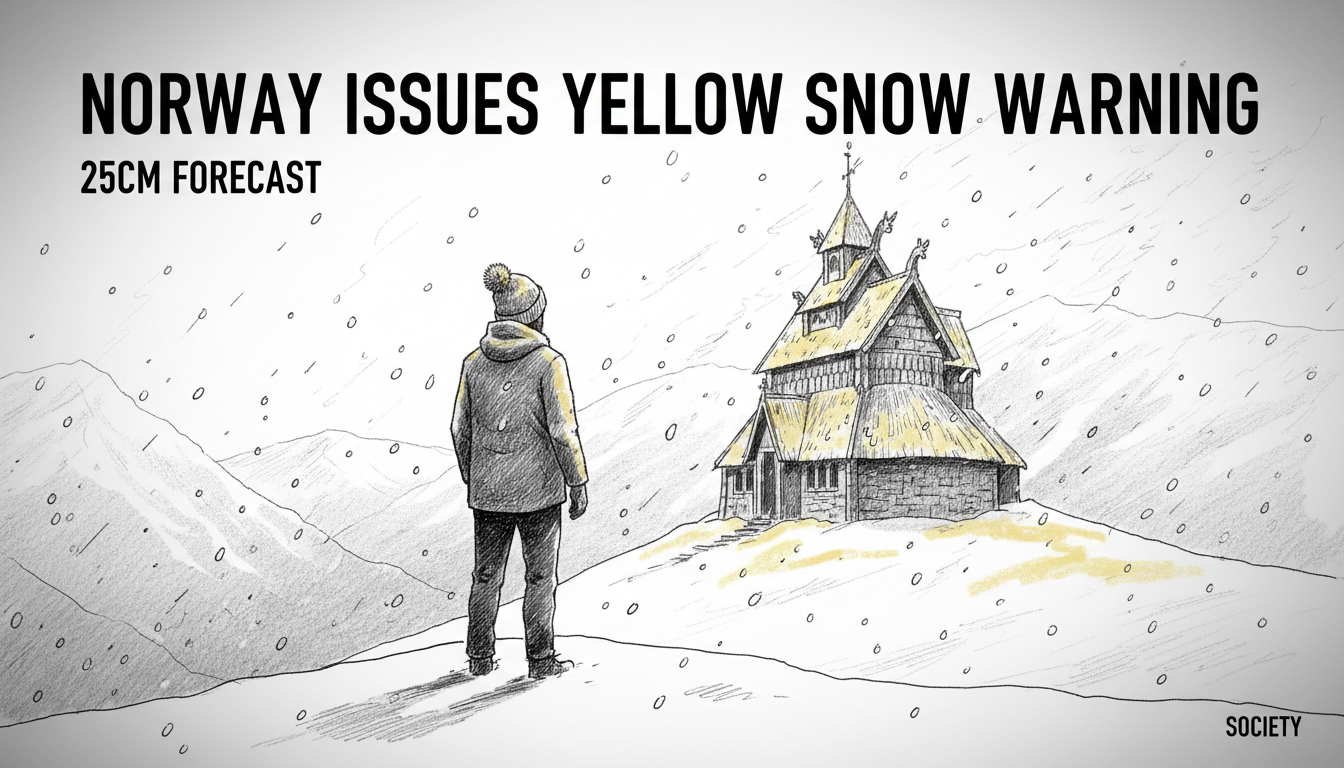
Norway's Meteorological Institute has issued a yellow-level weather warning for heavy snow across Eastern Norway, forecasting up to 25 centimeters of accumulation overnight. The warning, active from 18:00 Wednesday to 10:00 Thursday, targets parts of Østfold and areas near the Swedish border, predicting difficult driving conditions, potential road closures, and disruptions to air and public transport.
This moderate-level alert places the nation's most populous region on standby. Eastern Norway, home to the capital Oslo and nearly half of the country's population, is bracing for a significant late-season snowfall that could paralyze Thursday morning's commute. Meteorologists warn that even a yellow warning for snow in this densely populated corridor can trigger widespread logistical challenges.
A Disruption to the Capital Region's Pulse
The timing of this weather system poses the greatest threat. Snowfall is expected to intensify overnight, meaning plows will be working against accumulating snow during the early hours. This sets the stage for a problematic morning rush hour across the greater Oslo area and surrounding counties. Commuters who rely on trains, buses, and the region's extensive road network are advised to expect delays and cancellations.
"A yellow warning in Eastern Norway is not to be taken lightly," said a meteorologist with the Institute. "The combination of heavy, wet snow and high traffic volumes at dawn can quickly overwhelm clearing operations. We strongly advise people to plan extra travel time and consider working from home if possible."
This event tests the region's winter preparedness infrastructure. While Norway is no stranger to snow, a concentrated dump on a major urban center at the start of a workday strains resources. The Norwegian Public Roads Administration (Statens vegvesen) has likely deployed its fleet of plows and salting trucks, prioritizing the E6 and E18 highways—the main arteries connecting Oslo to cities like Drammen, Moss, and the Swedish border.
Understanding Norway's Color-Coded Alert System
Norway employs a four-tiered, color-coded weather warning system managed by the Meteorological Institute. Green indicates no unusual weather. Yellow, the level issued for this snow event, signals a moderate risk where weather conditions may cause danger and limited disruption. The public is advised to stay informed and plan activities considering the forecast.
The next levels escalate sharply. An orange warning is issued for dangerous weather expected to cause significant damage, disruption, and risk. A red warning, rarely used, indicates an extreme weather event with severe damage and threat to life, requiring immediate action from the public and authorities. The jump from yellow to orange represents a substantial increase in expected impact, not just snowfall totals.
"The threshold for an orange snow warning in Eastern Norway would involve a forecast of more widespread, heavier snowfall with a high certainty of major infrastructure disruption," the meteorologist explained. "While 25 centimeters is significant, the current forecast for localized areas and the timing led to the yellow classification. However, the impact on travel will be real and substantial."
Economic and Logistical Ripple Effects
Beyond the commute, such weather warnings trigger a cascade of contingency planning. Oslo Airport Gardermoen (OSL), one of Scandinavia's busiest hubs, will be implementing its snow plan. This includes intensified runway and aircraft de-icing procedures, which can lead to flight delays and cancellations as ground handling slows. Airlines often issue flexible rebooking policies in advance of such forecasts.
The freight and logistics sector also braces for impact. Deliveries across the region may be delayed, affecting everything from post to grocery supplies. For businesses, the uncertainty around employee arrival times and potential school closures can reduce productivity. The Norwegian Confederation of Enterprises (NHO) often highlights the significant economic cost of single severe weather days disrupting the eastern corridor.
Energy consumption provides another metric of the storm's impact. A sudden drop in temperature coupled with precipitation typically leads to a spike in electricity demand as households and businesses increase heating. Norway's robust hydropower system usually manages such loads, but it underscores the immediate societal response to changing conditions.
Historical Context and a Changing Climate
Late April snowfall in Eastern Norway is not unprecedented, but it often feels anomalous to residents anticipating spring. Historical data shows that measurable snow in lowland areas of Østlandet can occur well into April. However, the frequency and intensity of such late-season events are a subject of ongoing climatic study.
Researchers note that while a warming climate generally reduces total snow cover days, it can also lead to more volatile precipitation patterns. Warmer air holds more moisture, which can fall as heavy snow when it collides with lingering cold air masses. This dynamic can sometimes produce significant, disruptive snowfall events even as the overall winter season shortens.
"We analyze trends over decades, not single events," a climate researcher noted. "One heavy spring snowstorm does not contradict a warming trend. However, understanding how climate change affects the behavior of individual storms, including their precipitation type and intensity, is a key area of research. The public should expect continued variability, even within broader warming patterns."
Preparedness and the Public Response
The effectiveness of Norway's response hinges on public heeding of official advice. Authorities consistently message three key actions during a yellow snow warning: adjust travel plans, prepare your vehicle, and check on vulnerable neighbors. Winter tires are legally required in Norway until after Easter, a rule that will prove its worth during this event.
Many municipalities will activate their emergency coordination centers to monitor the situation. Local decisions on school closures are often made by 6:00 AM based on the latest road condition reports from plow drivers. The public is encouraged to use official sources like the Meteorological Institute's website (Yr.no) and the Road Administration's traffic map (Vegvesen.no) for real-time information, rather than relying solely on social media.
This event also serves as a reminder of regional interdependence. Disruptions in Eastern Norway affect travel and freight moving to and from Western Norway, the Trøndelag region, and Sweden. Cross-border commuters and freight haulers along the E6 toward Gothenburg will need to pay particular attention to conditions.
As the snow begins to fall Wednesday evening, the region will settle into a familiar, if inconvenient, winter routine. The quiet hum of plows, the crunch of snow underfoot, and the revised morning plans will define the night. The true test comes with the dawn, as a major European capital assesses its ability to adapt and move forward, blanketed once more in white.
Will this late-season snowfall be a manageable disruption or a full-scale transport paralysis? The answer lies in the precise track of the storm, the efficiency of the response, and the caution exercised by every individual on the roads at daybreak.