
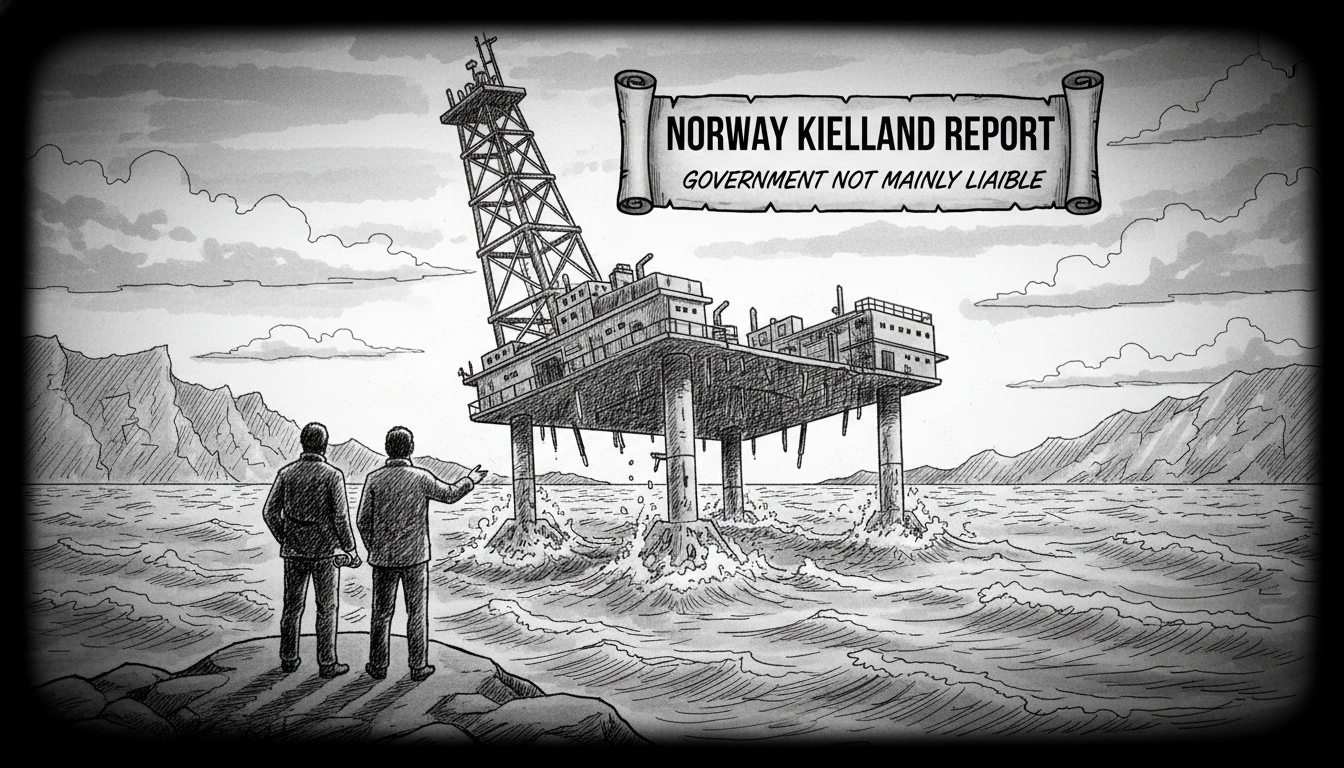
Norway's Office of the Auditor General has reaffirmed its position on the 1980 Alexander Kielland disaster. The government did not hold primary responsibility for the accident that killed 123 people. The supreme audit institution's latest report, released this week, concludes that serious weaknesses in how authorities handled their duties before the tragedy may have contributed to its occurrence and scale. This finding comes after a fresh parliamentary request to re-examine the case in light of new information.
A Tragedy Revisited
On March 27, 1980, the Alexander L. Kielland accommodation platform capsized in heavy seas in the North Sea. Of the 212 people on board, 123 perished. The disaster remains the deadliest industrial accident in Norway's history. It occurred during the early, rapid expansion of the country's offshore oil industry. The Riksrevisjonen, often called the government's watchdog, first issued a critical report on official handling of the disaster in 2021. In June, the Storting asked the auditor to look again. This request followed two subsequent reports containing new information about the catastrophe.
The watchdog's latest assessment states the new reports do not provide grounds to alter its 2021 criticism. "The private actors had the main responsibility for ensuring safety in the petroleum operations and that regulations were followed in their own operations," the Riksrevisjonen writes. "The authorities had the responsibility to establish regulations, issue approvals and permits, and to conduct supervision." The report identifies serious flaws in how these supervisory duties were executed prior to the platform's collapse.
The Enduring Search for Accountability
Forty-five years after the disaster, a definitive establishment of ultimate responsibility remains elusive. A series of investigations and inquiries have been conducted over the decades. Experts point to a confluence of factors: a critical design flaw in a welded bracing, inadequate safety procedures, and insufficient regulatory oversight at the time. The accident triggered a seismic shift in Norway's approach to offshore safety. It led to the creation of the Petroleum Safety Authority Norway and a much stricter regulatory framework emphasizing independent verification and risk assessment.
Yet, for survivors and the families of victims, the lack of a clear, final answer on responsibility has compounded their trauma. The Riksrevisjonen's report notes that while the government did not have primary fault, its failures in supervision and follow-up had profound human consequences. "These weaknesses may have had significance for the accident being able to happen, and that the consequences became so great," the report states.
The Human Cost of Institutional Failure
The report incorporates findings from Norway's National Knowledge Center for Violence and Traumatic Stress (NKVTS). Their research shows the affected individuals from the Kielland disaster continue to suffer significant health problems. The Riksrevisjonen states this research does not provide new information about the authorities' follow-up actions. However, it starkly illustrates the long-term consequences of the state's inadequate support for survivors and the bereaved.
This human impact sits at the heart of ongoing political action. When the Storting asked for this new audit in the summer, it also voted to establish a compensation scheme for survivors and next of kin. This decision was made despite opposition from the government. In a move that caused further distress, the government announced in October that payments might not be distributed until 2027. The delay highlights the ongoing struggle for recognition and restitution that has spanned generations.
A Legacy of Improved Safety
The Kielland disaster's shadow fundamentally reshaped Norway's oil and gas industry. The push for improved safety standards became non-negotiable. The industry adopted new design philosophies, rigorous inspection regimes, and a stronger safety culture. The concept of the "tripartite collaboration" between government, employers, and unions was strengthened, putting worker safety at the forefront of operational planning. Many of the global safety standards now used in offshore operations can trace their lineage back to lessons learned from this Norwegian tragedy.
Safety experts note that the disaster moved the industry from a reactive to a proactive safety mindset. The focus shifted to preventing accidents before they could occur, through better engineering, continuous risk assessment, and empowering workers to halt unsafe operations. While the human cost was catastrophic, the regulatory and cultural legacy is considered one of the world's most robust offshore safety regimes.
Unresolved Questions and Future Steps
The Riksrevisjonen's report closes another chapter of official scrutiny, but it does not provide finality. It reinforces a complex picture of shared responsibility, where systemic regulatory failures enabled a private-sector catastrophe. The ball is now back in the government's court regarding the promised compensation scheme. Victims' groups and supporting politicians are demanding swift and fair action.
"Now I expect the government to present a good and fair compensation scheme for the Kielland victims," a parliamentary proponent of the scheme said following the report's release. The wait for compensation continues, even as the wait for a simple, singular answer on blame appears endless. The report serves as a somber reminder that institutional accountability is often a mosaic of partial failures, not a single point of blame. It underscores that the duty of care extends far beyond the prevention of a disaster to the decades-long support required in its aftermath. The Alexander L. Kielland remains a stark monument in Norway's national consciousness, a tragedy that defined an industry's future but left a past forever unresolved.