
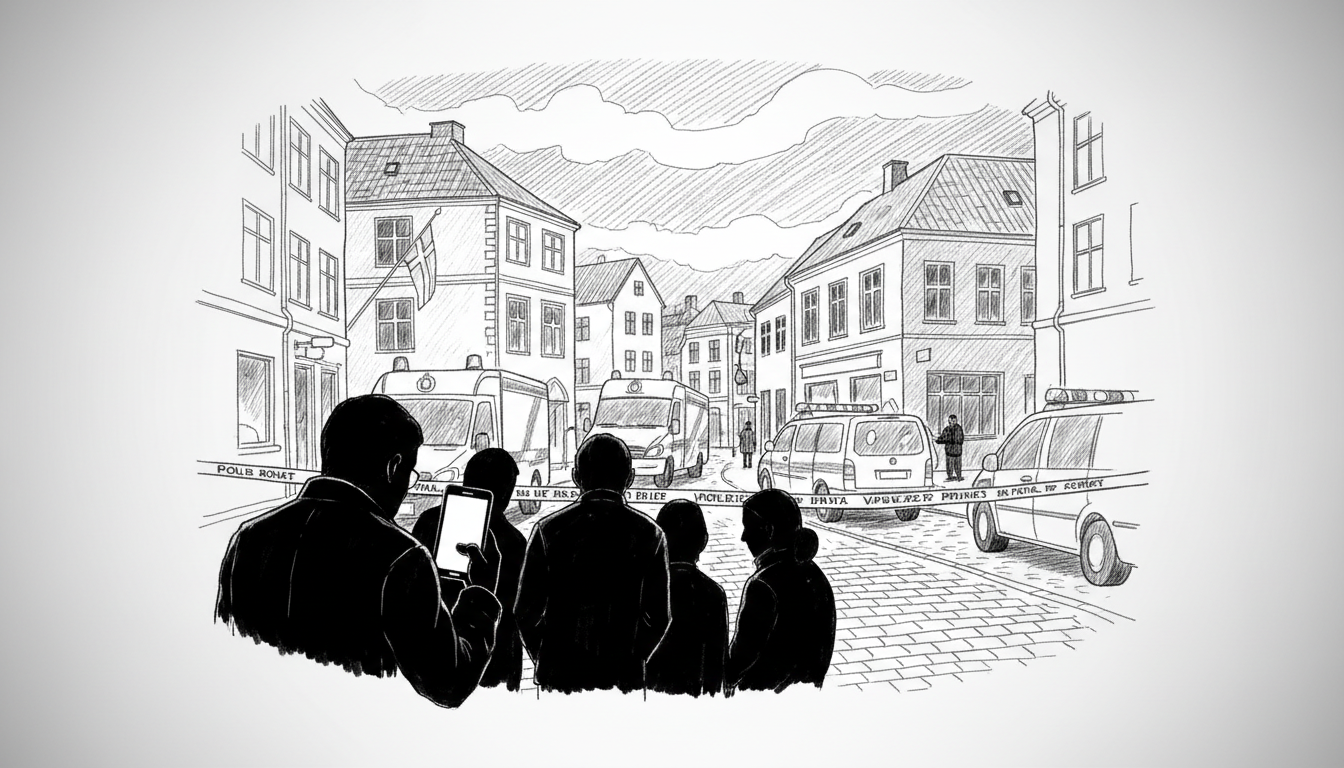
Norway's capital Oslo was shaken by a serious knife attack in its city center on Wednesday. Police responded to reports of a stabbing on Brugata, a busy street near Oslo Central Station, where one victim was found with life-threatening injuries. Witnesses reported seeing several individuals fleeing the scene, prompting a large-scale police operation in the Sentrum borough.
Emergency services arrived at Brugata shortly after the incident was reported. Officers cordoned off a section of the street, a major thoroughfare known for its shops, cafes, and constant pedestrian flow. The victim, whose identity has not been released, received immediate medical attention at the scene before being transported to a hospital.
"We are treating this as a very serious assault. Our primary focus is on the victim's condition and securing evidence," a police operations leader said in a statement. The police log initially noted injuries consistent with a stabbing. No arrests were made immediately following the event, and the investigation is ongoing.
A Busy Urban Corridor Disrupted
Brugata functions as a central artery connecting the Grünerløkka district to the main train station and the heart of downtown Oslo. Its character is a mix of retail stores, fast-food outlets, and residential buildings, attracting a diverse cross-section of the city's population. The attack occurred in an area typically bustling with commuters, tourists, and locals, transforming a routine urban space into a crime scene.
Yellow police tape and multiple patrol cars created an unusual spectacle for afternoon shoppers. The swift response involved both patrol officers and detectives from the Oslo Police District. This visible police presence is a key part of the response strategy in such a densely populated zone, aiming to both investigate and reassure the public.
"Incidents in locations like this naturally cause significant concern," the police statement continued. "We understand the public's need for information and will provide updates as the investigation allows." The proximity to Oslo Central Station, Scandinavia's largest railway terminal, means any major incident has ripple effects on transportation and public perception of safety.
Contextualizing Violence in the Capital
While Norway maintains low rates of violent crime compared to many other Western nations, incidents in central Oslo garner intense scrutiny. Knife-related violence, though relatively uncommon, features in public and political debates about urban safety, social services, and policing. Each serious event prompts a re-examination of these broader issues.
Experts point to a complex interplay of factors that can contribute to street violence in urban centers. "Isolated incidents occur, but we must look at the underlying environment," said Dr. Lena Larsen, a sociologist at the University of Oslo who studies urban issues. "Areas with high foot traffic and mixed commercial activity can see conflicts escalate, sometimes related to disputes, substance abuse, or other social challenges. The response must balance immediate law enforcement with long-term social support structures."
Statistics from the Norwegian National Crime Prevention Council show that most violent crimes in Norway are not random. They often occur between individuals known to each other. However, the public nature of an attack on a street like Brugata amplifies feelings of insecurity. Community policing models, which emphasize officer visibility and local engagement, are frequently cited as crucial for prevention and trust-building.
The Investigation and Public Reaction
The police investigation will likely focus on witness interviews, forensic evidence from the scene, and reviewing footage from the area's extensive network of public and private security cameras. The report of multiple people fleeing suggests the possibility of more than one individual being involved, either as perpetrators or bystanders.
Public reaction in Norway to such events typically follows a pattern of shock followed by a demand for factual information. Norwegian media reporting is generally restrained, focusing on confirmed details from authorities rather than speculation. The focus remains on the victim's condition and the procedural steps of the police inquiry.
Local business owners on Brugata expressed concern. "It's usually very safe here, just busy," said one shop manager who declined to give his name. "You don't expect this right outside your door. We hope the person who was hurt recovers." This sentiment reflects a common view of Oslo as a secure city, making violent breaches of that norm particularly jarring.
The Broader Implications for Urban Safety
This incident will inevitably feed into ongoing political discussions in the Oslo City Council and the Storting about resource allocation for police and social services. The Conservative Party (Høyre) and the Labour Party (Arbeiderpartiet), which often differ on approaches to crime and social policy, may reference the event in debates about municipal budgets.
"Every serious violent crime is one too many," said a statement from the Ministry of Justice and Public Security. "Our thoughts are with the victim and their family. The police have our full confidence in their investigation." The national government oversees police funding and broad legislative frameworks, while the Oslo Police District handles operational responses.
Analysts note that Norway's approach to crime remains fundamentally preventive and rooted in social welfare principles, even when reacting to acute incidents. Investment in youth programs, drug rehabilitation services, and mental health support are seen as long-term deterrents. However, the immediate need for effective law enforcement and emergency response in the city center is never in doubt.
A City's Resilience in Focus
As the police work continues on Brugata, life in the surrounding area gradually returns to normal. The cordon will be lifted, and the flow of people and traffic will resume. Yet, the memory of the attack lingers, posing quiet questions about safety in shared public spaces.
The true test for Oslo is not whether such rare, violent events occur, but how the city's systems—from emergency medical response to community support networks—function in their aftermath. The victim's medical prognosis will be the most critical indicator in the coming hours. The police's ability to provide answers and, if possible, make arrests will determine the next chapter of this story.
For now, the incident stands as a stark reminder that even in one of the world's safest capitals, the fabric of urban life can be torn by sudden violence. The response, from the first police officer on the scene to the eventual political discourse, will define its lasting impact far more than the act itself.