
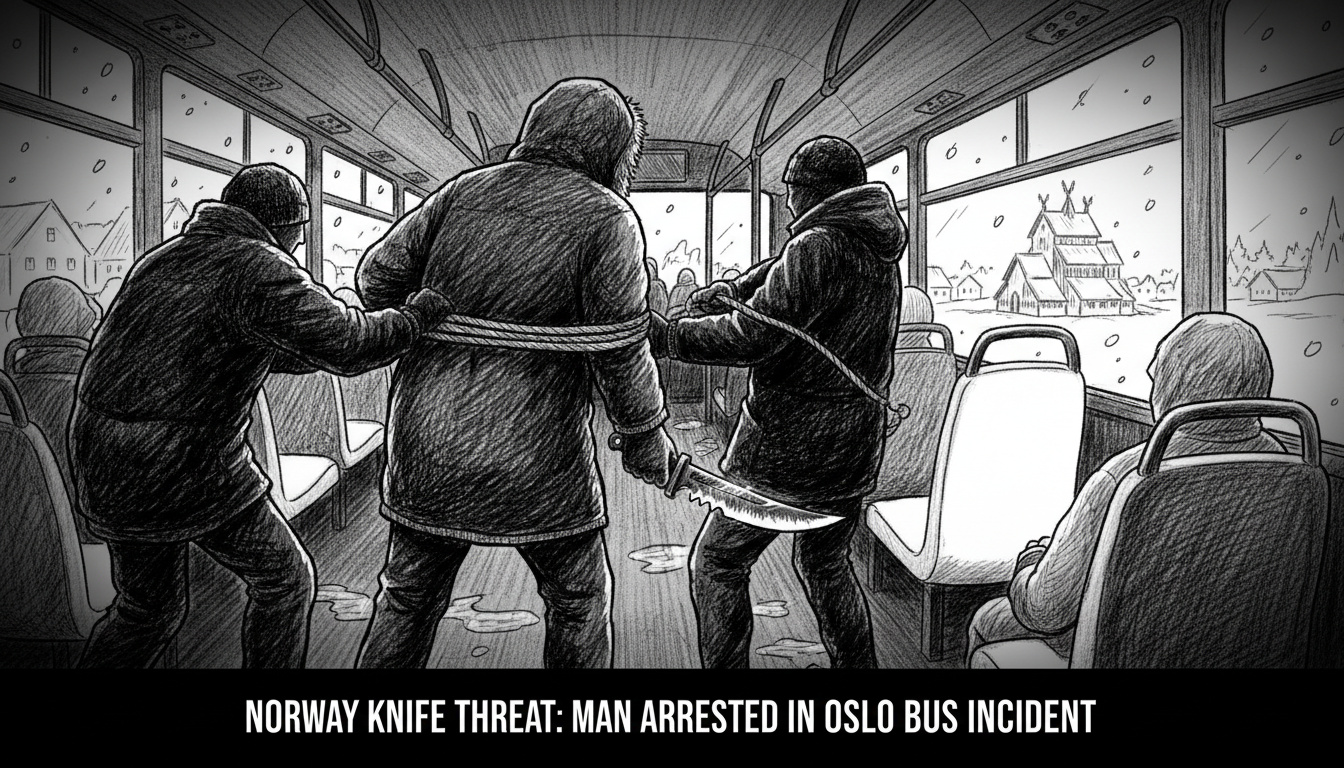
Norway's capital city police arrested a man in his 50s early Sunday morning following a knife threat incident in the Ryen district of Oslo. The suspect was apprehended on a bus heading toward the city center after allegedly chasing and threatening a victim with a knife outdoors. The victim was not physically injured, according to police operations leader Bjørn Gunnar Nysæter.
This single event, while resulting in no physical harm, cuts against the grain of Norway's reputation as one of Europe's safest nations. It forces a momentary examination of public security in Oslo's neighborhoods and the police response mechanisms designed to protect them. The rapid apprehension on public transport highlights both the challenges and capabilities of urban policing.
A Swift Response on Public Transport
Police moved quickly to detain the suspect after the reported threat. The incident occurred in Ryen, a mixed residential and commercial area in Oslo's east, before the suspect boarded a bus bound for the central city. Officers intercepted the bus, preventing the individual from reaching the more crowded downtown core. This containment likely limited potential public alarm.
Operations leader Bjørn Gunnar Nysæter confirmed the arrest in a statement released just after midnight. He noted that police had made contact with both a witness and the victim. The fact that the victim sustained no physical injuries represents the most positive outcome in a scenario involving a weapon.
The Context of Violence in a Safe Society
Norway maintains exceptionally low rates of violent crime compared to international averages. Knife-related violence constitutes a small fraction of overall crime statistics in Oslo. According to data from Statistics Norway (SSB), reported cases of violence resulting in bodily harm have seen fluctuations but remain below levels recorded in the early 2000s.
Oslo, as the nation's largest and most densely populated urban center, naturally experiences a higher concentration of reported incidents than rural areas. Yet it consistently ranks among the world's safest capitals. Isolated events like the Ryen incident often garner significant attention precisely because they are statistical anomalies in a generally secure environment.
Criminologists note that while serious violent crime is rare, any weapon-related threat in a public space can impact the community's sense of security. "The psychological effect of a weapon being brandished in public should not be underestimated, even if no one is hurt," says a researcher familiar with Nordic crime trends, who asked not to be named as they were not directly involved in the case. "It violates the expected social contract of safety in shared spaces."
Policing and Public Trust in Oslo
The Oslo Police District's handling of this incident demonstrates standard protocol for a weapon threat. The priority is always immediate containment to prevent escalation and ensure no one is harmed. The subsequent steps involve securing evidence, interviewing all involved parties, and building a case for prosecutors.
Public trust in Norwegian police remains high by global standards. This trust is reinforced by generally positive interactions and a policing model that emphasizes de-escalation. Rapid, effective responses to incidents like the one in Ryen are crucial for maintaining that confidence. The police's ability to locate and arrest the suspect on a moving bus within a short timeframe will be viewed as an operational success.
However, each incident also prompts internal review. Police will examine their response times, communication protocols, and tactical decisions. This continuous improvement process is a cornerstone of Norway's preventive security approach.
The Broader Picture of Urban Safety
For Oslo's residents, daily life is characterized by a high degree of personal security. The city's crime rates are low, and violent encounters are uncommon. Yet no major city is entirely immune to random acts of aggression or threats. The infrastructure of safety—well-lit streets, visible police patrols, and reliable emergency services—is designed to minimize both the occurrence and impact of such events.
International observers often contrast Norway's crime statistics with those of other European capitals. The differences are stark. What might be considered a minor incident in Oslo could be part of a daily crime log in other metropolitan areas. This context is important for understanding the Norwegian public's and media's reaction to these events.
A single knife threat does not indicate a rising trend. Year-to-year statistics on violent crime in Norway show remarkable stability. The SSB data reveals no significant surge in weapon-related offenses. This stability is the result of long-term social policy, economic factors, and policing strategies, not mere chance.
Looking Ahead: Legal Process and Community Impact
The man arrested now faces legal proceedings. Norwegian law treats threats with a weapon seriously, with potential penalties including imprisonment depending on the circumstances and the individual's history. The investigation will determine the precise charges.
For the victim and witnesses, the psychological impact, though hopefully minimal, is real. Support services are available through the police and victim assistance organizations in Norway. The absence of physical injury does not negate the experience of being threatened.
In the coming days, the story will likely fade from the headlines, replaced by other news. It will become a single line in Oslo Police District's annual statistics. But for a brief moment on a Saturday night in Ryen, the ordinary peace of an Oslo neighborhood was disrupted. The system, from the first emergency call to the arrest on the bus, functioned as intended.
This incident serves as a reminder that safety is a dynamic condition, actively maintained. It reaffirms the importance of effective policing and community vigilance, even in societies where serious crime is an exception rather than the rule. The true test of a safe society is not the complete absence of threat, but the capacity to respond to it decisively and justly when it arises. Oslo's response this weekend appears to have met that test.
Does the swift resolution of such an incident reinforce public faith, or does the mere occurrence of it subtly erode the feeling of absolute security that many Norwegians take for granted? That is a question for sociologists, not crime reporters. The factual record shows a threat was made, police intervened, and a suspect is in custody. In the meticulous order of Norwegian justice, that is where the matter now stands.