
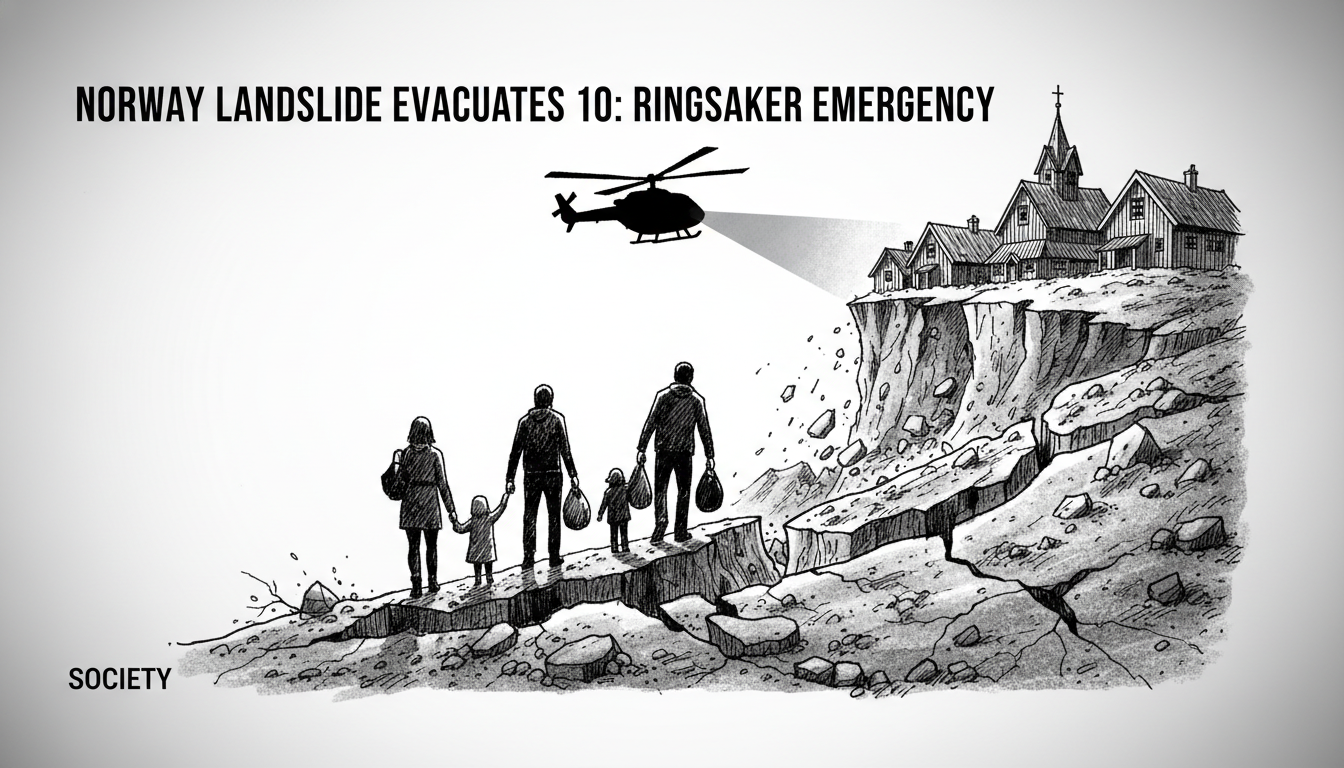
Norway landslide evacuations have begun in Ringsaker municipality after a minor landslide threatened a local road. Ten people from three households are being moved to safety as a precautionary measure. The incident near Spikdalsvegen highlights the persistent geological risks facing communities across the country, even from relatively small events.
Emergency operations leader Ove Stian Ovrum stated that accumulated water masses pose a danger to the road structure. "This is pending better conditions to assess the risk of further landslides. It will be followed up in daylight," Ovrum wrote in the police log. The decision to evacuate reflects Norway's cautious, safety-first protocol developed through hard experience with unstable terrain.
A Familiar Threat in Norwegian Terrain
Landslides are a recurring natural hazard in Norway. The nation's dramatic geography of steep mountains, deep valleys, and unstable soil types creates inherent risks. These risks are often activated by heavy rainfall or rapid snowmelt, which saturates the ground and reduces stability. While this week's event in Ringsaker appears limited, it triggers immediate memories of far more severe incidents.
The shadow of the 2020 catastrophe in Ask, Gjerdrum, looms large over all Norwegian landslide responses. That disaster resulted in multiple fatalities and the complete destruction of homes, shocking the nation with its severity. It forced a nationwide re-evaluation of risk mapping, emergency preparedness, and construction regulations in hazard-prone areas. Every evacuation order since is informed by the lessons of Gjerdrum.
The Science of Sliding Ground
Geotechnical engineers assessing the Ringsaker site will focus on soil stability and water saturation levels. Their investigation will determine whether the initial slide is a isolated event or a precursor to further movement. Hydrologists will analyze local drainage patterns to understand why water accumulated, creating the immediate threat to Spikdalsvegen.
"The precautionary evacuation is the correct procedure," says Dr. Ingrid Hjelmervik, a geohazards consultant familiar with the region. "Even a small landslide can destabilize a larger area, and the presence of significant water is a major warning sign. The priority must always be human safety before property assessment." The Norwegian Water Resources and Energy Directorate (NVE) continuously monitors such risks, issuing warnings based on rainfall data and geological surveys.
Emergency Protocols in Action
Local authorities in Ringsaker, supported by the police and emergency services, are executing established response plans. The evacuation of ten individuals from three households is a manageable operation, but it requires coordination for shelter, information, and potential welfare needs. The logistics extend beyond simply moving people; it involves registering evacuees, providing clear communication on timelines, and securing the area to prevent unauthorized entry.
Emergency management specialists emphasize the psychological impact of such events. Even a short-term, precautionary displacement creates stress and uncertainty for affected families. The goal of authorities is to minimize this disruption while unequivocally prioritizing safety. The statement that follow-up will occur in daylight is a practical recognition that proper risk assessment cannot be done safely in the dark.
A National Challenge of Geography and Climate
Norway's relationship with its landscape is one of both dependence and risk. Communities are built in stunning but potentially dangerous locations. Climate change introduces a new variable, with projections suggesting increased precipitation and more frequent extreme weather events in parts of the country. This could potentially elevate landslide risks in the coming decades, putting pressure on existing risk maps and mitigation strategies.
Mitigation efforts include engineering solutions like stabilization projects, improved drainage systems, and early warning technology. Land-use planning remains the most critical tool, directing new development away from high-risk zones identified by NVE. However, for existing homes in areas now deemed riskier, such as those in Ringsaker, the solutions are more complex and costly, involving property-specific measures or, in extreme cases, relocation.
The Human Cost of Precaution
For the three households evacuated in Ringsaker, the event is a personal disruption. It means leaving homes behind with uncertainty about what might happen to their property. While no damage to residences has been reported initially, the threat to the road and the potential for further slides creates anxiety. The efficiency of Norway's social safety net and emergency support systems is tested in these small-scale, localized incidents.
Community response often supplements official efforts. Neighbors offer support, local organizations may provide assistance, and the municipal government activates its welfare services. This network is a crucial part of resilience, turning a clinical evacuation procedure into a supported human experience. The success of the operation will be judged not just by the prevention of physical harm, but by how well the affected people are cared for throughout the process.
Looking Ahead: Assessment and Return
The immediate next step is the daylight assessment promised by authorities. Geologists and engineers will examine the slide area, the stability of the surrounding slopes, and the water drainage issue. Their findings will determine when residents can safely return home. This could be a matter of hours or days, depending on what the investigation reveals.
If the risk is deemed ongoing, the evacuation could be prolonged, requiring more permanent temporary housing solutions. The municipality will also need to plan for any necessary repairs to Spikdalsvegen and mitigation work to prevent a recurrence. Each event like this adds data to Norway's extensive understanding of its geohazards, informing future responses and planning decisions in Ringsaker and similar municipalities across the country.
Norway's approach to landslide risk is necessarily conservative, shaped by tragedy. The evacuation of ten people in Ringsaker is a small event in national statistics, but it perfectly illustrates the principle that guides modern Norwegian emergency management: when in doubt, get people out. It is a policy written in the memory of those who were not evacuated in time elsewhere. As the climate evolves and pressure on land continues, balancing safety, community, and the realities of living in a majestic but unstable landscape will remain one of Norway's most persistent challenges. Will the cautious approach seen in Ringsaker become the standard for an increasingly unpredictable environment?