
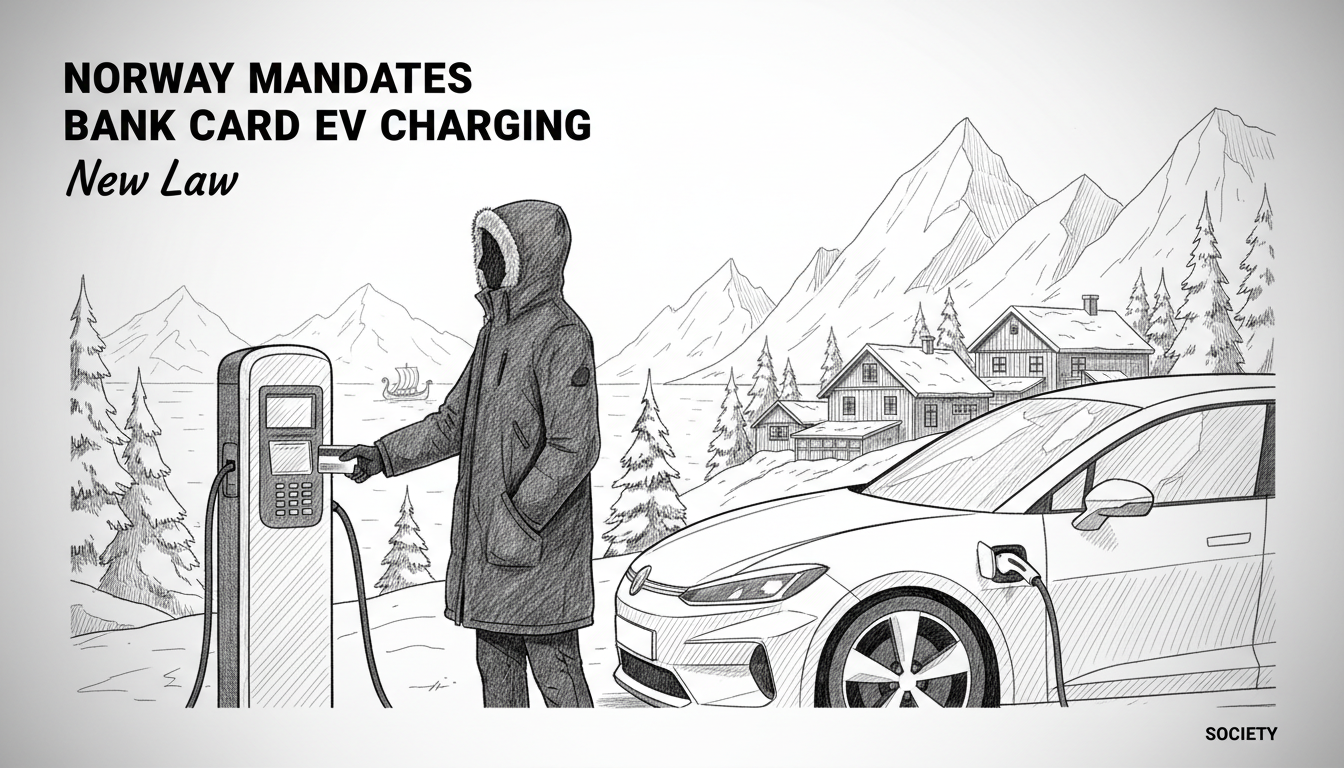
Norway's government has proposed a new law requiring all electric vehicle charging stations to accept standard bank cards and contactless payments. The Ministry of Transport sent the legislative proposal for public consultation on Monday, aiming to standardize payment methods across the country's extensive charging network. This move targets a significant pain point for both domestic EV owners and international visitors in the world's most advanced electric car market.
Transport Minister Jon-Ivar Nygård stated the change is necessary for user-friendliness. "Everyone should be able to charge simply and securely," Nygård said in a statement. "A common, recognizable, and simple payment solution is an important step." The proposal mandates that both new and existing charging stations must enable payments via physical bank cards or contactless 'tap' functions, directly at the charging point.
Ending the App Subscription Maze
Currently, Norway's charging infrastructure is a fragmented landscape dominated by proprietary systems. Drivers often need multiple smartphone apps, memberships, or RFID cards from different operators like Fortum Recharge, Mer, and Tesla. This creates friction, particularly for tourists, occasional users, and those less comfortable with digital solutions. The new law would make paying for electricity as straightforward as buying fuel or a coffee.
"This is about removing a barrier that shouldn't exist in 2024," said Erik Lorentsen, a policy advisor with the Norwegian Electric Vehicle Association. "We have supported this principle for years. For Norway to maintain its leadership and reach its zero-emission goals, charging must be universally accessible, not just for those who navigate a dozen different apps." The association's annual member surveys consistently rank complicated payment systems as a top complaint.
The Technical and Economic Implications
The government's consultation paper acknowledges the cost and effort for charging point operators. Existing stations may require hardware upgrades to incorporate card readers compliant with Norwegian payment security standards. The ministry has proposed a transition period, though the specific timeline will be determined after the consultation feedback. Operators will likely factor these costs into their business models and future pricing.
Analysts see this as a push towards market consolidation and increased competition on price and service, rather than on locking users into a closed ecosystem. "It levels the playing field," noted energy market analyst Silje Kvalheim. "The competition shifts from capturing a user in an app to providing reliable, fast, and competitively priced electricity at the plug. For consumers, that's a positive. It may also lower the barrier for new, smaller operators to enter the market."
A Move Aligned with National Ambitions
This legislative push is not an isolated measure. It fits squarely within Norway's aggressive transport electrification strategy. The country aims for all new passenger cars and light vans sold to be zero-emission by 2025. With battery electric vehicles (BEVs) already constituting over 80% of new car sales, the focus is intensifying on refining the ownership experience and supporting infrastructure.
Norway's parliament, the Storting, has used a powerful combination of tax exemptions, toll-road passes, and charging infrastructure investment to achieve its world-leading adoption rates. The government and municipalities have installed thousands of public chargers, from standard AC points in suburban parking lots to ultra-rapid DC hubs along the E6 highway. Ensuring these are easy for everyone to use is the next logical step.
The Road Ahead: Consultation and Implementation
The public consultation process, a cornerstone of Norwegian lawmaking, allows businesses, organizations, and individuals to submit feedback on the proposal's technical and economic aspects. Key stakeholders like the Norwegian Charging Station Association, consumer councils, and finance industry groups will provide detailed responses. Their input will shape the final legislation presented to the Storting, likely later this year or in early 2025.
If passed, Norway would join a small group of countries, including the United Kingdom, which has implemented similar mandates. The European Union is also moving towards legislation for standardized payment options at charging stations, meaning Norway's move positions it ahead of broader European regulations.
For the average Norwegian EV driver, the change promises simplicity. Imagine a future where pulling up to a charger in Geiranger, at Oslo Central Station, or a remote mountain pass in Finnmark requires only the same card used at any grocery store. It eliminates the frustration of a low battery coupled with a failed app login or an unrecognized RFID tag.
A Model for the Electric Future
Norway's experiment with electric transport is closely watched by policymakers worldwide. This focus on user-centric regulation offers another lesson. Technological adoption is not just about hardware and subsidies; it's about creating a seamless, intuitive system for the end-user. By mandating universal payment access, Norway is addressing a final layer of digital friction in its otherwise smooth electric transition.
The success of this policy will be measured in reduced driver complaints and increased confidence among potential EV adopters who are hesitant about life beyond the gas pump. As the Arctic nation continues its journey towards a fully electrified transport sector, ensuring that the infrastructure is as reliable and straightforward as possible remains paramount. This law proposal is a decisive step in that direction, signaling that in Norway, the future of charging is as simple as a tap.