
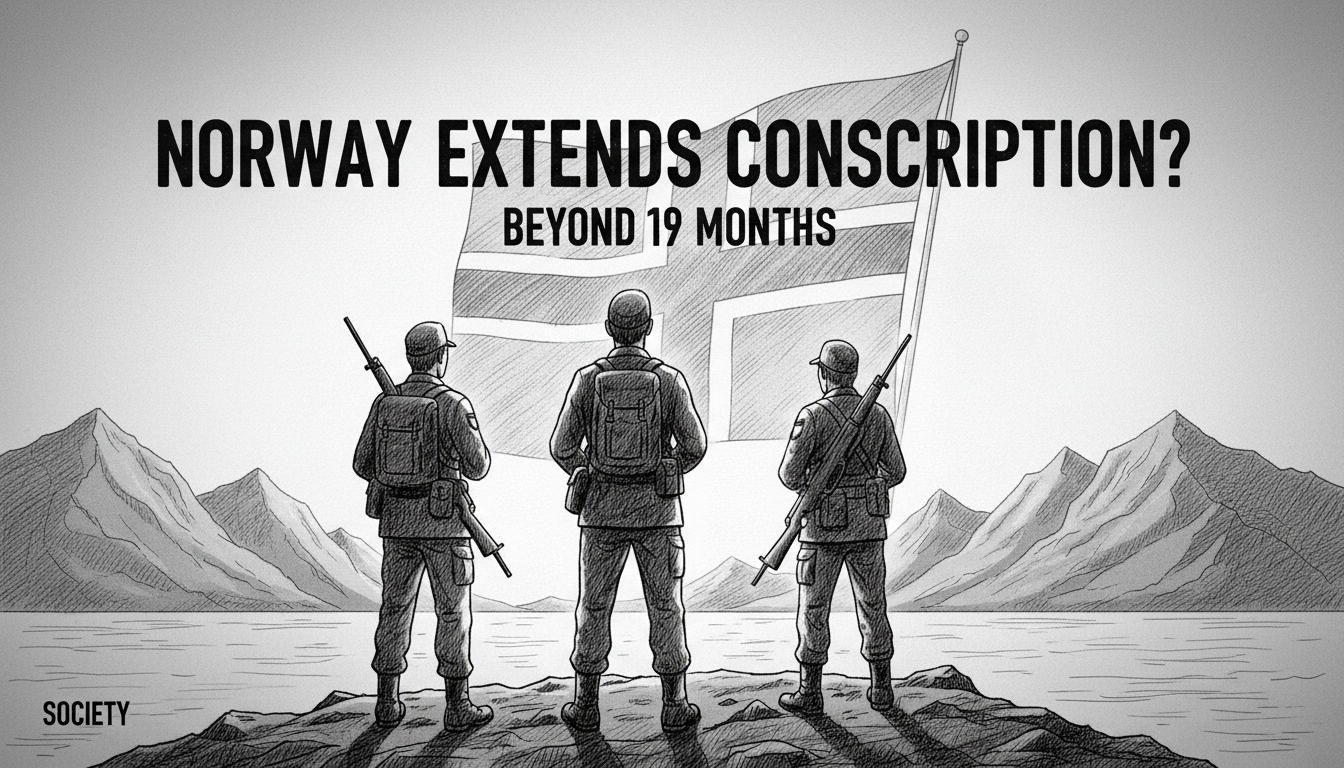
Norway's 60,000 annually eligible conscripts face a pivotal shift as the government orders a comprehensive review of the mandatory military service law, known as verneplikt. Defense Minister Tore O. Sandvik confirmed that Defense Chief General Eirik Kristoffersen has been tasked with examining the conscription system. The goal is to secure access to more soldiers, with several branches of the armed forces advocating for an extension of service terms beyond the current legal maximum of 19 months. This potential expansion signals a significant recalibration of Norway's defense posture in response to a transformed European security environment.
The Bedrock of Norwegian Defense
Conscription is the foundational element of Norway's national defense, a tradition with roots stretching back centuries. The modern system applies to all citizens, both men and women, between the ages of 19 and 44. Since 2015, Norway has enforced gender-neutral conscription, standing as the first European NATO country to draft women on equal legal terms. In practice, however, only a fraction of the eligible pool is summoned. Each year, roughly 8,000 individuals are called to serve from the eligible cohort of approximately 60,000. This selective model has balanced military needs with societal and economic considerations, but defense leaders now argue it requires modernization to meet contemporary threats.
Mounting Pressures for a Longer Service Term
The review ordered by Minister Sandvik stems from direct requests from within the armed forces. The Army, Navy, and Air Force have all indicated a need for personnel with higher levels of training and specialization, which a longer conscription period could facilitate. "Our operational requirements are evolving," a defense ministry spokesperson said in a statement, echoing the concerns of service chiefs. "We must ensure our conscripts receive the depth of training necessary for today's complex security tasks, from Arctic surveillance to cyber defense." The current 19-month ceiling is seen by some commanders as insufficient for building the advanced competencies needed in domains like intelligence, engineering, and naval warfare. This push aligns with Norway's increased defense spending and focus on its strategic Arctic territory.
Analyzing the Readiness Equation
Military experts are weighing the potential benefits against substantial challenges. Extending active service could undeniably enhance the readiness and skill level of the Norwegian Armed Forces' baseline personnel. "A longer conscription period allows for more thorough training and specialization, which directly translates to a more capable reserve force," said Dr. Ingrid Moe, a defense policy analyst at the Norwegian Institute of International Affairs. She notes that with Norway's long coastline and vast Arctic areas, having a larger pool of well-trained conscripts is a force multiplier. However, other analysts caution that the policy must be carefully calibrated. The economic impact of retaining more young adults in military service, thereby temporarily removing them from higher education or the workforce, requires scrutiny. Furthermore, extended service demands increased investment in barracks, equipment, and instructional capacity.
The Gender-Neutral Model Under Scrutiny
The review will also assess the implementation of gender-neutral conscription. The proportion of female conscripts has grown steadily but remains at about 17% as of 2023. An extended service obligation could have differential impacts on recruitment and retention across genders, a factor the defense chief's analysis must consider. Proponents argue that a longer, more meaningful service period could make military duty more attractive to a broader demographic, potentially boosting female participation. Critics, however, worry that longer mandates might dissuade volunteers. The outcome will test Norway's commitment to being a leader in gender equality within defense structures, a point of pride often cited in the Storting.
Broader Economic and Social Ripples
Any decision to lengthen national service will send waves through Norwegian society. The business community, particularly in sectors like technology and maritime industries that compete for young talent, may express concerns. The government would need to evaluate compensation models for conscripts and potential offsets for employers. Socially, extending a mandatory civic duty touches on principles of equity and personal freedom. "We must have an honest debate about the burden and privilege of service," remarked a member of the parliamentary defense committee. "Is it fair to ask a young person to give over a year and a half, or more, of their life? In a high-threat environment, the public answer may be changing." The review will likely model different scenarios, examining impacts on university enrollment timelines and vocational training.
Nordic Context and NATO Implications
Norway's deliberation occurs alongside similar debates in other Nordic nations. Sweden reinstated conscription in 2017, and Finland maintains a robust universal model. Norway's potential move towards a longer, perhaps more inclusive, draft would further harmonize Nordic defense preparedness. For NATO, a strengthened Norwegian conscription system enhances the alliance's northern flank, crucial for deterrence and Arctic security. A more substantial Norwegian home-grown force allows for greater specialization in key national assets, such as the F-35 fighter jets based in Ørland or the fleet of P-8 Poseidon maritime patrol aircraft monitoring the Barents Sea. This directly supports collective defense pledges made in the wake of heightened tensions in Europe.
The Political Pathway Forward
The review led by General Kristoffersen is expected to take several months, with findings presented to the defense ministry. Any legislative change to the Conscription Act would require a proposal from the government and a vote in the Storting. With a multi-party coalition in power, building consensus will be key. The opposition is likely to demand detailed justifications, focusing on specific capability gaps and cost analyses. The process will be transparent but fraught with the detailed budgetary and policy negotiations characteristic of Norwegian politics. The final decision will hinge on a difficult calculation: balancing perceived security necessities with the societal contract of the verneplikt system.
A Defining Choice for National Security
Norway stands at a crossroads with its conscription policy. The review of verneplikt is more than an administrative exercise; it is a statement about national priorities in an uncertain age. Extending service represents a tangible ask of the citizenry, a shared investment in sovereignty that transcends oil wealth and pension funds. As the analysis proceeds, the fundamental question remains: In a world where threats are no longer distant, is a longer, deeper commitment to national service the price of preserving the Norwegian way of life? The answer will shape the nation's defense for a generation.