
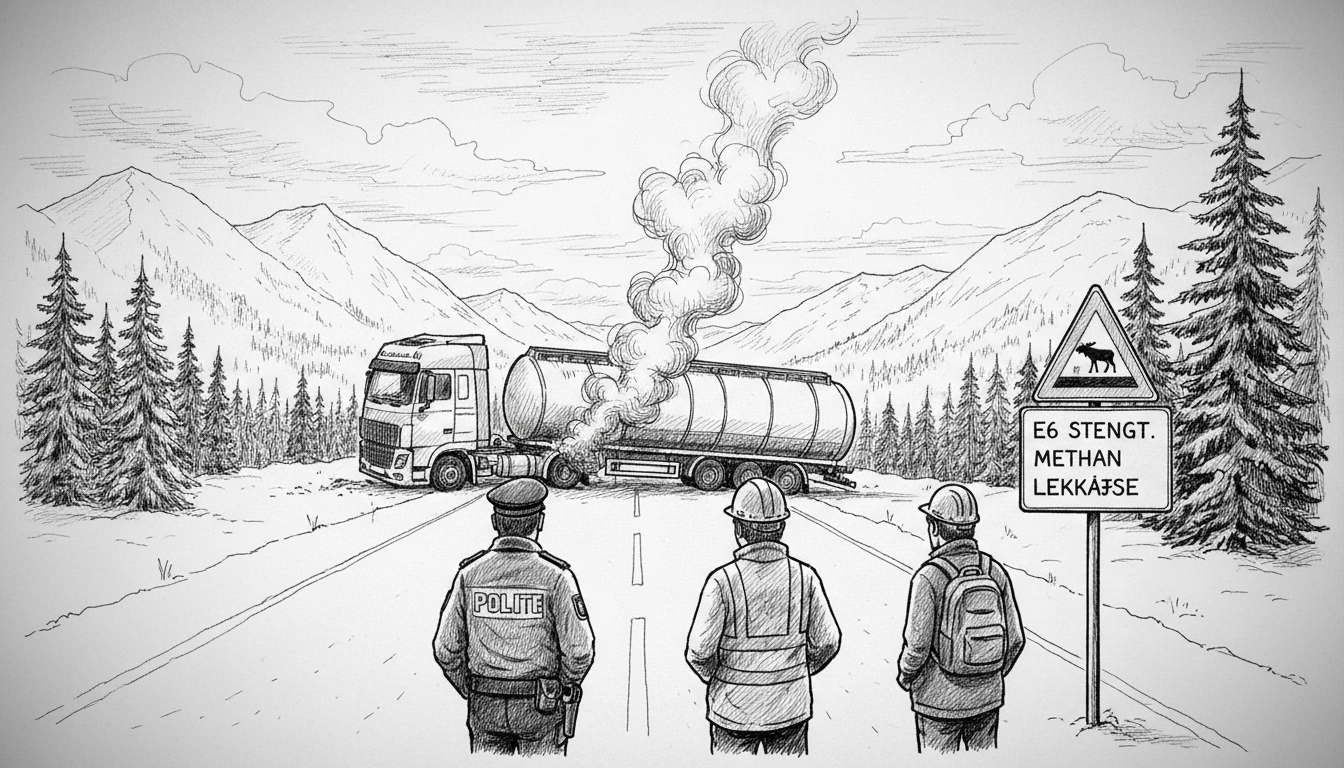
Norway police and emergency services are responding to a major incident after a truck carrying methane gas overturned on a Norwegian road Thursday morning. The accident, reported at 10:46 AM, has prompted a significant emergency response as crews work to determine if the flammable gas is leaking. The driver reportedly escaped the vehicle, but authorities have advised residents in the immediate area to stay indoors.
Emergency Response and Immediate Risks
Police operations leader Geir Rune Ekse confirmed the driver's escape in an initial statement. While no mandatory evacuation order has been issued for nearby residents, the advisory to remain indoors is a standard precaution for potential gas leaks. Methane, the primary component of natural gas, is colorless, odorless, and highly flammable. It poses a dual threat: risk of explosion if it mixes with air in the right concentration, and the danger of asphyxiation as it can displace oxygen in confined spaces.
Fire and rescue services are leading the on-scene assessment. Their primary tasks are to establish a safety perimeter, use gas detection equipment to monitor for leaks, and stabilize the vehicle to prevent any rupture of its specialized pressure tanks. "The first priority is always to secure the area and prevent any ignition source," a veteran fire service commander, who asked not to be named while operations were ongoing, explained to Nordics Today. "With methane, we are dealing with a gas that dissipates upward quickly, which can be an advantage in open air, but the confined space of an overturned truck trailer creates a complex scenario."
Norway's Gas Transport Safety Framework
This incident places a spotlight on the safety protocols governing Norway's extensive energy logistics network. As Europe's second-largest supplier of natural gas, Norway moves vast quantities of the fuel, both via subsea pipelines like Europipe and through specialized transport. While most gas for export travels by pipeline, compressed natural gas (CNG) or liquefied natural gas (LNG) is sometimes transported by road or sea for specific industrial uses, remote locations, or as fuel for gas-powered vehicles.
Norwegian regulations for transporting dangerous goods, including methane, are among the strictest in the world. They govern everything from tanker construction standards and mandatory safety systems to driver training and approved transport routes. Vehicles must be clearly marked, and drivers carry detailed emergency instructions. "The regulatory framework is robust," said Dr. Ingrid Selmer, a risk management specialist at the University of Stavanger. "Accidents are rare, but each one is treated with extreme seriousness because the potential consequences demand it. The response we see today—the coordination between police, fire, and environmental authorities—is a direct result of that rigorous planning."
The Environmental and Economic Context
Beyond immediate safety, a methane leak carries significant environmental implications. Methane is a potent greenhouse gas, with a global warming potential estimated to be over 80 times that of carbon dioxide over a 20-year period. Norway, despite its role as a major fossil fuel exporter, has ambitious climate goals and closely monitors methane emissions from its energy sector. Any substantial release from this incident would be factored into the country's emissions accounting.
The economic stakes are also high. Natural gas, primarily methane, accounted for approximately 21% of Norway's total export value in 2022, a figure that surged following geopolitical shifts in European energy supply. The industry is a cornerstone of the Norwegian economy, funding the world's largest sovereign wealth fund. Public confidence in the safe handling of this resource is paramount. "Safety is not just an operational concern; it's a social license to operate," noted energy analyst Per Hansen. "The Norwegian public accepts the oil and gas industry because it is perceived as technologically advanced and safe. An incident like this, even if contained, is scrutinized heavily."
Investigation and Next Steps
The immediate crisis response will be followed by a thorough investigation. Norway's Safety Investigation Authority (Sikkerhets- og ettersynsmyndigheten) will likely examine the cause of the crash. Investigators will look at factors such as road conditions, vehicle maintenance, driver actions, and the security of the cargo. Their findings will contribute to updated safety guidelines.
For now, the focus remains on the crash site. The strategy will involve either patching a minor leak if one is found, or more complexly, preparing for a controlled transfer of the remaining gas to another tanker if the vehicle's integrity is compromised. This is a delicate operation requiring specialized equipment and personnel. Road closures in the area are expected to continue for several hours, possibly extending into the night, causing significant disruption to local traffic.
Local municipalities have activated their emergency communication channels. Residents are being told to follow official updates and to avoid the area. While the advice to stay indoors suggests a highly localized risk, it underscores the cautious approach authorities are taking.
A Test of Preparedness
This truck accident, while initially a local traffic incident, rapidly escalates into a test of national safety systems due to its cargo. It intersects several key Norwegian policy areas: industrial safety, environmental protection, energy logistics, and emergency preparedness. The response demonstrates the layered protocol designed for such events, where local fire crews are the first line of defense, backed by specialized national hazardous materials teams and guided by clear regulatory frameworks.
As the situation develops, key questions will emerge. How effective were the vehicle's safety features in preventing a catastrophic rupture? Was the transport following an optimal route? The answers will feed into an ongoing process of refining safety standards. For Norway, a nation that has built immense wealth and geopolitical influence on its hydrocarbon resources, managing the physical risks of that bounty is a continuous, non-negotiable task. The silent, invisible nature of the hazard in this crash—a gas with no smell or color—makes the professional, measured response all the more critical. The ultimate success will be measured by an outcome where the only damage reported is to the vehicle itself, a testament to the systems designed to prevent a localized accident from becoming a regional disaster.