
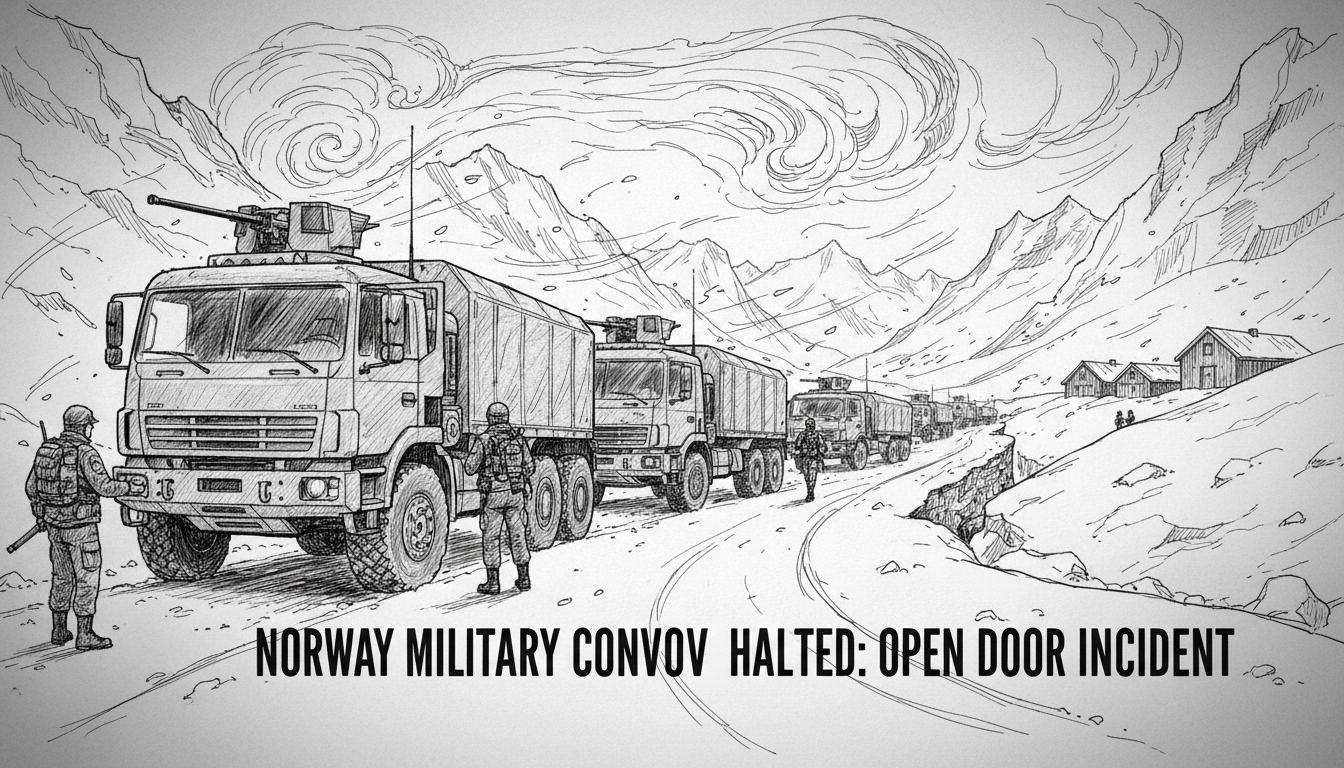
Norway's military police stopped a military convoy Tuesday morning at the Taraldsvikbrua bridge near Narvik. According to police reports, the convoy was traveling with a side door open on one of its vehicles. Officers intercepted the transport just before 10:30 AM, bringing it to a safe stop. The incident highlights routine safety protocols but raises questions about transport procedures for sensitive military equipment in a strategically vital region.
A Routine Stop with Strategic Implications
The halted convoy was operating in Nordland county, home to several key Norwegian Armed Forces installations. Narvik's ice-free port and railway links to Sweden make it a critical logistics hub for national defense. Military convoys moving equipment between bases, training grounds, and ports are common here. This particular stop, however, was triggered by a basic safety violation. An unsecured door on a moving vehicle poses an immediate hazard. It risks cargo shifting or falling onto the roadway, creating danger for other drivers on the E6 highway near the bridge.
Police followed standard procedure for a vehicle safety check. The convoy commander was notified and complied with the order to halt. Military authorities have launched their own internal review of the incident. They are examining whether the door was improperly latched before departure or came open during transit. The Norwegian Armed Forces maintain strict internal regulations that supplement national road safety laws. All personnel responsible for vehicle preparation and convoy operations undergo rigorous training.
The Framework of Military Transport on Public Roads
Norway's military vehicles, when operating on public roads, must comply with the Norwegian Road Traffic Act. The Norwegian Public Roads Administration (Statens vegvesen) sets the technical and safety standards these vehicles must meet. This includes regulations on load security, vehicle integrity, and lighting. While the military has certain exemptions during specific operational exercises, routine transfers between bases fall under standard civilian rules.
"Safety is paramount, whether for a civilian truck or an army transport," says Lars Holm, a former military logistics officer now with the Institute for Transport Economics. "An open door is a clear breach of secure transport protocols. It suggests a possible failure in the pre-movement checklist, which is a fundamental part of military logistics. For public confidence, it's crucial that such checks are performed meticulously every time."
The incident did not involve specialized hazardous materials or unusually sensitive cargo, according to preliminary statements. It was likely part of regular equipment rotation or a scheduled training exercise. Nonetheless, the principle remains. Any lapse in a basic procedure can have cascading effects on operational readiness and public safety.
Narvik's Enduring Strategic Role
To understand the context of military movements here, one must appreciate Narvik's history. The town was a pivotal battleground in 1940 due to its iron ore railway from Sweden and its year-round navigable port. Today, it remains a strategic asset for the Norwegian military and NATO. The nearby Heggmola training area and the importance of northern flank defense ensure a consistent military presence. Convoys are a visible sign of this ongoing activity.
This geographic significance means transport safety has dual importance. It is about protecting road users and safeguarding military assets in a region central to national defense planning. The Norwegian Joint Headquarters in Bodø oversees operations in the north, coordinating movements that often pass through Narvik's transport corridor. Each movement is logged and planned, with safety as a declared priority.
Analysis: Procedure, Perception, and Preparedness
This event is minor in isolation but instructive for broader analysis. First, it demonstrates the effectiveness of inter-agency cooperation. Civilian police identified a hazard and communicated effectively with military police to resolve it. This interface between civilian and military authorities functions smoothly, a necessity in a country where military and public infrastructure are deeply intertwined.
Second, it touches on public perception. The Norwegian Armed Forces rely on high levels of public trust. Incidents that suggest lapses in basic discipline or safety can subtly erode that trust. The military's response—a swift internal review—is designed to reinforce accountability. They will likely reiterate procedures to all units, using this as a training example.
Finally, it underscores a constant tension in military logistics: maintaining peak readiness while adhering to stringent peacetime safety rules. The culture within the armed forces emphasizes 'attention to detail' for a reason. A missing pin, an unlatched door, or an unsecured strap can have consequences far beyond a traffic fine. It can compromise a mission.
Looking Ahead: Protocols Under Scrutiny
The internal investigation will focus on the specific chain of events leading to the open door. Who conducted the final vehicle check? Was the door noted as secure on the manifest? Was there a mechanical failure with the latch? The findings may lead to refreshed training or minor adjustments to inspection routines. The military is unlikely to publicize detailed results, but a summary of corrective actions is probable.
For residents of Nordland, this is a brief reminder of the active military presence in their community. It also confirms that the rules of the road apply equally to all. The silent contract between the public and the military includes an expectation that heavy equipment will be transported with utmost care.
As Norway continues to bolster its northern defenses, the frequency of such convoys may increase. The efficiency and safety of these movements are a practical measure of logistical competence. Tuesday's incident at Taraldsvikbrua was a small test. The systems in place detected an error and corrected it. The greater test is ensuring the lesson is learned, so that next time, the door is closed long before the convoy reaches the bridge.