
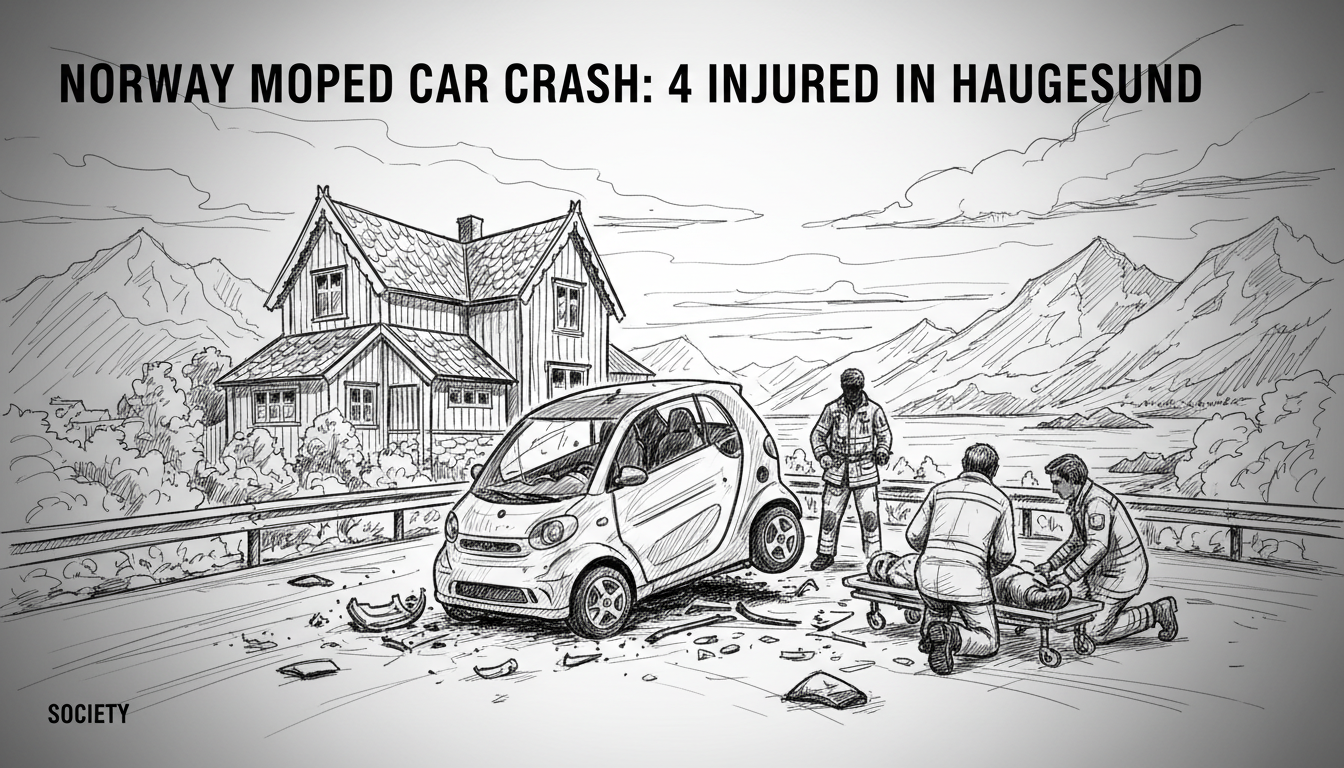
Norway moped car safety concerns have been reignited after a serious overnight crash in Haugesund. Police responded to Steinsfjellet just after midnight following reports a moped car had left the road and plunged down a slope. Four people were involved, all of whom managed to exit the vehicle themselves. The extent of their injuries remains unclear, according to police operations leader Helene Strand.
This incident highlights persistent debates surrounding the regulation of these lightweight vehicles, popular among Norwegian youth. The crash occurred on a road where standard traffic moves at significantly higher speeds than a moped car's maximum of 45 km/h, a common point of contention for safety experts.
A Narrow Escape on a Dark Fjord Road
The accident happened in the early hours, with police receiving the alert at 00:44. The location, Steinsfjellet, offers sweeping views of the Haugesund region but features winding roads that can challenge even experienced drivers. For the occupants of the small, low-speed moped car, the drop down the slope could have been catastrophic. Their ability to get out of the vehicle suggests they avoided the most severe outcomes, but the event underscores the inherent vulnerability of these cars in mixed traffic.
Moped cars, classified as AM147 vehicles, occupy a unique space in Norwegian transport. They provide mobility for 16- and 17-year-olds not yet eligible for a full Class B license, serving as a stepping stone in a country where car ownership is high but distances can be long. Their registration has surged in recent years, making safety discussions increasingly urgent for communities across the country, from the fjords of the west to the forests of the east.
The Regulatory Tightrope: Access vs. Safety
Norwegian authorities walk a fine line with moped car policy. On one side is the practical need for youth mobility, especially in rural areas with limited public transport. On the other is the undeniable physics of placing a lightweight, slow-moving vehicle on roads shared with trucks and cars traveling at 80 km/h or more. The vehicles require registration, insurance, and a specific license obtained through theory and practical tests, but critics argue the rules do not go far enough.
“The core issue is one of compatibility,” explains Lars Tennøy, a senior researcher at the Institute of Transport Economics (TØI). “You have a vehicle designed for low-speed, urban environments often operating on rural or connector roads where speed differentials are large. This creates dangerous situations, particularly on curves or in poor weather.” Tennøy points to Scandinavian design principles for ‘forgiving roadsides’ but notes that the small wheelbase and high center of gravity in some moped car models make them uniquely susceptible to leaving the roadway.
Statistics from the Norwegian Public Roads Administration (Statens vegvesen) show a concerning trend. While comprehensive national figures for 2023 are still being compiled, preliminary data from several police districts indicate accidents involving moped cars are not declining proportionally to their increased safety features. The number of registered moped cars has grown by approximately 40% over the past five years, deepening the pool of vehicles—and young drivers—on the road.
A National Debate with Local Consequences
The debate often plays out in local newspapers and municipal meetings. Some politicians advocate for stricter rules, such as banning moped cars from certain high-speed road sections or mandating more robust roll-cage structures. Others focus on driver education, pushing for advanced courses in vehicle handling and defensive driving for young AM147 license holders.
In the Storting, the issue periodically surfaces in transport committee discussions. “We must constantly evaluate whether our regulations match the reality on the road,” said Conservative Party (Høyre) MP Nils A. Røhne, who sits on the transport committee. “The goal is to preserve access for young people while doing everything we can to minimize risk. That might involve looking at technical standards or approved road networks.” The Labour Party (Arbeiderpartiet) has similarly called for periodic reviews of the safety framework.
For parents in communities like Haugesund, the crash is a sobering reminder. The vehicles offer independence but come with palpable anxiety. “You’re glad they aren’t on a scooter, which feels even more exposed, but you know the car isn’t as safe as a regular vehicle,” said one Haugesund resident, who asked not to be named as his son uses a moped car. “You just hope they are careful and that other drivers see them.”
The Road Ahead: Technology and Infrastructure
Looking forward, solutions may come from both technology and infrastructure. Some experts suggest geofencing technology could limit a moped car’s operation on unsuitable roads. More immediately, road engineering—better signage, rumble strips, or even designated slow-vehicle lanes on key stretches—could reduce conflict points.
The Haugesund police will continue their investigation into the precise cause of the Steinsfjellet crash. Factors like speed, road conditions, and potential mechanical issues will be examined. Their findings will add another data point to a national conversation that balances freedom, mobility, and the fundamental duty of care to young drivers.
As the sun rose over the Haugesund bridges, the damaged vehicle was recovered. The four individuals involved face a recovery period, and a community is left to ponder a familiar dilemma. How does a nation committed to road safety—with Vision Zero as its official policy—square the circle of the moped car? The vehicles are unlikely to disappear from Norway’s picturesque but often challenging roads. The question that lingers after this midnight crash is whether their safe integration requires a new roadmap.