
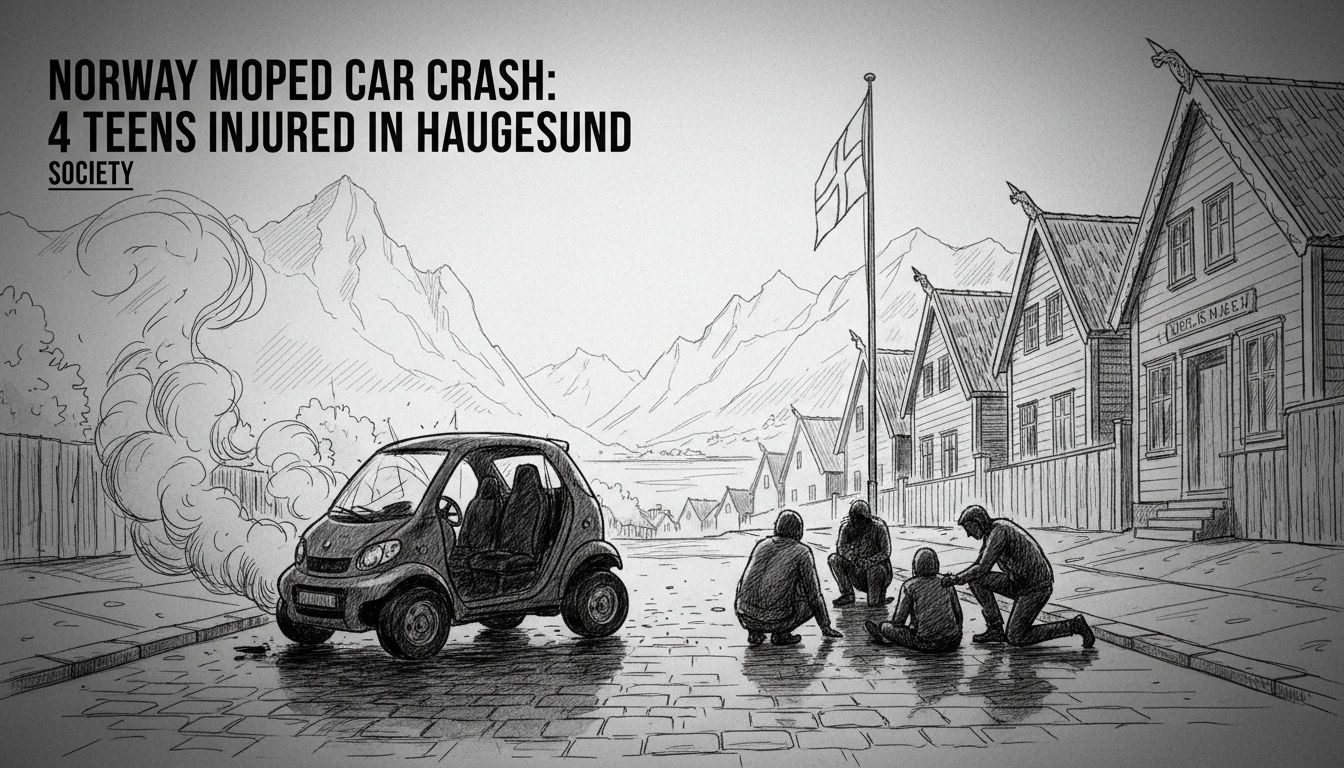
Norway moped car safety is under renewed scrutiny after four 16-year-old boys were rushed to the emergency room following a crash near Haugesund. The incident occurred in the early hours of Saturday morning when the vehicle, legally registered for only two occupants, veered off the road and down a slope near Steinsfjellet. Police have confirmed the moped car was totaled and the driver's license will be confiscated.
This accident highlights persistent concerns about the risks associated with these small, low-speed vehicles popular among Norwegian youth. The police log entry from operations leader Helene Strand stated simply: "Moped car that has driven off the road and down a slope." While the extent of the teenagers' injuries remains unknown, the case has ignited a familiar debate about regulation, supervision, and the inherent dangers of putting inexperienced drivers behind the wheel.
A Vehicle Built for Two, Carrying Four
The most immediate violation in the Haugesund incident was overloading. Norwegian moped cars, classified as L6e light quadricycles, have strict occupancy limits based on their design and safety features, which typically include seatbelts for only two people. Police suspect all four teenagers were in the vehicle during the crash, a dangerous practice that drastically compromises stability and control.
"The driver will have his license confiscated as a result of the incident," Strand said in a statement. This is a standard administrative procedure in serious traffic violations. The crash site, a few kilometers east of Haugesund's city center, suggests the group may have been on a recreational drive in the hilly terrain surrounding the coastal city.
The Allure and Risk of the Moped Car
For many Norwegian teens, especially in rural and suburban areas, the moped car represents a first taste of independent mobility. Available to 16-year-olds with a basic moped license (AM147), these vehicles are restricted to 45 km/h. Their enclosed cabin offers more protection from the elements than a scooter, making them appealing for year-round use.
Statistics Norway (SSB) data shows a steady increase in registered moped cars in recent years. They fill a transport gap in regions with limited public transit. However, road safety experts consistently warn that their small size, light weight, and often narrow wheelbase make them susceptible to rollovers, especially on uneven terrain or during sharp turns. When speed limits are ignored or vehicles are overloaded, these risks multiply.
"We see a pattern where the perceived safety of being in a 'car' leads to riskier behavior," said a road safety advisor with the Norwegian Public Roads Administration (Statens vegvesen), who spoke on background about general trends. "A teenager might not attempt to carry three passengers on a moped, but the enclosed cabin of a moped car creates a false sense of security. The physics, however, do not change. Overloading is dangerously unstable."
Regulatory Gaps and Enforcement Challenges
The Haugesund crash points to two core challenges: regulation and enforcement. The rules are clear—a 45 km/h limit, a requirement for an AM147 license, and occupancy limits. Yet, ensuring compliance among young drivers is difficult. Moped cars are not required to have black boxes, making it hard to prove speeding after a crash unless witnessed.
Police patrols cannot be everywhere, particularly on the network of local and county roads where these vehicles are most common. Furthermore, the penalty of license confiscation, while significant, occurs after the fact. Prevention relies heavily on parental oversight and driver education that truly emphasizes the consequences of breaking these specific rules.
Some municipalities have debated local restrictions or increased monitoring in areas known for youth traffic, but no nationwide tightening of moped car regulations has been implemented recently. The debate often balances personal freedom and practical transport needs against undeniable safety concerns.
A Community's Wake-Up Call
Accidents like the one in Haugesund send shockwaves through small communities. They serve as a grim reminder of how quickly a night out can turn tragic. While comprehensive national statistics isolating moped car accidents are limited, each serious incident is logged by authorities and contributes to an internal understanding of risk factors.
For parents, the incident is a catalyst for conversations about responsibility. For local policymakers, it raises questions about road design and traffic calming measures in areas frequented by young drivers. For the police, it underscores the importance of visible traffic monitoring, even during late hours.
The injured teens' recovery is the immediate priority. The longer-term impact will be measured in whether this event becomes a forgotten statistic or a catalyst for greater awareness among Haugesund's youth about the limits—both legal and physical—of their moped cars.
The Road Ahead for Youth Mobility
Norway's driving age framework is designed to phase in privileges. The moped car sits at the entry level. This incident will likely renew calls from some safety advocates to review this access. Suggestions have included mandatory advanced safety courses, technological limiters that are harder to tamper with, or even a higher minimum age for enclosed cabin vehicles.
Opponents argue this would unfairly penalize responsible young drivers and hinder mobility in regions where alternatives are scarce. They stress that education and consistent enforcement of existing laws are the solutions.
The damaged moped car at the base of a slope in Haugesund is a physical testament to a miscalculation. As these vehicles continue to grow in number across Norway, the challenge remains: how to preserve a valuable tool for youth independence while embedding a culture of respect for its dangers. The answer lies not just in law books, but in the messages passed from parents, teachers, and peers every time the keys are handed over.