
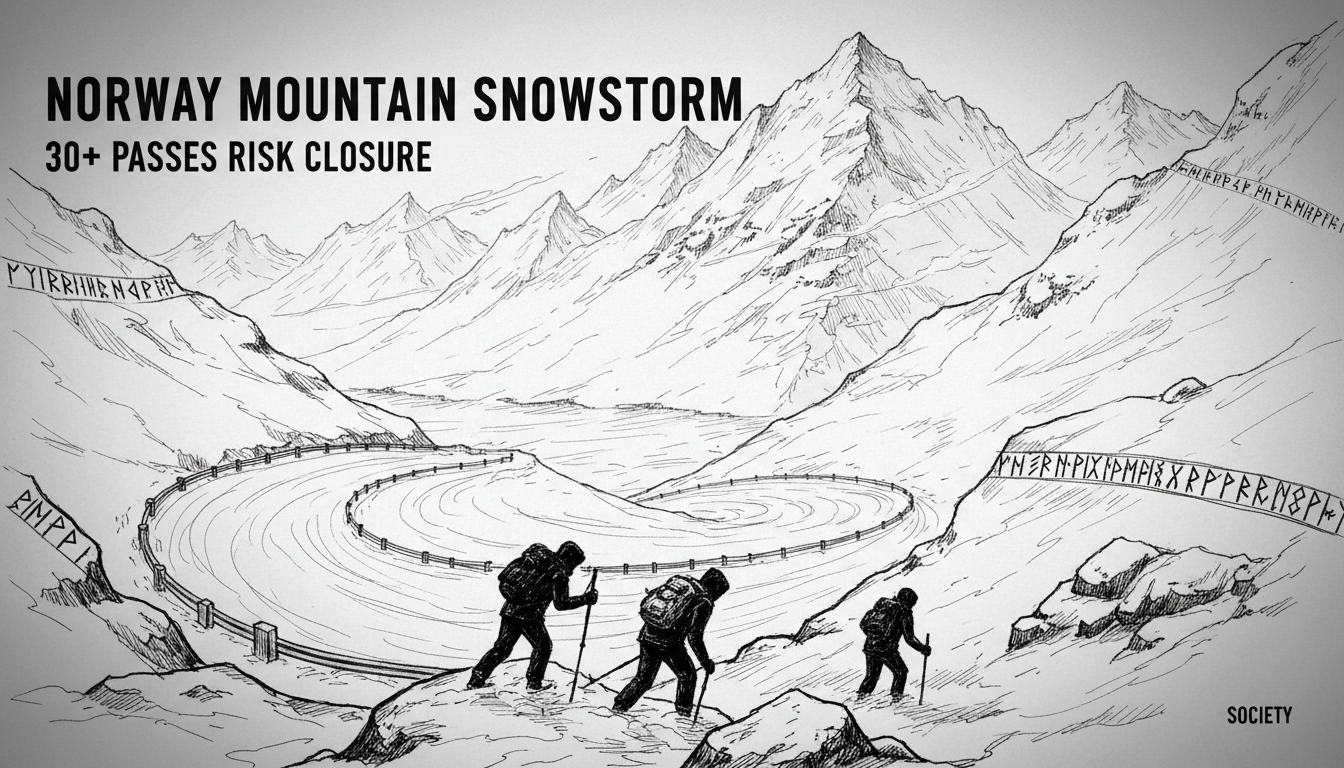
Norway’s Meteorological Institute issued a direct yellow danger warning for severe snowdrifts across the mountain regions of Southern Norway, predicting reduced visibility and hazardous driving conditions through Thursday morning. The alert, active from Wednesday evening, specifically warns of 'snøfokk'—a combination of blowing snow and strong winds that can create sudden whiteout conditions on exposed high-altitude roads.
“Snøfokk gives locally reduced visibility and snow that packs onto the road surface,” the Institute stated in its warning bulletin. “Roads may be closed and convoy driving may be introduced at short notice.” This immediate warning underscores the volatile nature of mountain weather in Norway, where conditions can deteriorate from clear to critical within minutes, catching unprepared motorists off guard.
The Mechanics of a Mountain Blizzard
Snøfokk is a distinctly Scandinavian winter hazard. It does not necessarily require new snowfall; instead, it occurs when strong winds lift existing snow from the ground, creating a dense, moving cloud that severely limits visibility. In the mountainous terrain of Sør-Norge (Southern Norway), winds are funneled and accelerated over passes like the formidable Hardangervidda plateau and the Filefjell route. This phenomenon poses a dual threat: drivers lose visual reference, and the wind-blown snow rapidly forms hard-packed drifts directly on the roadway.
The Norwegian Public Roads Administration (Statens vegvesen) maintains a constant vigil during such warnings. Their decision to implement 'kolonnekjøring'—convoy driving—is a standard but serious safety protocol. A snowplow or service vehicle leads a line of cars at slow speed through the most dangerous sections, ensuring no one becomes stranded or loses the road. In extreme cases, roads are preemptively closed. "Safety is the absolute priority," a road administration spokesperson said. "When the meteorologists issue a yellow warning for snøfokk, our regional centers are poised to act. Convoy driving is not an inconvenience; it is a lifesaving measure."
Understanding Norway's Color-Coded Alert System
Norway’s weather warning system operates on a four-tier color scale. A yellow ('gult') warning, like the current one, signifies a moderate level of danger where weather conditions are potentially hazardous. The public is advised to stay informed, plan travel carefully, and be prepared for disruptions. It is the most frequently issued alert for winter mountain travel. An orange warning indicates considerable danger, often leading to widespread road closures and travel advice against all non-essential journeys. A red warning, rare and reserved for extreme events, signals a threat to life and property, triggering broad civil contingency measures.
Meteorologists stress that a yellow warning should never be ignored, especially in alpine environments. "The difference between a yellow and an orange warning can be a matter of a few degrees in temperature or a slight shift in wind direction," explained a forecaster with the Meteorological Institute. "In the mountains, moderate danger is still very real danger. A yellow warning for snøfokk means you must check the road reports (vegvesen.no) continuously and be ready to delay your trip."
The High Cost of Mountain Travel Disruptions
The closure of key mountain passes has significant ripple effects. Southern Norway's road network includes vital arteries like the E134 over Hardangervidda and the E6 over Dovrefjell, which connect major population centers in the east with coastal regions in the west. When these close, commercial transport is delayed, supply chains are impacted, and tourism-related travel is disrupted. Local municipalities in mountain regions also activate emergency preparedness plans, checking on isolated residents and ensuring emergency services have clear access routes.
For Norwegians, winter preparedness is a cultural norm. The authorities' consistent advice includes equipping vehicles with winter tires (studded tires are common), carrying a full emergency kit with thermal blankets, food, water, and a shovel, and ensuring the fuel tank is always at least half full. Yet, every season, drivers underestimate the conditions. “We see the same mistakes,” said a veteran operator for the Norwegian Automobile Federation (NAF). “People drive cars unsuitable for winter mountains, they do not have proper supplies, and they attempt to bypass closed roads. Respecting a 'kolonnekjøring' order or a closure is paramount.”
A Broader Pattern in a Changing Climate
While snøfokk is an age-old winter event, climatologists are studying how a warming Arctic may be influencing its patterns. Warmer air holds more moisture, which can potentially lead to heavier snowfall events. Simultaneously, changing wind patterns could affect the frequency and intensity of snow-drift conditions. The Norwegian Meteorological Institute integrates these evolving climate models into its forecasting, aiming to provide earlier and more accurate warnings for extreme weather.
This particular warning fits into a pattern of active winter weather for the region. It serves as an annual reminder of the formidable power of Norway's natural environment, even as the country maintains one of the world's most advanced road maintenance and weather forecasting systems. The seamless coordination between the Meteorologists, the Road Administration, and emergency services is a testament to Norway's proactive approach to public safety in harsh climates.
What Travelers Need to Know Now
For anyone considering travel through Southern Norway's mountains in the coming days, the advice is clear and unequivocal. First, monitor the official weather warning page at met.no. Second, check the detailed road conditions and any active closures or convoy driving announcements at vegvesen.no. Third, plan for extra travel time and inform others of your route. Finally, be psychologically prepared to postpone your journey. The mountains will still be there tomorrow; the goal is to ensure you are too.
The yellow warning will lift early Thursday morning, but the hazard does not instantly vanish. Road crews will be assessing damage, clearing drifts, and determining when normal traffic can safely resume. As one seasoned mountain rescue volunteer put it: “The warning is just the forecast. The real weather is what you meet outside your car window. In the fjell, you are a guest, and you must behave like one.” This latest alert is a stark reminder that in Norway, especially between November and April, the mountain passes command the utmost respect.