
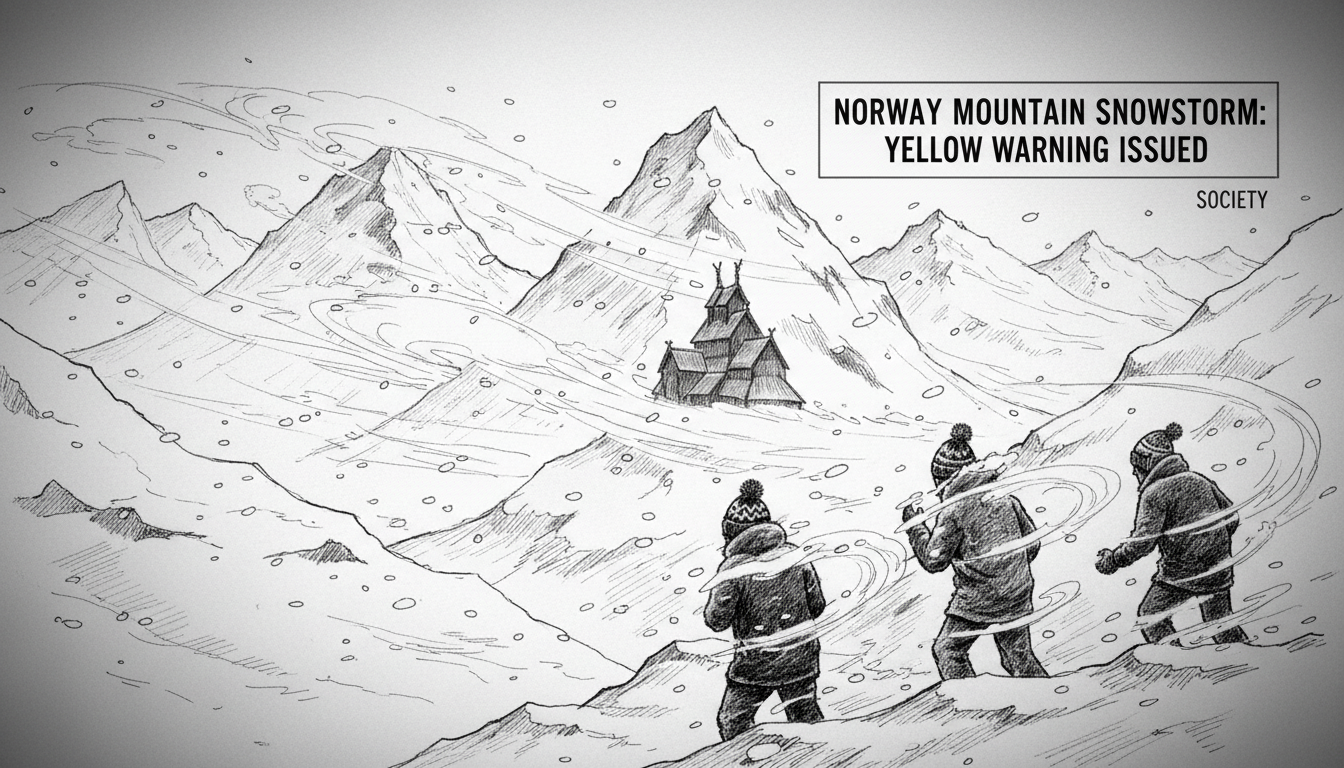
Norway's Meteorological Institute has issued a yellow weather warning for powerful snowdrifts across the mountain regions of Southern Norway. The alert, active from Wednesday evening through Thursday afternoon, forecasts hazardous conditions driven by strong winds that will reduce visibility and create dangerous travel situations.
This warning triggers a well-rehearsed response from emergency services and demands immediate attention from anyone planning to traverse Norway's rugged interior. The phenomenon, known locally as 'snøfokk,' involves high winds whipping loose snow into blinding, disorienting clouds that can strand motorists and obscure roads within minutes.
Understanding the Yellow Warning System
Norway's four-tiered weather warning system is a critical public safety tool. A yellow warning, the second level, indicates a moderate risk where weather conditions have the potential to cause damage and disruption. While not the most severe alert, it signifies a tangible threat that requires precaution. The Norwegian Meteorological Institute bases these warnings on precise thresholds for wind speed, precipitation, and temperature.
"A yellow warning is not to be ignored, especially in the mountains," explains a senior meteorologist with the Institute. "It means the conditions are present for a rapid deterioration. What starts as a manageable drive can become a life-threatening situation in a very short time if you are caught unprepared." The warning specifically mentions the risk of roads being closed and the potential implementation of convoy driving, or 'kolonnekjøring,' on short notice.
The Specific Threat of 'Snøfokk'
The term 'snøfokk' describes more than just heavy snowfall. It is a specific and dangerous condition where strong winds lift already-fallen snow from the ground, creating a ground-level blizzard. This drastically reduces visibility, sometimes to just a few meters, and causes snow to pack densely onto road surfaces, creating an icy, treacherous layer. Unlike falling snow, which accumulates gradually, a snøfokk can reshape a landscape in hours, burying vehicles and road signs.
Mountain passes in Southern Norway, such as those connecting the eastern and western parts of the country, are particularly vulnerable. These high-altitude corridors funnel wind, accelerating its speed and magnifying its effect. The combination of open, snow-covered terrain and powerful gusts creates the perfect recipe for severe snowdrifts. Historical data shows these regions consistently experience the highest frequency of such events during the winter months.
Public and Official Response Protocols
Upon issuance of a yellow warning, a coordinated response swings into action. The Norwegian Public Roads Administration (Statens vegvesen) increases patrols and prepares snow-clearing equipment. Their teams monitor key mountain passes like the E134 over Haukelifjell and the E6 over Dovrefjell, ready to close roads or initiate convoy driving if conditions worsen. In convoy driving, all traffic is halted until a snowplow can lead a group of vehicles through the most hazardous section, a slow but vital safety measure.
Local emergency services, including the Norwegian Red Cross and mountain rescue teams, often place volunteers on standby. These groups, deeply familiar with their regional terrain, are essential for responding to incidents where travelers become stranded or disoriented. The national emergency broadcast system can be activated to send SMS alerts to all mobile phones in the affected area, a system used sparingly for significant threats.
Expert Advice for Travelers and Residents
Meteorologists and safety experts uniformly stress preparation. The core advice is straightforward: reconsider non-essential travel. For those who must travel, checking multiple information sources is non-negotiable. This includes the live traffic camera feeds and road reports provided by the Public Roads Administration, in addition to the detailed forecast maps from the Meteorological Institute.
"Your vehicle must be winter-ready with good tires, and your tank should be full," advises a veteran instructor with the Norwegian Automobile Federation (NAF). "But the most important equipment is in your head. You need a plan. Tell someone your route and expected arrival time. Pack a winter emergency kit with warm clothing, blankets, food, water, and a shovel. If you are caught in a snøfokk, the safest action is often to stay in your vehicle, run the engine sparingly for heat, and wait for help."
Experts also emphasize dressing for the conditions, even for short stops. The warning explicitly notes that "snow and wind can make it difficult to move outdoors." Wind chill can cause frostbite rapidly, and losing visibility just a few meters from shelter can become fatal.
The Broader Context of Climate and Preparedness
This event occurs within a broader conversation about climate change and extreme weather in Norway. While individual storms cannot be directly attributed to climate change, the Norwegian Climate Services Centre notes that warming trends may be altering precipitation patterns and potentially increasing the intensity of some winter storms. This underscores the importance of maintaining and adapting robust forecasting and response systems.
Norway's approach is considered among the world's most effective, blending advanced meteorological technology with a strong culture of public trust and personal responsibility. The population generally heeds official warnings, a cultural trait built on decades of experience with the power and unpredictability of nature. The yellow warning system itself is a product of continuous refinement, aiming to provide clear, actionable information without causing unnecessary alarm.
Looking Ahead: A Nation Accustomed to Nature's Force
As the warning period progresses, the situation will be monitored closely. A yellow warning can be upgraded to orange or red if forecast models show increasing severity, or it can be downgraded as the system passes. The true test lies in the public's response and the seamless operation of the safety infrastructure.
For now, the message from authorities is clear and consistent. The mountains demand respect, and a yellow warning is the formal signal to provide it. The coming hours will reveal whether this particular snøfokk becomes a minor disruption or a significant event, but the systems designed to protect life and property are already in motion. In Norway, where weather is a dominant force, preparedness is not just a recommendation—it is a fundamental aspect of daily life, especially when the wind begins to howl across the frozen peaks.