
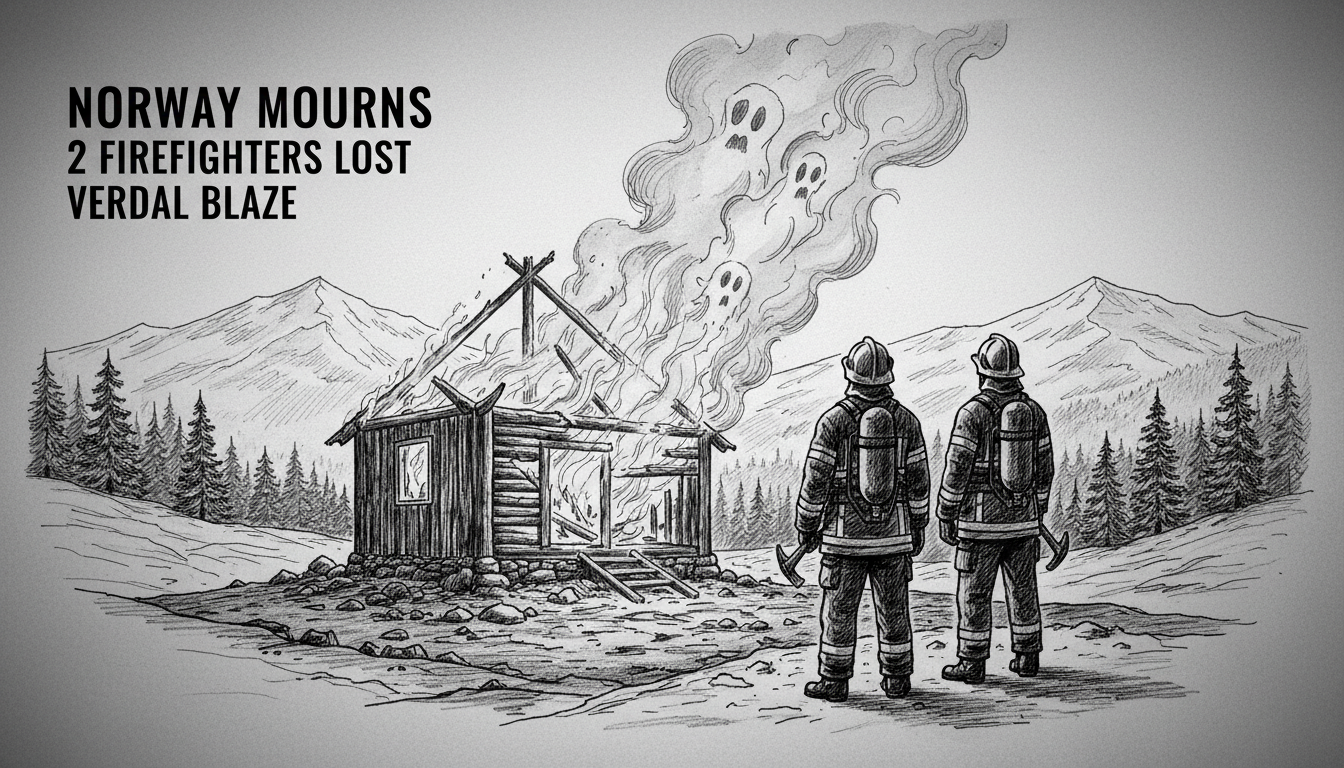
Norway's firefighting community is in mourning after two firefighters are presumed dead following a house fire in Verdal, Trøndelag. The two smoke divers, employed by the municipal fire service Brannvesenet IKS-Midt, lost contact with emergency services around 3 AM Wednesday. The sole resident of the detached house had already evacuated safely before their arrival, leaving unanswered questions about why the crew entered the burning structure.
"We consider that a serious accident has occurred," said operations manager Marie Fossen of the Trøndelag Police District. The incident has sent shockwaves through Norway's close-knit emergency services, described by those on scene as a profound tragedy. The police have now launched a formal investigation into the circumstances surrounding the firefighters' deaths.
A Community and a Profession in Shock
The immediate aftermath at the scene in Verdal was one of palpable grief and disbelief. Innsatsleder Thor Inge Oxholm Aas, the on-site operations leader, gave voice to the collective trauma. "This should not happen, but being on the front line involves risk. It is deeply tragic and it hits all of us hard. I have never lost my own personnel before," he said. He described the crews involved in the operation as "strongly affected" and emphasized the familial bonds within the fire service. "We are a big family, and this affects the rest of us."
Trond Marius Fornes, the fire service's own operations leader, was visibly shaken. "It hurts incredibly. These are two incredibly good colleagues who have most likely passed away. It feels heavy and meaningless right now, but our thoughts go to the next of kin," he stated. The psychological impact on first responders is a primary concern, with Aas confirming that professional help would be brought in to help crews process the event. This focus on mental health reflects a broader, evolving understanding within Norway's emergency services of the long-term toll of such traumatic incidents.
The Unfolding Emergency in Verdal
The sequence of events began in the early hours of Wednesday morning. Police reported the fire at the detached house around 2 AM. The resident, a man in his thirties, managed to self-evacuate and seek refuge with neighbors, escaping injury. The house was fully involved and is considered a total loss. Fire crews, including the two smoke divers, responded to the call. According to police, contact with the two firefighters was lost approximately one hour later, at 3 AM.
A critical and as-yet-unanswered question forms the core of the pending police investigation: Why did the firefighters enter the structure if the resident was already confirmed safe? Operations manager Karina Hollås stated that this would be a key part of the inquiries, now that the case has moved into an investigative phase. Police have maintained a guard at the site and will conduct forensic technical examinations once the fire scene is fully extinguished and cooled. No other individuals are reported missing in connection with the blaze, though two adults and two children from a neighboring house were evacuated as a precaution.
The Inherent Risks of Structural Firefighting
While such a double fatality is rare in modern Norwegian firefighting, experts underscore that the profession remains inherently dangerous. Smoke diving—entering burning buildings with breathing apparatus—is among the highest-risk activities. Hazards include sudden flashovers, structural collapse, and disorientation in zero-visibility conditions. Robust communication protocols and team integrity are vital lifelines. The loss of contact with the Verdal crew suggests a rapid, catastrophic development inside the home.
Norway's fire and rescue services are primarily organized at the municipal level. Many departments, especially in rural areas, rely on a combination of professional and dedicated volunteer firefighters. This system fosters deep community ties but also means that a tragedy like this resonates far beyond a single station, affecting entire towns and regions. Brannvesenet IKS-Midt, the employer of the fallen firefighters, is an inter-municipal company providing services to several communities in the region, highlighting how the loss will be felt across multiple jurisdictions.
A National History of Fire and Safety Evolution
Norway has a sobering history of deadly fires, from the 1942 Grini fire to more recent apartment blazes. Each tragedy has, over decades, contributed to stricter building codes, improved safety equipment for firefighters, and enhanced public awareness campaigns. The country has invested significantly in fire prevention and response technology. Yet, as this incident demonstrates, the fundamental volatility of structural fires can never be entirely eliminated. The investigation will likely scrutinize equipment, procedures, and decision-making to determine if any lessons can be learned to enhance operational safety.
The focus now turns to the families of the two firefighters, who have been notified. The Norwegian fire service, described repeatedly as a "family," will embark on the difficult process of mourning its own while continuing to fulfill its duty to the public. The incident serves as a stark reminder of the price first responders can pay. As the community of Verdal and the nation process this loss, the investigation will seek answers to the urgent question of how such a tragedy could occur after the resident was already safe, hoping to prevent a similar outcome in the future. The ultimate tribute to the fallen will be a relentless pursuit of greater safety for those who run toward the danger everyone else flees.